What does Isaiah 48:22 mean?
"There is no peace, saith the LORD, unto the wicked." - Isaiah 48:22

Isaiah 48:22, from the King James Version of the Bible, reads: "There is no peace, saith the Lord, unto the wicked." This verse is a powerful declaration of the consequences of living a life of sin and disobedience to God. It serves as a warning and a call to repentance, reminding us that true peace can only be found in a close and obedient relationship with God.
Isaiah 48:22 is a powerful and direct statement from the Lord, as communicated through the prophet Isaiah. It is important to remember the context in which this verse is situated. The book of Isaiah is a prophetic book, written during a time when the people of Israel were facing the consequences of their disobedience to God. The prophet Isaiah served as a voice of warning, urging the people to repent and turn back to God in order to avoid further judgment.
The verse speaks to the nature of sin and its impact on our lives. The concept of peace is a central theme in the Bible, representing not only an absence of conflict, but also a state of wholeness, well-being, and harmony. In this verse, God declares that true peace is not attainable for the wicked. This highlights the spiritual and moral consequences of living a life of sin. Without repentance and a turning away from wickedness, there can be no true peace in the lives of those who choose to ignore God's commandments.
The statement "saith the Lord" emphasizes the authority and certainty of this pronouncement. It is not merely the opinion of the prophet or the people, but the very word of God. This lends weight and significance to the warning being given, emphasizing the seriousness of the consequences that come from living a life of wickedness.
The verse also serves as a reminder of God's justice. The Lord is just and righteous, and He cannot coexist with wickedness. His holiness and purity cannot tolerate sin, and this verse serves as a reminder of the consequences of living in rebellion against His will.
Furthermore, the verse can be seen as a call to repentance. In declaring that there is no peace for the wicked, God is extending an invitation for those who have strayed from His path to come back to Him. The absence of peace serves as a wake-up call, urging the wicked to turn away from their sinful ways and seek reconciliation with God. It is an act of mercy and grace, as God desires the restoration of His relationship with His people.
The verse also carries a message of hope for those who heed its warning. It serves as a reminder that true peace and fulfillment can be found in a life of obedience and righteousness. By turning away from sin and embracing the ways of God, one can experience the peace that surpasses all understanding.
Symbolically, this verse represents the eternal struggle between good and evil, righteousness and wickedness. It serves as a reminder of the consequences of our choices and the importance of aligning our lives with God's will. It also highlights the deep longing of our hearts for true peace, which can only be found in a life surrendered to God.
In conclusion, Isaiah 48:22 is a powerful and necessary reminder of the consequences of living a life of wickedness. It emphasizes the incompatibility of sin with true peace and highlights the need for repentance and obedience to God. This verse serves as a warning, a call to repentance, and a message of hope for those who seek true peace in their lives. It is a timeless reminder of the importance of choosing righteousness and aligning our lives with God's will.
Have questions about Isaiah 48:22?
Dive deeper into this scripture with Bible Chat — an AI-powered tool for exploring God's Word through conversation. Ask questions, get context, and grow in your understanding of the Bible.
Get Our Apps


Isaiah 48:22 Artwork

Isaiah 48:22 - "There is no peace, saith the LORD, unto the wicked."

"There is no peace, saith the LORD, unto the wicked." - Isaiah 48:22

Isaiah 48

Isaiah 48

Isaiah 48

Isaiah 48

Isaiah 48:5

Isaiah 48:5

Isaiah 48:5

Isaiah 48:5

Jeremiah 48:22 - "And upon Dibon, and upon Nebo, and upon Beth-diblathaim,"

2 Samuel 22:48 - "It is God that avengeth me, and that bringeth down the people under me,"

Luke 22:48 - "But Jesus said unto him, Judas, betrayest thou the Son of man with a kiss?"

Isaiah 48:10 - "Behold, I have refined thee, but not with silver; I have chosen thee in the furnace of affliction."

Isaiah 48:4 - "Because I knew that thou art obstinate, and thy neck is an iron sinew, and thy brow brass;"

Isaiah 48:2 - "For they call themselves of the holy city, and stay themselves upon the God of Israel; The LORD of hosts is his name."

1 Kings 22:48 - "Jehoshaphat made ships of Tharshish to go to Ophir for gold: but they went not; for the ships were broken at Ezion-geber."

Isaiah 48:18 - "O that thou hadst hearkened to my commandments! then had thy peace been as a river, and thy righteousness as the waves of the sea:"

Isaiah 48:9 - "¶ For my name's sake will I defer mine anger, and for my praise will I refrain for thee, that I cut thee not off."

"And upon Dibon, and upon Nebo, and upon Beth-diblathaim," - Jeremiah 48:22

Isaiah 48:12 - "¶ Hearken unto me, O Jacob and Israel, my called; I am he; I am the first, I also am the last."

Ezekiel 48:22 - "Moreover from the possession of the Levites, and from the possession of the city, being in the midst of that which is the prince's, between the border of Judah and the border of Benjamin, shall be for the prince."

Isaiah 48:7 - "They are created now, and not from the beginning; even before the day when thou heardest them not; lest thou shouldest say, Behold, I knew them."

Isaiah 48:15 - "I, even I, have spoken; yea, I have called him: I have brought him, and he shall make his way prosperous."

Isaiah 48:11 - "For mine own sake, even for mine own sake, will I do it: for how should my name be polluted? and I will not give my glory unto another."
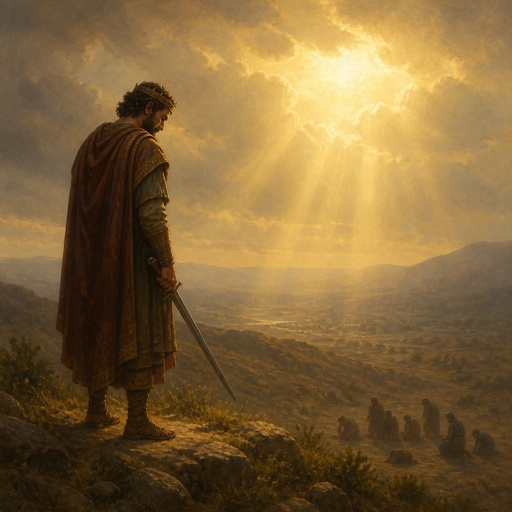
"It is God that avengeth me, and that bringeth down the people under me," - 2 Samuel 22:48

Isaiah 48:13 - "Mine hand also hath laid the foundation of the earth, and my right hand hath spanned the heavens: when I call unto them, they stand up together."

Isaiah 48:21 - "And they thirsted not when he led them through the deserts: he caused the waters to flow out of the rock for them: he clave the rock also, and the waters gushed out."

Genesis 48:22 - "Moreover I have given to thee one portion above thy brethren, which I took out of the hand of the Amorite with my sword and with my bow."

Isaiah 48:5 A highly conceptual and symbolic representation of Isaiah 48:5. Visualize a vast, ancient timepiece or scroll that is simultaneously unrolling into the present moment. The scroll is emanating a brilliant, glowing light which is eclipsing shadowed, shattered fragments of carved wood and broken metal idols scattered at the base of the image. The style should be highly detailed, luminous, and inspired by Baroque painting, emphasizing dramatic contrast (chiaroscuro) between the divine light and the darkness of human-made deities.