What does Isaiah 41:13 mean?
"For I the LORD thy God will hold thy right hand, saying unto thee, Fear not; I will help thee." - Isaiah 41:13

Isaiah 41:13 in the KJV reads, “For I the LORD thy God will hold thy right hand, saying unto thee, Fear not; I will help thee.” In its plain sense the verse is God’s personal promise of steadying, guiding, and rescuing help to His people. Yet its force comes from how intimate the language is: the LORD does not merely send help from afar, but speaks as One who comes near enough to take the trembling hand of His own and lead them through what frightens them.
The context of Isaiah 41 is the LORD’s open declaration of His sovereignty over the nations and over history, contrasted with the emptiness of idols. Throughout the chapter God summons the world, challenges false gods to show any power to declare the end from the beginning, and then turns to address His chosen people with strong reassurance. Isaiah 41 speaks to a people who know weakness and threat, who can feel outmatched by forces larger than themselves. Against that fear, the LORD grounds their hope not in their strength, strategy, or numbers, but in His covenant presence and His unmatched power. The verse therefore functions as a tender conclusion to a larger argument: since the LORD alone is God and since He has set His love upon His people, they can live without paralyzing fear even when circumstances are intimidating.
A key theme is the personal relationship implied in the words “I the LORD thy God.” God identifies Himself not only by His holy name, “the LORD,” but also by His covenant claim, “thy God.” The help promised is not generic benevolence; it is the faithful action of the One who has bound Himself to His people. This matters because the chapter repeatedly distinguishes between gods that must be carried and the living God who carries His own. Isaiah 41:13 places the weight of salvation on God’s initiative: He takes hold, He speaks, He helps.
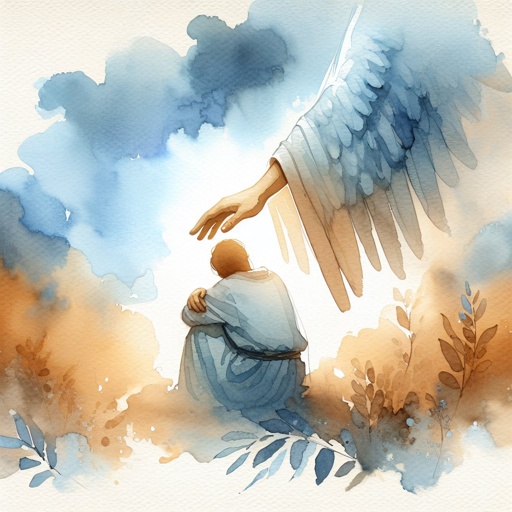
The symbolism of “hold thy right hand” is especially rich. The right hand in Scripture is commonly associated with strength, action, and skill; it is the hand by which one works, fights, swears, and prevails. To have one’s right hand held by the LORD suggests more than comfort; it suggests stabilization and empowerment at the point of greatest need. When fear makes the hand shake, God steadies it. When weakness makes the hand droop, God lifts it. When danger makes the way uncertain, God leads with a grip that does not fail. The image also evokes guidance like that of a father or protector taking the hand of someone vulnerable, keeping them from falling and directing their steps. The promise is not that the path will contain no threats, but that God’s grasp will be stronger than the threats.
The phrase “saying unto thee” emphasizes that God’s help is accompanied by His word. He does not only act; He speaks. The command “Fear not” is not mere encouragement but divine instruction grounded in divine presence. In Scripture, “Fear not” often appears when God is about to reveal Himself, call someone to a task, or deliver them from something beyond human control. Here, “Fear not” is coupled with “I will help thee,” making the reason for courage explicit. The believer’s fear is answered not by denial of trouble but by the promise of divine aid. God’s word is part of His holding: His voice steadies the heart as His hand steadies the person.
Another theme is the immediacy and certainty contained in “I will help thee.” The KJV’s wording is simple and absolute. It does not specify every method of help, and it does not set conditions in this verse itself; it rests on the identity of the speaker and His commitment. Within Isaiah 41 as a whole, this assurance is aimed at those whom God has chosen and not cast away, those who are called to trust Him rather than idols. The help promised is thus both spiritual and practical: the LORD strengthens faith, restrains fear, supplies what is lacking, and intervenes in history as He pleases. The chapter’s repeated assurances to the weak and oppressed show that God’s help includes defending His people, sustaining them, and bringing them through seasons where they feel like “worm Jacob” and yet are not abandoned.
Isaiah 41:13 is significant because it portrays God’s comfort as both majestic and tender. The same LORD who challenges the nations and exposes idols as nothing is also the LORD who stoops to take the right hand of His own. The verse invites the reader to see divine power not as distant force but as personal, covenantal care. It teaches that fear is answered most deeply not by increased self-confidence but by a clearer grasp of God’s presence: the believer is held, spoken to, and helped. In a world where human strength fails and false refuges collapse, Isaiah 41:13 presents the living God as One who steadies His people at the very point where they feel least steady, and who commands them to abandon fear because His help is not uncertain but promised.
Have questions about Isaiah 41:13?
Dive deeper into this scripture with Bible Chat — an AI-powered tool for exploring God's Word through conversation. Ask questions, get context, and grow in your understanding of the Bible.
Get Our Apps


Isaiah 41:13 Artwork

Isaiah 41:13

Isaiah 41:13 - "For I the LORD thy God will hold thy right hand, saying unto thee, Fear not; I will help thee."

"For I the LORD thy God will hold thy right hand, saying unto thee, Fear not; I will help thee." - Isaiah 41:13

isaiah 41:13 For I, the Lord your God, will hold your right hand, Saying to you, 'Fear not, I will help you.'

"For I the LORD thy God will hold thy right hand, saying unto thee, Fear not; I will help thee." - Isaiah 41:13

What a beautiful and comforting selection of verses! These passages from Isaiah and Psalm 63 are rich with the assurance of God's constant presence and support. **Isaiah 41:13** powerfully declares, "For I the LORD your God hold your right hand, it is I who say to you, 'Fear not, I am your help.'" This is echoed in **Psalm 63:8**: "My soul clings to you; your right hand upholds me." And further, **Isaiah 46:4** promises, "Even to your old age I am he, and to gray hairs I will carry you. I have made, and I will bear; I will carry and will save you." These verses together paint a magnificent picture of Jehovah Jireh, our provider and sustainer, who never abandons His people. It's a testament to His unfailing love and strength throughout all of life's seasons. Is there a particular theme or promise within these verses that you wish to explore further?

isaiah 41:10

isaiah 41:10

isaiah 41:10

isaiah 41:10

isaiah 41:10

isaiah 41:10

isaiah 41:10

isaiah 41:10

isaiah 41:10

isaiah 41:10

isaiah 41:10

Isaiah 41

isaiah 41:10

isaiah 41:10

isaiah 41:10

isaiah 41:10

isaiah 41:10

isaiah 41:10

isaiah 41:10

isaiah 41:10
isaiah 41:10

isaiah 41:10

isaiah 41:10

isaiah 41:10