What does Isaiah 36:11 mean?
"¶ Then said Eliakim and Shebna and Joah unto Rabshakeh, Speak, I pray thee, unto thy servants in the Syrian language; for we understand it: and speak not to us in the Jews' language, in the ears of the people that are on the wall." - Isaiah 36:11
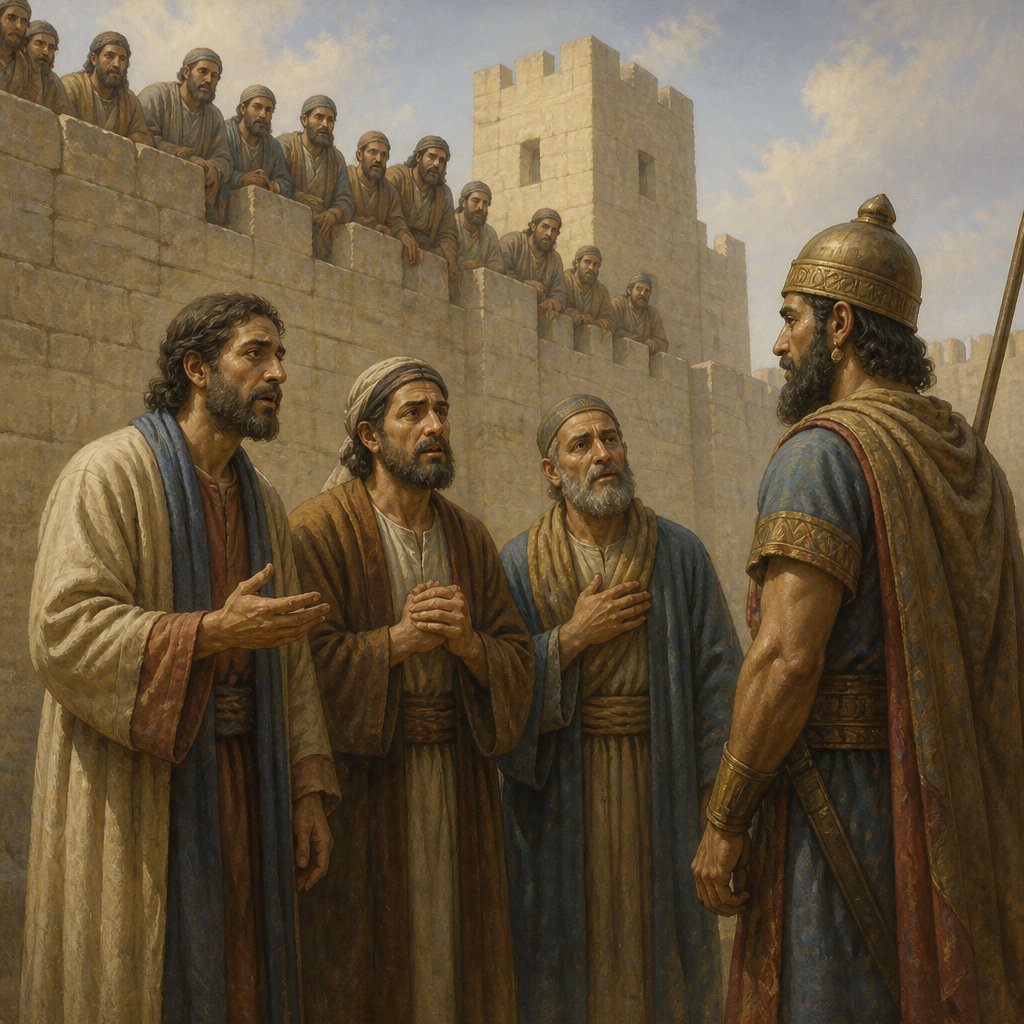
Isaiah 36:11 (KJV) reads: "Then said Eliakim and Shebna and Joah unto Rabshakeh, Speak, I pray thee, unto thy servants in the Syrian language; for we understand it: and speak not to us in the Jews' language, in the ears of the people that are on the wall."
This verse comes from the book of Isaiah in the Old Testament and is part of a larger narrative that details the interaction between the Assyrian envoy, Rabshakeh, and the officials of King Hezekiah of Judah. It takes place during the Assyrian siege of Jerusalem, as Rabshakeh attempts to persuade the people to surrender to the Assyrian forces.
In this particular verse, we see the officials of King Hezekiah, Eliakim, Shebna, and Joah, cautioning Rabshakeh to speak in the Syrian language rather than in the Jews' language, as they didn't want the people on the wall to understand the conversation. This signifies the tension and conflict between the Assyrians and the Kingdom of Judah, as well as the political and military strategies at play during this time.
One of the key themes present in this verse is the theme of communication and language. The fact that the officials requested Rabshakeh to speak in the Syrian language rather than the Jews' language highlights the importance of understanding and being understood in diplomatic and political interactions. Language serves as a barrier or a bridge between different cultures and nations, and in this case, it is used as a tool for strategic advantage in the midst of a siege.
Additionally, this verse also reveals the power dynamics at play during wartime. The Assyrians, a powerful and dominant force, sought to undermine the morale and unity of the people of Judah. By speaking in a language understood only by the officials, they sought to create a sense of fear or distrust among the people on the wall, ultimately weakening their resolve to resist.
Symbolically, the use of language in this verse can also be seen as representative of the broader theme of division and conflict. The request to speak in the Syrian language rather than the Jews' language reflects the larger divide between the Assyrians and the people of Judah, both linguistically and culturally. This division serves as a metaphor for the broader conflict and enmity between the two nations.
Contextually, this verse is part of Isaiah's prophecy and historical account of the Assyrian siege of Jerusalem. It serves as a reminder of the historical struggles and conflicts faced by the people of Judah, as well as their reliance on God for deliverance and protection. Throughout the book of Isaiah, there is a consistent emphasis on the sovereignty and faithfulness of God in the midst of political turmoil and national crises.
In conclusion, Isaiah 36:11 (KJV) presents a rich and multi-layered depiction of the complexities of warfare, diplomacy, and language within the historical context of the Assyrian siege of Jerusalem. It encompasses themes of communication, power dynamics, division, and ultimately serves as a reminder of the enduring faith and reliance on God in the face of adversity. This verse continues to offer valuable insights and lessons for readers today, reminding them of the importance of understanding the complexities of human interactions and the unwavering faith in God's providence.
Have questions about Isaiah 36:11?
Dive deeper into this scripture with Bible Chat — an AI-powered tool for exploring God's Word through conversation. Ask questions, get context, and grow in your understanding of the Bible.
Get Our Apps


Isaiah 36:11 Artwork

Isaiah 36:11 - "¶ Then said Eliakim and Shebna and Joah unto Rabshakeh, Speak, I pray thee, unto thy servants in the Syrian language; for we understand it: and speak not to us in the Jews' language, in the ears of the people that are on the wall."
"¶ Then said Eliakim and Shebna and Joah unto Rabshakeh, Speak, I pray thee, unto thy servants in the Syrian language; for we understand it: and speak not to us in the Jews' language, in the ears of the people that are on the wall." - Isaiah 36:11

Romana 11:33-36

Nehemiah 11:36 - "And of the Levites were divisions in Judah, and in Benjamin."

1 Chronicles 11:36 - "Hepher the Mecherathite, Ahijah the Pelonite,"

Isaiah 36:21 - "But they held their peace, and answered him not a word: for the king's commandment was, saying, Answer him not."

John 11:36 - "Then said the Jews, Behold how he loved him!"

Isaiah 36:14 - "Thus saith the king, Let not Hezekiah deceive you: for he shall not be able to deliver you."

Genesis 36:11 - "And the sons of Eliphaz were Teman, Omar, Zepho, and Gatam, and Kenaz."

Isaiah 36:19 - "Where are the gods of Hamath and Arphad? where are the gods of Sepharvaim? and have they delivered Samaria out of my hand?"

Job 36:11 - "If they obey and serve him, they shall spend their days in prosperity, and their years in pleasures."

Psalm 8:3-6

Romans 11:36 - "For of him, and through him, and to him, are all things: to whom be glory for ever. Amen."

Hebrews 11:36 - "And others had trial of cruel mockings and scourgings, yea, moreover of bonds and imprisonment:"

Isaiah 36:13 - "Then Rabshakeh stood, and cried with a loud voice in the Jews' language, and said, Hear ye the words of the great king, the king of Assyria."

Psalms 36:11 - "Let not the foot of pride come against me, and let not the hand of the wicked remove me."

Isaiah 11

Isaiah 36:3 - "Then came forth unto him Eliakim, Hilkiah's son, which was over the house, and Shebna the scribe, and Joah, Asaph's son, the recorder."

Psalms 36 verse 3-6

"Hepher the Mecherathite, Ahijah the Pelonite," - 1 Chronicles 11:36
"And of the Levites were divisions in Judah, and in Benjamin." - Nehemiah 11:36

Isaiah 36:17 - "Until I come and take you away to a land like your own land, a land of corn and wine, a land of bread and vineyards."

Numbers 36:11 - "For Mahlah, Tirzah, and Hoglah, and Milcah, and Noah, the daughters of Zelophehad, were married unto their father's brothers' sons:"

Leviticus 11:36 - "Nevertheless a fountain or pit, wherein there is plenty of water, shall be clean: but that which toucheth their carcase shall be unclean."

Jeremiah 36:11 - "¶ When Michaiah the son of Gemariah, the son of Shaphan, had heard out of the book all the words of the LORD,"

Isaiah 36:20 - "Who are they among all the gods of these lands, that have delivered their land out of my hand, that the LORD should deliver Jerusalem out of my hand?"

Isaiah 36:15 - "Neither let Hezekiah make you trust in the LORD, saying, The LORD will surely deliver us: this city shall not be delivered into the hand of the king of Assyria."

Isaiah 36:9 - "How then wilt thou turn away the face of one captain of the least of my master's servants, and put thy trust on Egypt for chariots and for horsemen?"

2 Chronicles 36:11 - "¶ Zedekiah was one and twenty years old when he began to reign, and reigned eleven years in Jerusalem."

Isaiah 11:1