What does Hebrews 7:8 mean?
"And here men that die receive tithes; but there he receiveth them, of whom it is witnessed that he liveth." - Hebrews 7:8
The verse Hebrews 7:8 from the King James Version of the Bible states:
"And here men that die receive tithes; but there he receiveth them, of whom it is witnessed that he liveth."
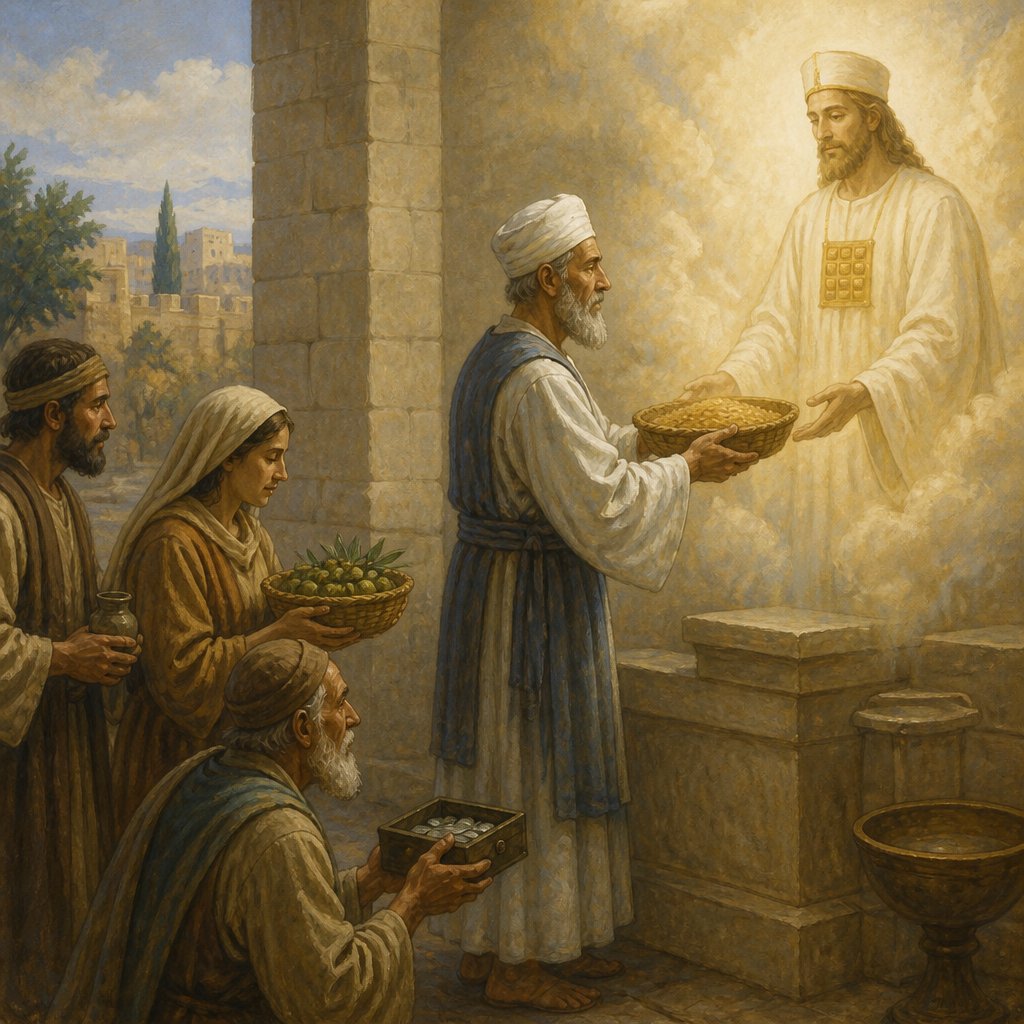
This verse is part of a broader discussion in the book of Hebrews about the priesthood of Melchizedek and its superiority to the Levitical priesthood. The author of Hebrews makes a comparison between the two priesthoods and argues that Melchizedek's priesthood is greater because it is eternal and not limited by the passing of generations. This particular verse emphasizes the eternal nature of Melchizedek's priesthood, in contrast to the mortal nature of the Levitical priests who received tithes from the people.
The theme of priesthood and tithing is central to this verse and the wider context of the book of Hebrews. The author is addressing Jewish Christians who were struggling with the idea of leaving behind the Levitical priesthood and embracing the new covenant brought by Jesus Christ. By establishing the superiority of Melchizedek's priesthood, the author is providing a theological basis for the authority and efficacy of Jesus' priesthood, which is after the order of Melchizedek.
In the broader context of the Old Testament, Melchizedek is a mysterious figure who appears in the book of Genesis. He is described as the king of Salem and a priest of God Most High, and he blesses Abraham after his victory in battle (Genesis 14:18-20). Melchizedek's priesthood is significant because it predates the establishment of the Levitical priesthood and serves as a prototype for Jesus' own eternal priesthood.
The symbolism in this verse lies in the contrast between the mortal priests who "receive tithes" and Melchizedek, "of whom it is witnessed that he liveth." The implication is that Melchizedek's priesthood is not limited by death, as the Levitical priesthood is, but endures forever. This points to the eternal nature of Jesus' priesthood, which brings salvation and intercedes for believers without interruption.
The verse also highlights the concept of tithing, which was a practice of giving a tenth of one's income or produce to support the priests and the temple in ancient Israel. By contrasting the mortal priests who "receive tithes" with Melchizedek, the author is emphasizing the superior nature of Melchizedek's priesthood and by extension, Jesus' priesthood. This reinforces the idea that Jesus is the ultimate recipient of our offerings and sacrifices, as he is the eternal high priest who continually intercedes for us before God.
The theological significance of Hebrews 7:8 cannot be overstated. It represents a key argument in the book of Hebrews for the superiority of Jesus' priesthood over the Levitical priesthood. By appealing to the timeless and eternal nature of Melchizedek's priesthood, the author establishes the foundation for the eternal and unchanging nature of Jesus' priesthood. This concept is crucial for understanding the continuity and fulfillment of God's plan of redemption through Jesus Christ.
In conclusion, Hebrews 7:8 is a crucial verse in the broader theological argument of the book of Hebrews. It underscores the eternal nature of Melchizedek's priesthood and by extension, the eternal priesthood of Jesus Christ. The verse also emphasizes the contrast between the mortal priests who receive tithes and the eternal priest who lives on to intercede for believers. This verse serves as a powerful affirmation of the unchanging and eternal nature of Jesus' priesthood and his ongoing role as the high priest of believers.
Have questions about Hebrews 7:8?
Dive deeper into this scripture with Bible Chat — an AI-powered tool for exploring God's Word through conversation. Ask questions, get context, and grow in your understanding of the Bible.
Get Our Apps


Hebrews 7:8 Artwork

Hebrews 7:8 - "And here men that die receive tithes; but there he receiveth them, of whom it is witnessed that he liveth."
"And here men that die receive tithes; but there he receiveth them, of whom it is witnessed that he liveth." - Hebrews 7:8

Hebrews 8:7 - "For if that first covenant had been faultless, then should no place have been sought for the second."

Hebrews 12:7-8 - "Endure hardship as discipline; God is treating you as his children. For what children are not disciplined by their father? If you are not disciplined - and everyone undergoes discipline - then you are not legitimate, not true sons and daughters at all."
"For if that first covenant had been faultless, then should no place have been sought for the second." - Hebrews 8:7

Hebrews 12:8

Hebrews 8:5

Hebrews 7:7 - "And without all contradiction the less is blessed of the better."

Hebrews 8:1-5

Hebrews 13:8 - "Jesus Christ the same yesterday, and to day, and for ever."

Hebrews 3:8 - "Harden not your hearts, as in the provocation, in the day of temptation in the wilderness:"

Hebrews 7:20 - "And inasmuch as not without an oath he was made priest:"

"And without all contradiction the less is blessed of the better." - Hebrews 7:7

Hebrews 7:22 - "By so much was Jesus made a surety of a better testament."

Hebrews 7:12 - "For the priesthood being changed, there is made of necessity a change also of the law."

Hebrews 7:24 - "But this man, because he continueth ever, hath an unchangeable priesthood."

Hebrews 8:12 - "For I will be merciful to their unrighteousness, and their sins and their iniquities will I remember no more."

Hebrews 8:2 - "A minister of the sanctuary, and of the true tabernacle, which the Lord pitched, and not man."

Hebrews 7:18 - "For there is verily a disannulling of the commandment going before for the weakness and unprofitableness thereof."

Hebrews 7:17 - "For he testifieth, Thou art a priest for ever after the order of Melchisedec."

Hebrews 7:10 - "For he was yet in the loins of his father, when Melchisedec met him."

Hebrews 7:16 - "Who is made, not after the law of a carnal commandment, but after the power of an endless life."

Hebrews 3:7 - "Wherefore (as the Holy Ghost saith, To day if ye will hear his voice,"

Hebrews 6:8 - "But that which beareth thorns and briers is rejected, and is nigh unto cursing; whose end is to be burned."

Hebrews 8:8 - "For finding fault with them, he saith, Behold, the days come, saith the Lord, when I will make a new covenant with the house of Israel and with the house of Judah:"

Hebrews 8:4 - "For if he were on earth, he should not be a priest, seeing that there are priests that offer gifts according to the law:"

Hebrews 7:15 - "And it is yet far more evident: for that after the similitude of Melchisedec there ariseth another priest,"
Hebrews 7:23 - "And they truly were many priests, because they were not suffered to continue by reason of death:"

Hebrews 1:7 - "And of the angels he saith, Who maketh his angels spirits, and his ministers a flame of fire."

Hebrews 5:8 - "Though he were a Son, yet learned he obedience by the things which he suffered;"