What does Hebrews 2:15 mean?
"And deliver them who through fear of death were all their lifetime subject to bondage." - Hebrews 2:15
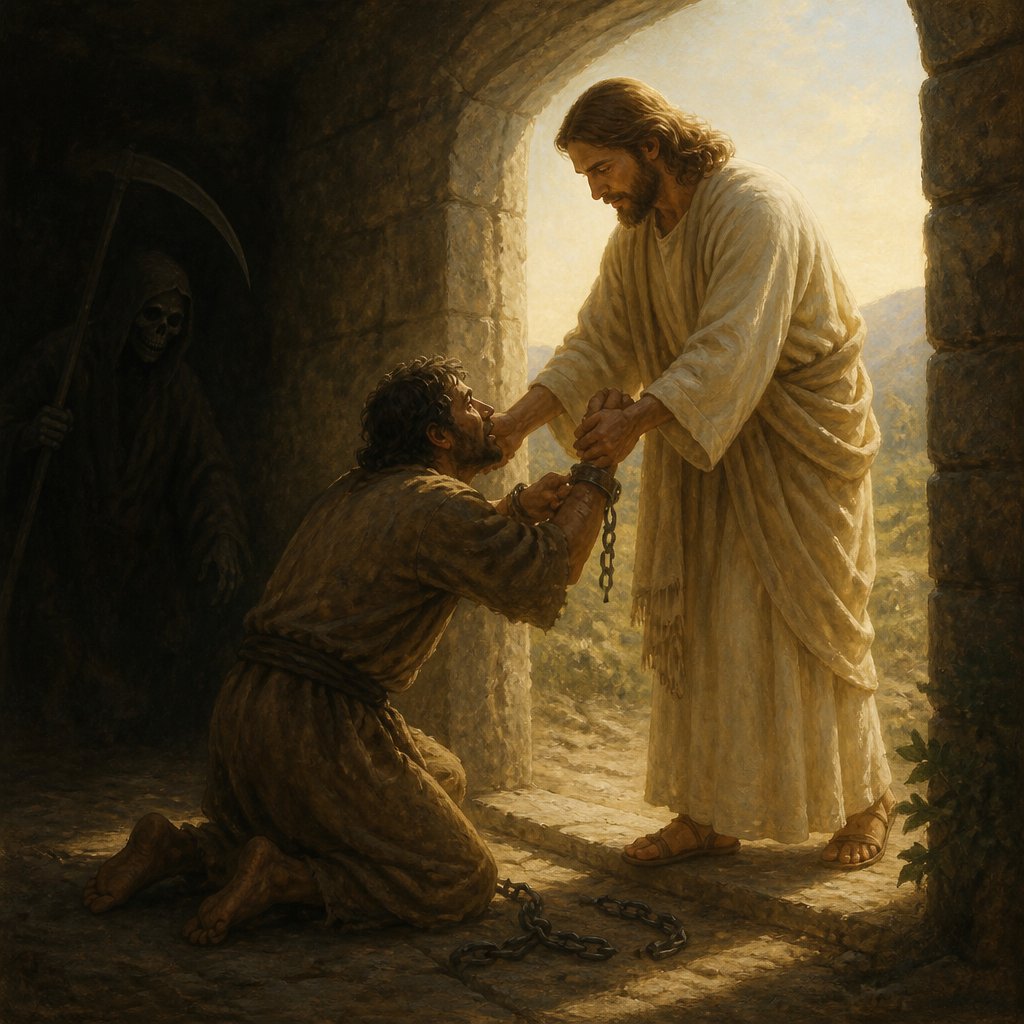
Hebrews 2:15 (KJV) says, "And deliver them who through fear of death were all their lifetime subject to bondage." This verse encapsulates a powerful message about the spiritual deliverance offered through the sacrifice of Jesus Christ. Let's explore the rich meaning and commentary of this verse, delving into its themes, context, and symbolism.
The Book of Hebrews was written to Jewish believers in Jesus Christ, seeking to demonstrate that Jesus was the fulfillment of Old Testament prophecies and the ultimate High Priest. The author of Hebrews emphasizes the superiority of Jesus and the new covenant He established. In the preceding verses of Hebrews 2, the author highlights the incarnation of Jesus and explains how He became human to deliver humanity from the power of sin and death. This serves as the backdrop for the verse in question.
The main theme of Hebrews 2:15 is the deliverance from the fear of death. The author acknowledges that fear of death has held the human race in bondage throughout its history. People of all cultures and backgrounds have grappled with the fear of the unknown, the cessation of life, and what lies beyond. This fear has shackled humanity, causing anxiety, despair, and a sense of hopelessness. However, the verse declares that Jesus came to deliver us from this fear and its accompanying bondage.
The context of Hebrews 2:15 is pivotal in understanding its meaning. The verse comes after a discussion about why Jesus had to become human and experience death. By taking on human form, Jesus was able to taste death for everyone (Hebrews 2:9), thereby defeating the power of death and the devil (Hebrews 2:14). This victory over death is the very essence of the Christian faith. The author of Hebrews is emphasizing that through Jesus' sacrificial death and resurrection, believers are set free from the fear of death and its enslaving hold on their lives.
The language of "bondage" in Hebrews 2:15 is profound and carries rich symbolism. It conveys the idea of being enslaved or held captive by something. In this case, it refers to the grip that the fear of death has on humanity. It is a fear that impacts every aspect of life, causing individuals to live in a state of apprehension and anxiety. The mention of "lifetime" highlights the enduring nature of this bondage, signifying that it is not a fleeting or temporary condition. In essence, the verse is addressing the universal human predicament of being bound by the fear of death, which necessitates a powerful and lasting solution.
The deliverance offered in Hebrews 2:15 is symbolically significant. It represents freedom from the oppressive weight of mortality and the unknown. This freedom is not merely a theoretical concept but a transformative reality that Jesus secured through His redemptive work. It is a deliverance that is comprehensive, impacting the entire scope of human existence. The imagery of deliverance evokes the notion of being rescued, released, and set free from captivity. This is precisely what Jesus accomplished through His death and resurrection, offering liberation to all who believe in Him.
In conclusion, Hebrews 2:15 provides a poignant commentary on the deliverance from the fear of death through the redemptive work of Jesus Christ. The verse reflects the overarching theme of freedom from bondage and the assurance of hope in the face of mortality. Its context within the book of Hebrews underscores the significance of Jesus' incarnation, death, and resurrection in securing this deliverance. The symbolism of deliverance, fear, and bondage amplifies the profound impact of Jesus' work on behalf of humanity. Ultimately, Hebrews 2:15 serves as a powerful declaration of the transformative deliverance offered to all who place their faith in Christ, releasing them from the fear of death and ushering them into the boundless freedom of eternal life.
Have questions about Hebrews 2:15?
Dive deeper into this scripture with Bible Chat — an AI-powered tool for exploring God's Word through conversation. Ask questions, get context, and grow in your understanding of the Bible.
Get Our Apps


Hebrews 2:15 Artwork

Hebrews 2:15 - "And deliver them who through fear of death were all their lifetime subject to bondage."
"And deliver them who through fear of death were all their lifetime subject to bondage." - Hebrews 2:15

Hebrews 6:15 - "And so, after he had patiently endured, he obtained the promise."

Hebrews 10:15 - "Whereof the Holy Ghost also is a witness to us: for after that he had said before,"

Hebrews 7:15 - "And it is yet far more evident: for that after the similitude of Melchisedec there ariseth another priest,"

Hebrews 3:15 - "While it is said, To day if ye will hear his voice, harden not your hearts, as in the provocation."

Hebrews 2:14-15 - "Since therefore the children share in flesh and blood, he himself likewise partook of the same things, that through death he might destroy the one who has the power of death, that is, the devil, and deliver all those who through fear of death were subject to lifelong slavery."

Genesis 40:15 - "For indeed I was stolen away out of the land of the Hebrews: and here also have I done nothing that they should put me into the dungeon."

Hebrews 11:15 - "And truly, if they had been mindful of that country from whence they came out, they might have had opportunity to have returned."

Hebrews 11:2 - "For by it the elders obtained a good report."

Hebrews 2:2 - "For if the word spoken by angels was stedfast, and every transgression and disobedience received a just recompence of reward;"

Hebrews 13:15 - "By him therefore let us offer the sacrifice of praise to God continually, that is, the fruit of our lips giving thanks to his name."

Deuteronomy 15:12 - "¶ And if thy brother, an Hebrew man, or an Hebrew woman, be sold unto thee, and serve thee six years; then in the seventh year thou shalt let him go free from thee."

Hebrews 4:15 - "For we have not an high priest which cannot be touched with the feeling of our infirmities; but was in all points tempted like as we are, yet without sin."

"And so, after he had patiently endured, he obtained the promise." - Hebrews 6:15

Hebrews 6:2 - "Of the doctrine of baptisms, and of laying on of hands, and of resurrection of the dead, and of eternal judgment."

Hebrews 12:15 - "Looking diligently lest any man fail of the grace of God; lest any root of bitterness springing up trouble you, and thereby many be defiled;"

Exodus 1:15 - "¶ And the king of Egypt spake to the Hebrew midwives, of which the name of the one was Shiphrah, and the name of the other Puah:"

Hebrews 8:2 - "A minister of the sanctuary, and of the true tabernacle, which the Lord pitched, and not man."

"For by it the elders obtained a good report." - Hebrews 11:2

Hebrews 9:15 - "And for this cause he is the mediator of the new testament, that by means of death, for the redemption of the transgressions that were under the first testament, they which are called might receive the promise of eternal inheritance."

Hebrews 13:2 - "Be not forgetful to entertain strangers: for thereby some have entertained angels unawares."

Hebrews 3:2 - "Who was faithful to him that appointed him, as also Moses was faithful in all his house."

Hebrews 2:5 - "For unto the angels hath he not put in subjection the world to come, whereof we speak."

Hebrews 2:18 - "For in that he himself hath suffered being tempted, he is able to succour them that are tempted."
"And it is yet far more evident: for that after the similitude of Melchisedec there ariseth another priest," - Hebrews 7:15

Hebrews 9:2 - "For there was a tabernacle made; the first, wherein was the candlestick, and the table, and the shewbread; which is called the sanctuary."

Hebrews 2:16 - "For verily he took not on him the nature of angels; but he took on him the seed of Abraham."
"Whereof the Holy Ghost also is a witness to us: for after that he had said before," - Hebrews 10:15

"While it is said, To day if ye will hear his voice, harden not your hearts, as in the provocation." - Hebrews 3:15