What does Hebrews 12:18 mean?
"For ye are not come unto the mount that might be touched, and that burned with fire, nor unto blackness, and darkness, and tempest," - Hebrews 12:18
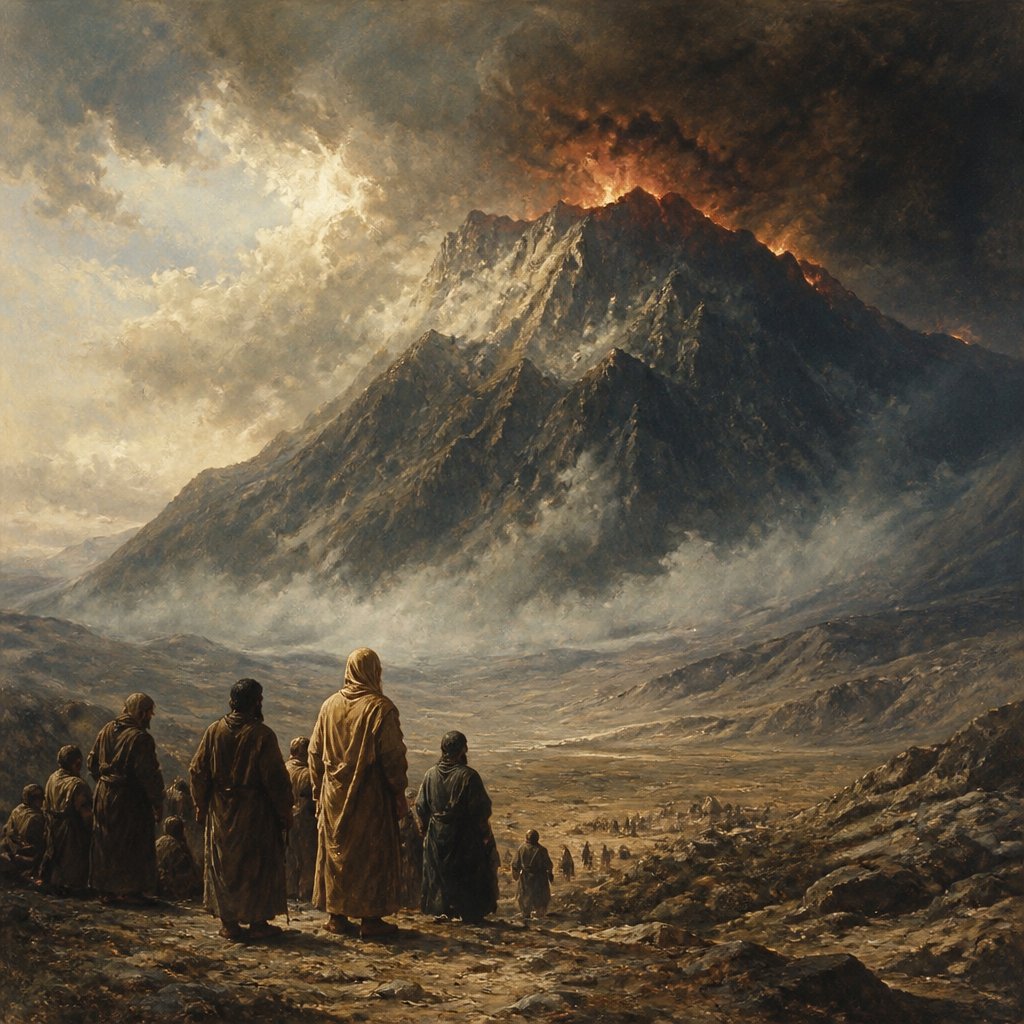
Hebrews 12:18, as quoted in the King James Version (KJV), reads:
"For ye are not come unto the mount that might be touched, and that burned with fire, nor unto blackness, and darkness, and tempest,"
This verse is a part of a larger passage in the book of Hebrews that discusses the contrasts between the old covenant, which was established through the law given to Moses, and the new covenant, which was established through the sacrifice of Jesus Christ. The author of Hebrews is writing to a group of Jewish Christians who were facing persecution and were tempted to return to the rituals and traditions of Judaism. In this particular verse, the author is drawing a comparison between the awe-inspiring scene that accompanied the giving of the law at Mount Sinai and the new covenant that was established through Christ's sacrifice.
The imagery in this verse is powerful and evocative. The "mount that might be touched, and that burned with fire" refers to Mount Sinai, where God gave the law to Moses. This event is described in the book of Exodus, where it is said that the mountain was covered in smoke and fire, and that the people were terrified by the thunder and lightning as God spoke to Moses. The "blackness, and darkness, and tempest" further emphasize the fear and awe that accompanied the giving of the law.
In contrast to this scene of fear and trembling, the author of Hebrews goes on to describe the new covenant in Christ, which is marked by grace and forgiveness rather than fear and judgment. The following verses in Hebrews 12 emphasize the idea that believers now have access to God through Christ, who is the mediator of the new covenant. This new covenant is characterized by the forgiveness of sins and the promise of eternal life, rather than the condemnation and fear associated with the old covenant.
One of the key themes in this verse is the contrast between law and grace. The old covenant, established at Mount Sinai, was based on the law given to Moses, which required obedience and sacrifices in order to attain righteousness. The new covenant, on the other hand, is based on the grace of God, which was made manifest through the sacrifice of Jesus Christ. This theme runs throughout the book of Hebrews, as the author repeatedly emphasizes the superiority of Christ and the new covenant over the old ways of Judaism.
Another important theme in this verse is the idea of approachability. The author of Hebrews is emphasizing that believers now have direct access to God through Christ, rather than needing to approach him through intermediaries such as priests or sacrifices. This idea of approachability is a central theme in the book of Hebrews, as the author repeatedly emphasizes the accessibility of God's grace and mercy through Christ.
The symbolism in this verse is also significant. The imagery of Mount Sinai, with its fire, smoke, darkness, and tempest, serves as a powerful representation of the fear and judgment associated with the law. By contrasting this with the grace and forgiveness of the new covenant, the author of Hebrews is emphasizing the radical shift that occurred with the coming of Christ. This imagery serves to highlight the transformative power of Christ's sacrifice and the new way of approaching God that it made possible.
In conclusion, Hebrews 12:18 is a powerful and evocative verse that encapsulates the central themes of the book of Hebrews. Through its vivid imagery and contrasts, it emphasizes the superiority of the new covenant in Christ, which is marked by grace, forgiveness, and approachability, over the old covenant of law and fear. This verse serves as a reminder to believers of the transformative power of Christ's sacrifice and the new way of approaching God that it made possible.
Have questions about Hebrews 12:18?
Dive deeper into this scripture with Bible Chat — an AI-powered tool for exploring God's Word through conversation. Ask questions, get context, and grow in your understanding of the Bible.
Get Our Apps


Hebrews 12:18 Artwork

Hebrews 12:18 - "For ye are not come unto the mount that might be touched, and that burned with fire, nor unto blackness, and darkness, and tempest,"
"For ye are not come unto the mount that might be touched, and that burned with fire, nor unto blackness, and darkness, and tempest," - Hebrews 12:18

Hebrews 12:8

Hebrews 12:12 - "Wherefore lift up the hands which hang down, and the feeble knees;"

Hebrews 10:18 - "Now where remission of these is, there is no more offering for sin."

"Of Bilgah, Shammua; of Shemaiah, Jehonathan;" - Nehemiah 12:18

Hebrews 11:18 - "Of whom it was said, That in Isaac shall thy seed be called:"

Hebrews 12:29 - "For our God is a consuming fire."

Hebrews 9:18 - "Whereupon neither the first testament was dedicated without blood."

Hebrews 7:18 - "For there is verily a disannulling of the commandment going before for the weakness and unprofitableness thereof."

Hebrews 3:18 - "And to whom sware he that they should not enter into his rest, but to them that believed not?"

Hebrews 7:12 - "For the priesthood being changed, there is made of necessity a change also of the law."
Hebrews 2:18 - "For in that he himself hath suffered being tempted, he is able to succour them that are tempted."

Hebrews 12:4 - "Ye have not yet resisted unto blood, striving against sin."

Hebrews 12:21 - "And so terrible was the sight, that Moses said, I exceedingly fear and quake:)"

Hebrews 4:12 – "For the word of God is alive and active. Sharper than any double-edged sword."

Hebrews 8:12 - "For I will be merciful to their unrighteousness, and their sins and their iniquities will I remember no more."

"For our God is a consuming fire." - Hebrews 12:29

Hebrews 4:12 – "For the word of God is alive and active. Sharper than any double-edged sword."
!["For our God [is] a consuming fire." - Hebrews 12:29](https://media.bible.art/d7477ab1-fc4c-4821-93d4-74621f3df94b-thumbnail.jpg)
"For our God [is] a consuming fire." - Hebrews 12:29

Hebrews 13:18 - "Pray for us: for we trust we have a good conscience, in all things willing to live honestly."

"Now where remission of these is, there is no more offering for sin." - Hebrews 10:18
!["For the word of God [is] quick, and powerful, and sharper than any twoedged sword, piercing even to the dividing asunder of soul and spirit, and of the joints and marrow, and [is] a discerner of the thoughts and intents of the heart." - Hebrews 4:12](https://media.bible.art/0705b859-7ae8-4ac8-9dce-49043e2ec43b-thumbnail.jpg)
"For the word of God [is] quick, and powerful, and sharper than any twoedged sword, piercing even to the dividing asunder of soul and spirit, and of the joints and marrow, and [is] a discerner of the thoughts and intents of the heart." - Hebrews 4:12

Hebrews 12:6 - "For whom the Lord loveth he chasteneth, and scourgeth every son whom he receiveth."

Hebrews 6:12 - "That ye be not slothful, but followers of them who through faith and patience inherit the promises."

"Wherefore lift up the hands which hang down, and the feeble knees;" - Hebrews 12:12
!["For the word of God [is] quick, and powerful, and sharper than any twoedged sword, piercing even to the dividing asunder of soul and spirit, and of the joints and marrow, and [is] a discerner of the thoughts and intents of the heart." - Hebrews 4:12](https://media.bible.art/adaff66c-0dbd-4c9b-b464-740ce2459397-thumbnail.jpg)
"For the word of God [is] quick, and powerful, and sharper than any twoedged sword, piercing even to the dividing asunder of soul and spirit, and of the joints and marrow, and [is] a discerner of the thoughts and intents of the heart." - Hebrews 4:12

Hebrews 12:14 - "Follow peace with all men, and holiness, without which no man shall see the Lord:"

Hebrews 12:24 - "And to Jesus the mediator of the new covenant, and to the blood of sprinkling, that speaketh better things than that of Abel."

Hebrews 12:16 - "Lest there be any fornicator, or profane person, as Esau, who for one morsel of meat sold his birthright."