What does Genesis 48:20 mean?
"And he blessed them that day, saying, In thee shall Israel bless, saying, God make thee as Ephraim and as Manasseh: and he set Ephraim before Manasseh." - Genesis 48:20
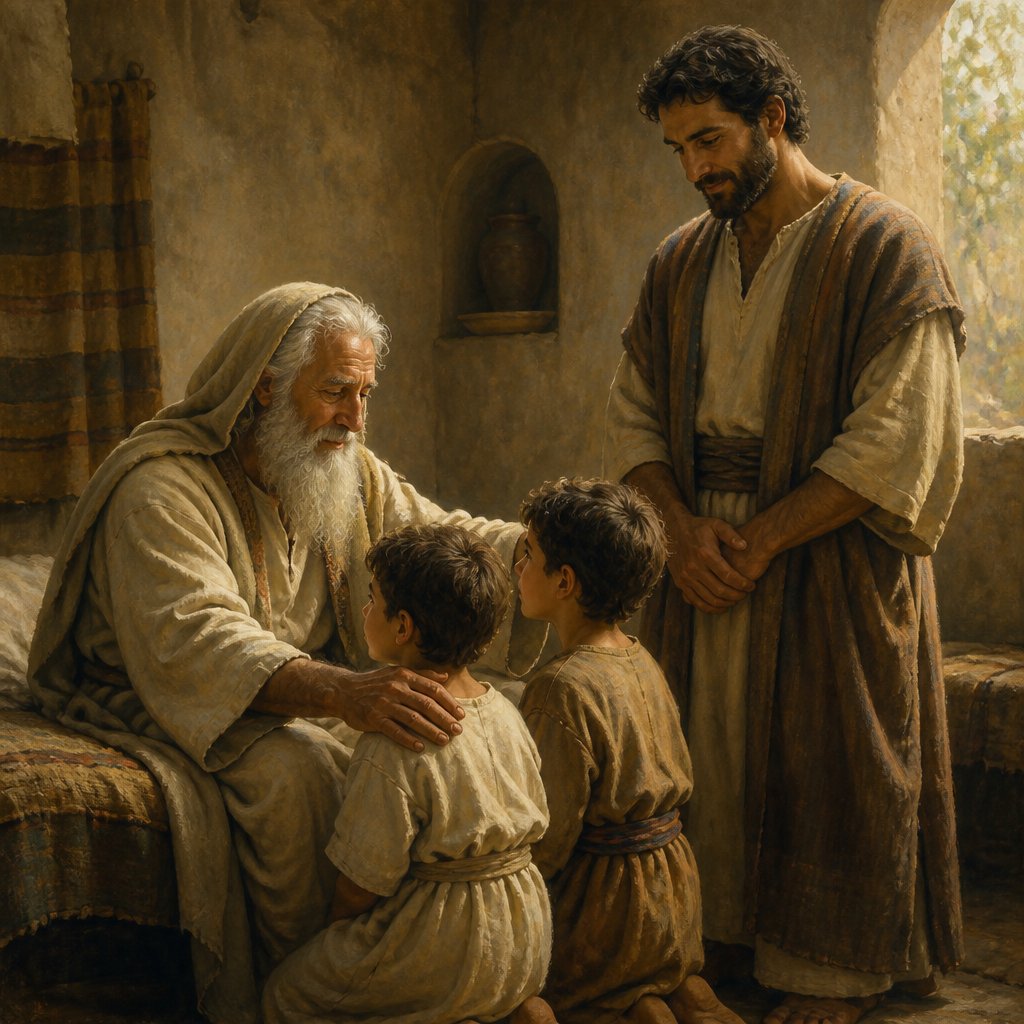
Sure, Genesis 48:20 in the King James Version (KJV) reads: "And he blessed them that day, saying, In thee shall Israel bless, saying, God make thee as Ephraim and as Manasseh: and he set Ephraang them, putting Ephraim before Manasseh." This verse is a part of the blessing that Jacob (also known as Israel) gives to his grandsons, the sons of Joseph, Ephraim, and Manasseh, in the book of Genesis.
The context of this verse is important to understand the significance of the blessings that Jacob bestows upon his grandsons. Joseph had brought his two sons to Jacob for a blessing, and Jacob, who was old and nearing the end of his life, took this opportunity to bless them. At this point, Jacob was blind, and his eyesight was failing, yet his spiritual insight was still very keen. He intentionally crossed his hands when he laid them on the heads of his grandsons, placing his right hand, the hand of greater blessing, on the younger Ephraim and his left hand on the older Manasseh. When Joseph objected and tried to correct his father by switching the boys around, Jacob refused, stating that he knew what he was doing. This was symbolic of the younger receiving the greater blessing, a theme that is repeated throughout the Bible.
The verse is significant in several ways. It not only signifies Jacob's official acknowledgement of the sons of Joseph as his own, but he also adopts them as his own children, giving them equal inheritance with his own sons. This acknowledgment elevated the status of Ephraim and Manasseh, essentially making them part of the twelve tribes of Israel.
There is a deeper symbolism in the blessings that Jacob gives to his grandsons. By blessing Ephraim and Manasseh, Jacob is not only blessing them personally, but also prophesying about their future and the future of their descendants. The blessing in Genesis 48:20 has been interpreted to mean that the two brothers will be as significant as the other tribes of Israel, and that they will be united and always recognized as two separate and equal tribes within Israel.
Moreover, this verse also highlights the theme of divine reversal, where the younger is preferred over the older. This theme is repeated throughout the Bible, from Cain and Abel to Isaac and Ishmael to Jacob and Esau. This demonstrates that God's favor and blessing are not limited by human conventions, but are based on His sovereign choice.
The blessing also serves as a reminder of God's faithfulness and His ability to turn difficult circumstances into blessings. Both Ephraim and Manasseh were born in Egypt during a time of great hardship for the Israelites. Their mixed heritage (their father Joseph was an Israelite and their mother was Egyptian) could have potentially caused them to be excluded or marginalized within the Israelite community. However, Jacob's blessing reaffirms their status as full members of the Israelite community, showing that God's plan and favor transcends human limitations and prejudice.
In conclusion, Genesis 48:20 in the KJV is a significant verse that holds deep theological and symbolic meanings. It not only signifies the inclusion of Ephraim and Manasseh within the twelve tribes of Israel, but also underscores the theme of divine reversal and the faithfulness of God in turning difficult circumstances into blessings. The verse serves as a reminder of God's sovereign choice and His ability to bless and elevate those whom He chooses, regardless of human conventions.
Have questions about Genesis 48:20?
Dive deeper into this scripture with Bible Chat — an AI-powered tool for exploring God's Word through conversation. Ask questions, get context, and grow in your understanding of the Bible.
Get Our Apps


Genesis 48:20 Artwork

Genesis 48:20 - "And he blessed them that day, saying, In thee shall Israel bless, saying, God make thee as Ephraim and as Manasseh: and he set Ephraim before Manasseh."
"And he blessed them that day, saying, In thee shall Israel bless, saying, God make thee as Ephraim and as Manasseh: and he set Ephraim before Manasseh." - Genesis 48:20
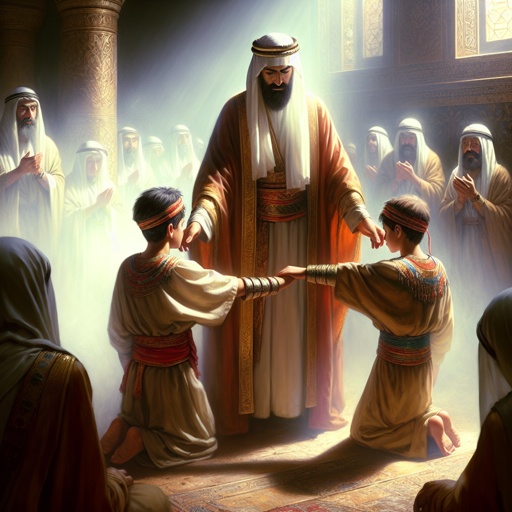
A man of Middle-Eastern descent wearing middle-eastern clothing crosses his arms and places his hands on two young boys who are also dressed in historical Middle-Eastern clothing. Ephraim and Manasseh, who are receiving the blessing, stand humbly and reverently. Ephraim, slighted in front of Manasseh, represents the text from Genesis 48:20. The scene conveys a strong sense of spirituality, reverence, and historical context, with softly glowing light and an ethereal atmosphere. The style should reflect the characteristics of digital painting, where the rich textures and bold strokes are visible.
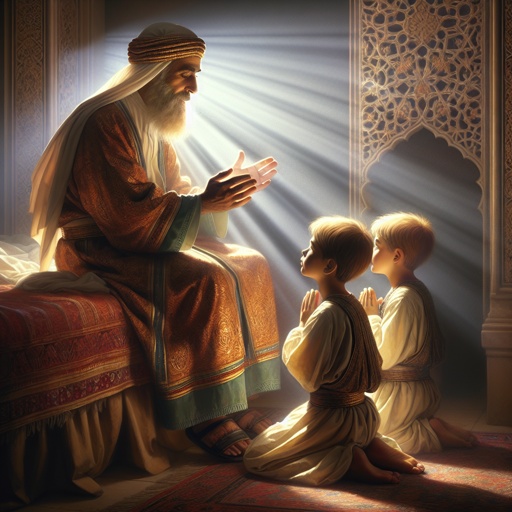
An man of Middle-Eastern descent wearing middle-eastern clothing is sitting on the edge of his bed. He is reaching out to his two young grandsons, and crosses his arms and places his hands on the two young boys who are also dressed in historical Middle-Eastern clothing. Ephraim and Manasseh, who are receiving the blessing, stand humbly and reverently. Ephraim, slighted in front of Manasseh, represents the text from Genesis 48:20. The scene conveys a strong sense of spirituality, reverence, and historical context, with softly glowing light and an ethereal atmosphere. The style should reflect the characteristics of digital painting, where the rich textures and bold strokes are visible.
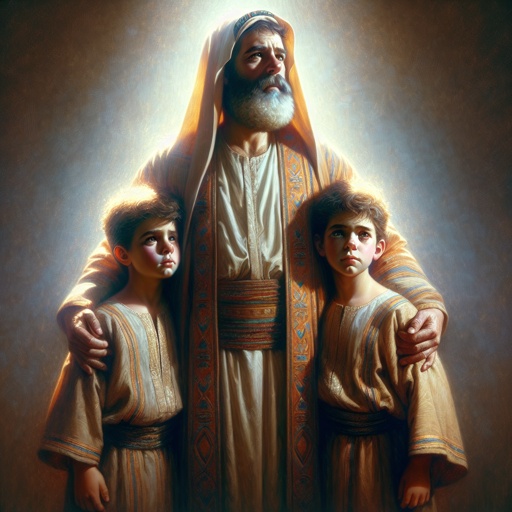
A man of Middle-Eastern descent wearing middle-eastern clothing crosses his arms and places his hands on two young boys who are also dressed in historical Middle-Eastern clothing. Ephraim and Manasseh, who are receiving the blessing, stand humbly and reverently. Ephraim, slighted in front of Manasseh, represents the text from Genesis 48:20. The scene conveys a strong sense of spirituality, reverence, and historical context, with softly glowing light and an ethereal atmosphere. The style should reflect the characteristics of digital painting, where the rich textures and bold strokes are visible.
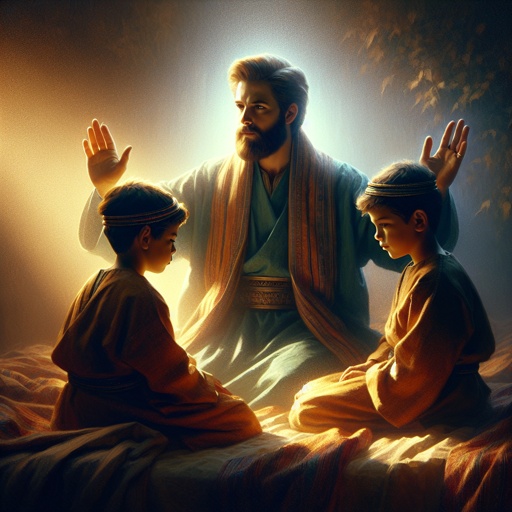
An man of Middle-Eastern descent wearing middle-eastern clothing is sitting on the edge of his bed. He is reaching out to his two young grandsons, and crosses his arms and places his hands on the two young boy's heads. The two boys are also dressed in historical Middle-Eastern clothing. Ephraim and Manasseh, who are receiving the blessing, stand humbly and reverently. Ephraim, slighted in front of Manasseh, represents the text from Genesis 48:20. The scene conveys a strong sense of spirituality, reverence, and historical context, with softly glowing light and an ethereal atmosphere. The style should reflect the characteristics of digital painting, where the rich textures and bold strokes are visible.

Genesis 24-48

Genesis 48:8 - "And Israel beheld Joseph's sons, and said, Who are these?"

Ezekiel 20:48 - "And all flesh shall see that I the LORD have kindled it: it shall not be quenched."

Jeremiah 48:20 - "Moab is confounded; for it is broken down: howl and cry; tell ye it in Arnon, that Moab is spoiled,"

Genesis 31:48 - "And Laban said, This heap is a witness between me and thee this day. Therefore was the name of it called Galeed;"
Genesis 48:3 - "And Jacob said unto Joseph, God Almighty appeared unto me at Luz in the land of Canaan, and blessed me,"

Genesis 48:12 - "And Joseph brought them out from between his knees, and he bowed himself with his face to the earth."
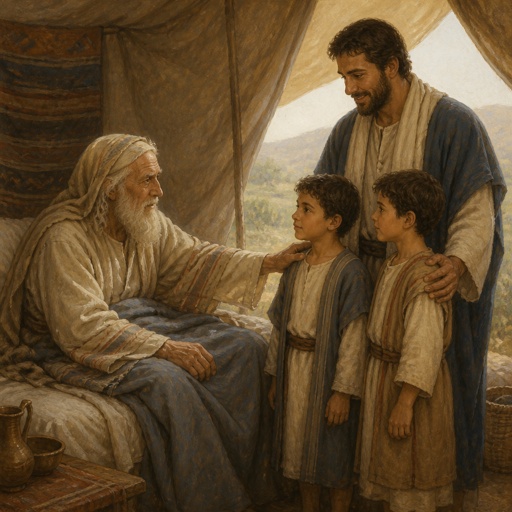
"And Israel beheld Joseph's sons, and said, Who are these?" - Genesis 48:8
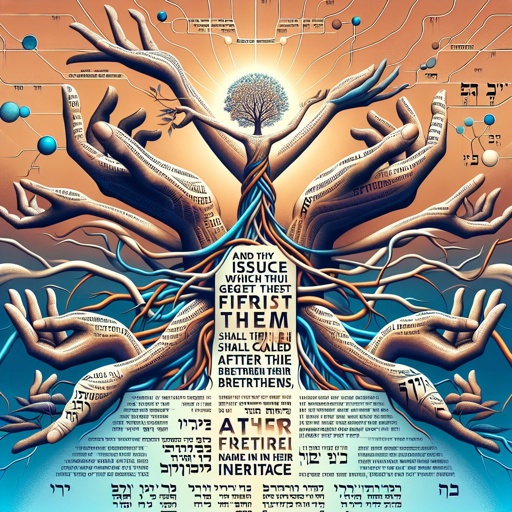
Genesis 48:6 - "And thy issue, which thou begettest after them, shall be thine, and shall be called after the name of their brethren in their inheritance."

Genesis 48:18 - "And Joseph said unto his father, Not so, my father: for this is the firstborn; put thy right hand upon his head."

Ezekiel 48:20 - "All the oblation shall be five and twenty thousand by five and twenty thousand: ye shall offer the holy oblation foursquare, with the possession of the city."
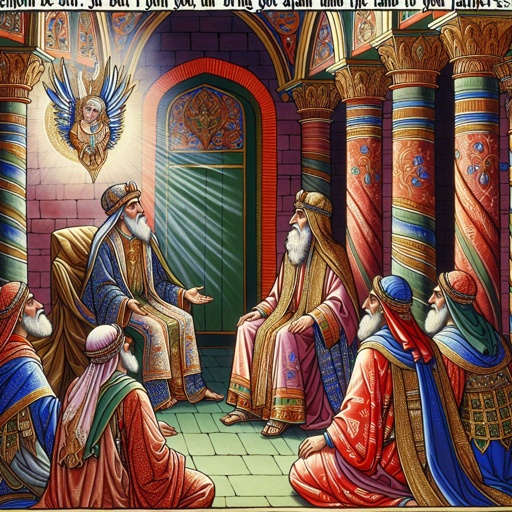
Genesis 48:21 - "And Israel said unto Joseph, Behold, I die: but God shall be with you, and bring you again unto the land of your fathers."

Genesis 48:2 - "And one told Jacob, and said, Behold, thy son Joseph cometh unto thee: and Israel strengthened himself, and sat upon the bed."
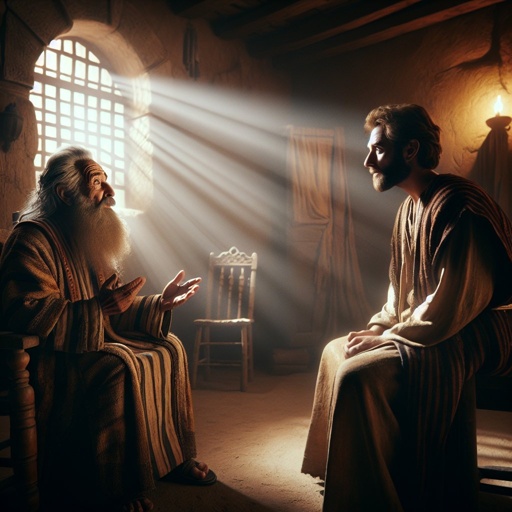
Genesis 48:11 - "And Israel said unto Joseph, I had not thought to see thy face: and, lo, God hath shewed me also thy seed."
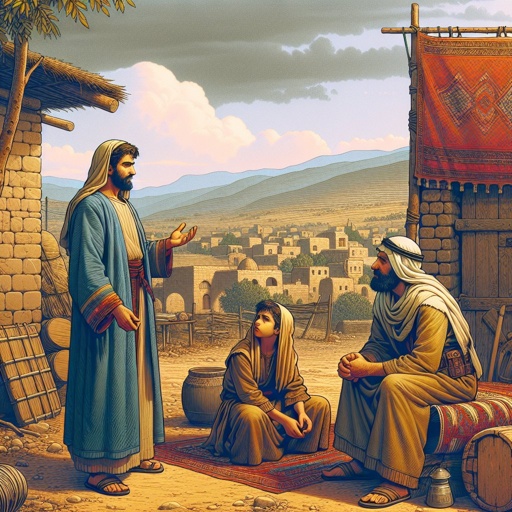
Genesis 48:1 - "And it came to pass after these things, that one told Joseph, Behold, thy father is sick: and he took with him his two sons, Manasseh and Ephraim."

Genesis 20

Genesis 48:22 - "Moreover I have given to thee one portion above thy brethren, which I took out of the hand of the Amorite with my sword and with my bow."

Genesis 48:10 - "Now the eyes of Israel were dim for age, so that he could not see. And he brought them near unto him; and he kissed them, and embraced them."
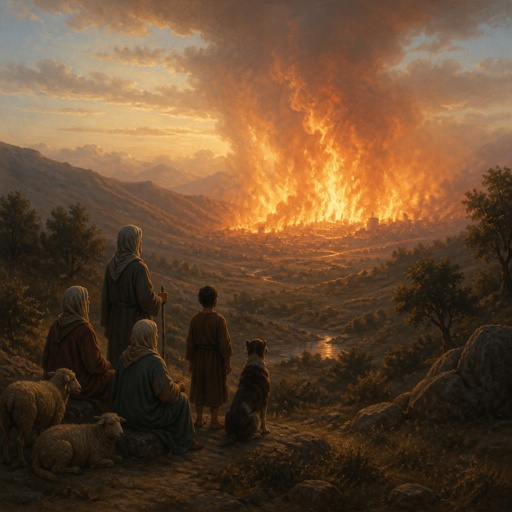
"And all flesh shall see that I the LORD have kindled it: it shall not be quenched." - Ezekiel 20:48

Genesis 20-18

Genesis 20-13

Genesis 20-16

Genesis 15:20

Genesis 20-4