What does Genesis 43:31 mean?
"And he washed his face, and went out, and refrained himself, and said, Set on bread." - Genesis 43:31
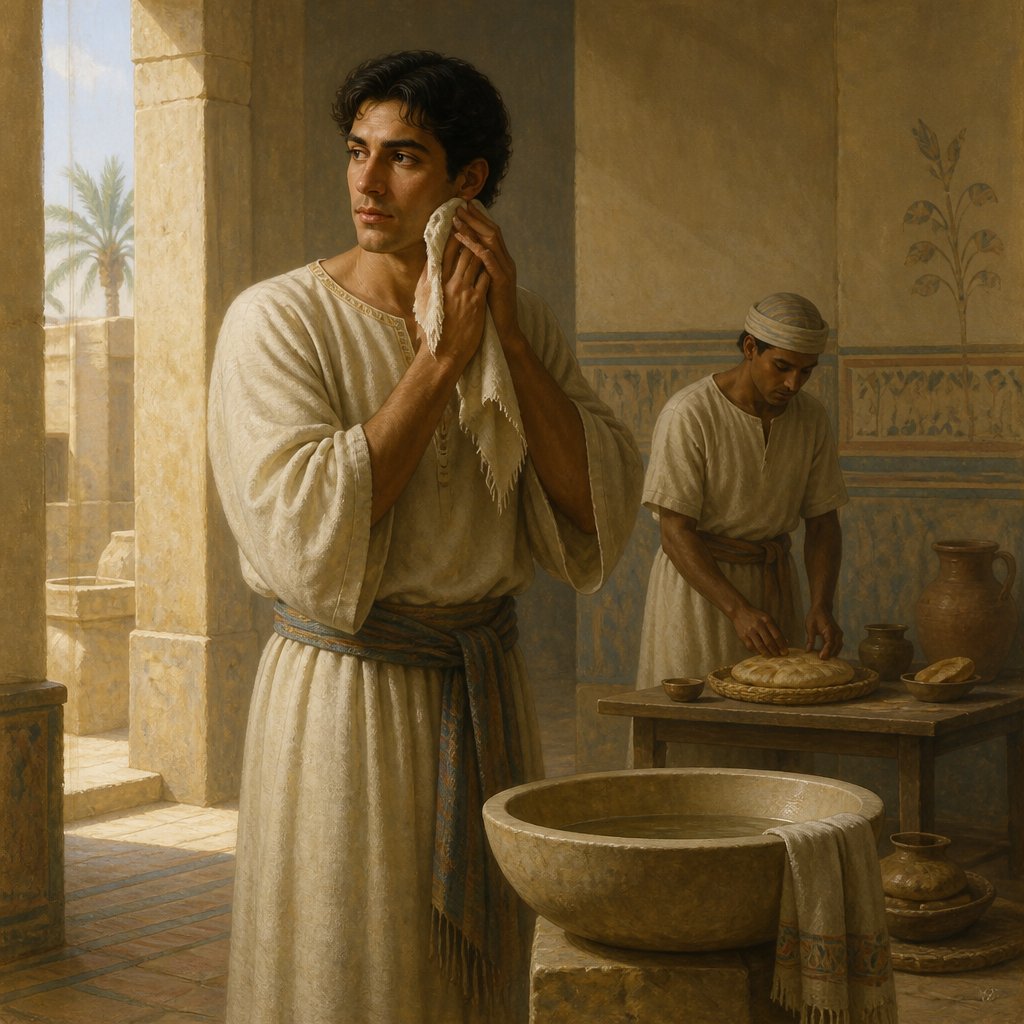
Genesis 43:31 (KJV) states, "And he washed his face, and went out, and refrained himself, and said, Set on bread." This verse comes from the story of Joseph and his brothers, specifically during the second meeting between Joseph and his brothers in Egypt. To understand the deeper meaning and themes of this verse, it is important to examine the context and symbolism within the overall narrative of Joseph's story.
The story of Joseph is a powerful and compelling narrative that encompasses themes of betrayal, forgiveness, and divine providence. It begins with Joseph's brothers' jealousy and subsequent betrayal, as they sell him into slavery out of envy for their father's favoritism. Despite encountering numerous trials and tribulations, Joseph ultimately rises to become a powerful figure in Egypt, second only to Pharaoh.
In Genesis 43, Joseph's brothers journey to Egypt to buy food during a severe famine. Unbeknownst to them, they come face to face with the very brother they had betrayed many years prior. As part of a test to gauge their character and remorse, Joseph accuses them of being spies and demands that they return to Canaan with their youngest brother, Benjamin, as proof of their honesty. The brothers comply and return with Benjamin, and Joseph is deeply moved by their actions.
Genesis 43:31 specifically describes Joseph's emotional response to the reunion with his brothers. After encountering them once again, Joseph is overwhelmed with emotion to the point where he is moved to tears. In the preceding verses, Joseph has a private moment where he weeps and then composes himself before rejoining his brothers. This act of washing his face and restraining himself before reemerging symbolizes Joseph's internal struggle and his commitment to maintaining composure despite being deeply moved. His command to "Set on bread" can be seen as a practical response to the emotional tension, as he shifts the focus back to the dinner at hand.
This verse captures the complex emotions Joseph experiences as he grapples with the reconciliation of his past with his present circumstances. It highlights the themes of forgiveness, reconciliation, and the internal struggle to contain overwhelming emotions. Despite the pain and betrayal Joseph endured at the hands of his brothers, he ultimately demonstrates grace and forgiveness, choosing to focus on the present moment rather than dwell on the past.
The deeper symbolism of this verse is further enriched by the broader biblical themes it embodies. The act of washing one's face can symbolize purification and renewal, representing Joseph's internal cleansing and renewal of spirit as he prepares to face his brothers. Additionally, the refrainment of self-control and composure in the midst of overwhelming emotions reflects the biblical themes of self-discipline, patience, and the human struggle to overcome inner turmoil through faith and steadfastness.
Furthermore, the act of breaking bread together carries significant symbolic weight in the Bible, representing unity, fellowship, and reconciliation. In this context, Joseph's command to "Set on bread" can be interpreted as a symbolic gesture of extending amnesty and fostering a sense of kinship and unity with his brothers, despite their troubled history.
In conclusion, Genesis 43:31 captures a pivotal moment in Joseph's story, highlighting themes of forgiveness, reconciliation, and the human struggle to overcome adversity and emotion through faith and grace. The verse carries profound symbolism, emphasizing the act of inner cleansing, self-control, and the transformative power of forgiveness and unity. It serves as a poignant reminder of the redemptive potential within the human spirit and the significance of reconciliation and grace in the face of adversity.
Have questions about Genesis 43:31?
Dive deeper into this scripture with Bible Chat — an AI-powered tool for exploring God's Word through conversation. Ask questions, get context, and grow in your understanding of the Bible.
Get Our Apps


Genesis 43:31 Artwork

Genesis 43:31 - "And he washed his face, and went out, and refrained himself, and said, Set on bread."
"And he washed his face, and went out, and refrained himself, and said, Set on bread." - Genesis 43:31

Exodus 28:31-43

Exodus 28:31-43
Genesis 31:43 - "¶ And Laban answered and said unto Jacob, These daughters are my daughters, and these children are my children, and these cattle are my cattle, and all that thou seest is mine: and what can I do this day unto these my daughters, or unto their children which they have born?"

Genesis 24-43

Genesis 43:1 - "And the famine was sore in the land."

"And the famine was sore in the land." - Genesis 43:1

Numbers 31:43 - "(Now the half that pertained unto the congregation was three hundred thousand and thirty thousand and seven thousand and five hundred sheep,"

Genesis 43:19 - "And they came near to the steward of Joseph's house, and they communed with him at the door of the house,"

Genesis 43:13 - "Take also your brother, and arise, go again unto the man:"

Genesis 43:17 - "And the man did as Joseph bade; and the man brought the men into Joseph's house."

Genesis 43:20 - "And said, O sir, we came indeed down at the first time to buy food:"

Genesis 43:25 - "And they made ready the present against Joseph came at noon: for they heard that they should eat bread there."

Genesis 30:43 - "And the man increased exceedingly, and had much cattle, and maidservants, and menservants, and camels, and asses."

Genesis 43:4 - "If thou wilt send our brother with us, we will go down and buy thee food:"

Genesis 21-31

Genesis 18-31

Genesis 31:35

Genesis 43:10 - "For except we had lingered, surely now we had returned this second time."

Genesis 19-31

Genesis 24-31

Genesis 43:24 - "And the man brought the men into Joseph's house, and gave them water, and they washed their feet; and he gave their asses provender."

Genesis 36:43 - "Duke Magdiel, duke Iram: these be the dukes of Edom, according to their habitations in the land of their possession: he is Esau the father of the Edomites."

Genesis 43:6 - "And Israel said, Wherefore dealt ye so ill with me, as to tell the man whether ye had yet a brother?"

Genesis 27:43 - "Now therefore, my son, obey my voice; and arise, flee thou to Laban my brother to Haran;"

Genesis 43:26 - "¶ And when Joseph came home, they brought him the present which was in their hand into the house, and bowed themselves to him to the earth."

Genesis 43:33 - "And they sat before him, the firstborn according to his birthright, and the youngest according to his youth: and the men marvelled one at another."

Genesis 43:28 - "And they answered, Thy servant our father is in good health, he is yet alive. And they bowed down their heads, and made obeisance."

Genesis 43:12 - "And take double money in your hand; and the money that was brought again in the mouth of your sacks, carry it again in your hand; peradventure it was an oversight:"