What does Genesis 38:13 mean?
"And it was told Tamar, saying, Behold thy father in law goeth up to Timnath to shear his sheep." - Genesis 38:13
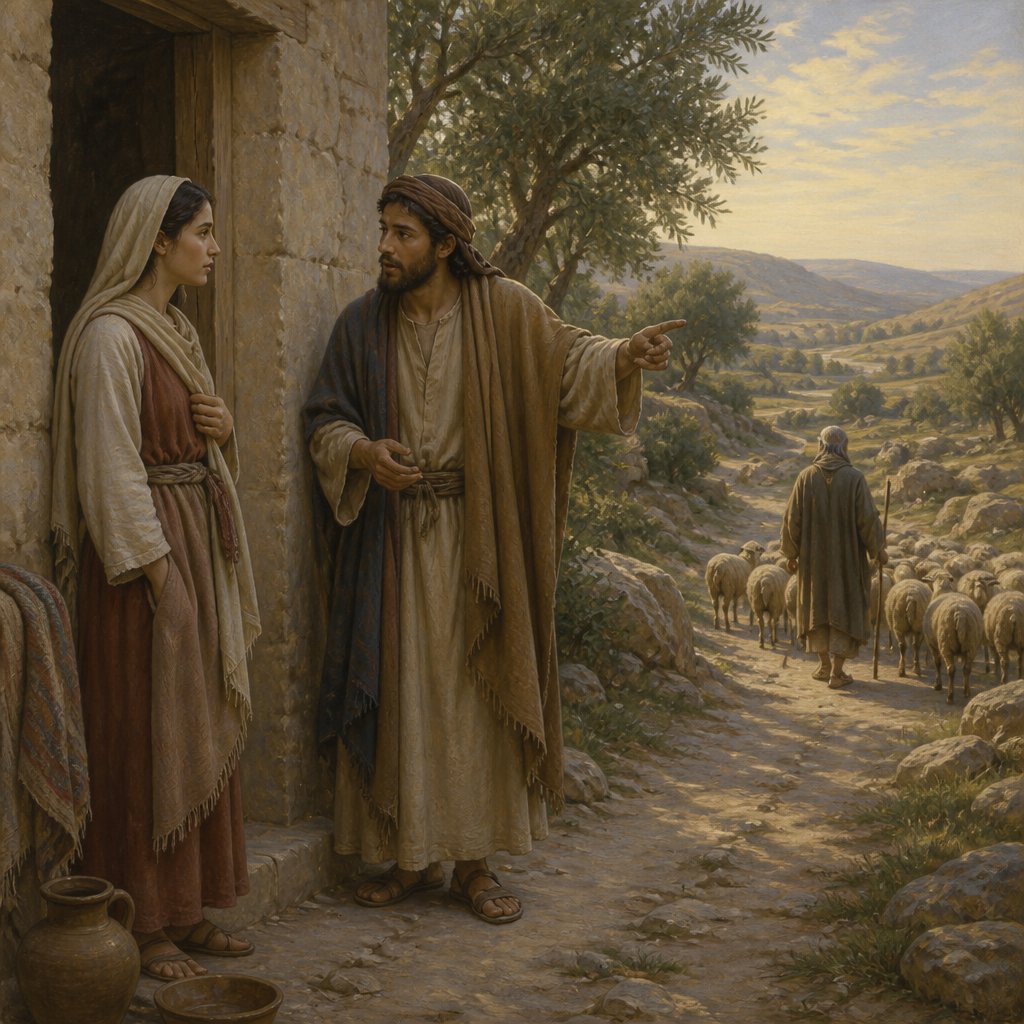
Genesis 38:13 (KJV) says, "And it was told Tamar, saying, Behold thy father in law goeth up to Timnath to shear his sheep."
This verse is part of the larger narrative of Tamar, the daughter-in-law of Judah, and it is significant in both its immediate context and its broader theological themes. In this chapter, Tamar's husband, Er, has died childless, and according to the custom of the time, it is the duty of his brother, Onan, to marry Tamar and produce offspring in Er's name. However, Onan refuses to fulfill this duty, and as a result, he also dies.
In an act of desperation, Tamar disguises herself as a prostitute and seduces her father-in-law, Judah. She becomes pregnant by him, and when Judah learns of this, he condemns her to death for her supposed immorality. However, when Tamar reveals that Judah himself is the father of her child, he acknowledges his own wrongdoing and admits that Tamar is more righteous than he.
In this verse, we see the beginning of Tamar's plan to meet Judah by the roadside on his way to Timnath. She takes the initiative to secure her own future by taking matters into her own hands. This act of agency is significant, as it demonstrates Tamar's resourcefulness and determination in the face of adversity. It also highlights the theme of God's control over the events of human history, even in the midst of human sin and folly.
The broader context of this passage is the theme of God's sovereignty and faithfulness. Despite the sinful actions of the characters in this narrative, God is still at work behind the scenes, bringing about His purposes. The ultimate result of Tamar's actions is the birth of twin sons, Perez and Zerah, who become part of the lineage of Jesus Christ. This demonstrates that God can use even the most unexpected and morally ambiguous circumstances to bring about His plan of redemption for humanity.
Symbolically, Tamar's actions can be seen as a foreshadowing of the unorthodox methods by which God often fulfills His promises. Tamar's boldness and willingness to take drastic measures to secure her future parallel the unexpected ways in which God brings about His purposes in the world. Additionally, Tamar's role as the matriarch of the line of Judah, a key tribe in Israel, underscores the theme of God's faithfulness to His covenant promises. Despite the failures of individuals, God remains faithful to His plan of salvation for His people.
Ultimately, this verse and the larger narrative of Tamar in Genesis 38 remind us of the complex and often messy ways in which God works in the world. It challenges us to see beyond the surface of human actions and to recognize the hand of God at work even in the most unlikely situations. It also emphasizes the importance of agency and determination in the face of adversity, as well as the need to trust in God's sovereignty even when circumstances seem bleak. Overall, this verse and its surrounding narrative serve as a powerful testament to the redemptive power of God in the midst of human frailty and sin.
Have questions about Genesis 38:13?
Dive deeper into this scripture with Bible Chat — an AI-powered tool for exploring God's Word through conversation. Ask questions, get context, and grow in your understanding of the Bible.
Get Our Apps


Genesis 38:13 Artwork

Genesis 38:13 - "And it was told Tamar, saying, Behold thy father in law goeth up to Timnath to shear his sheep." respectful, symbolic bible verse art
"And it was told Tamar, saying, Behold thy father in law goeth up to Timnath to shear his sheep." - Genesis 38:13

Philippians 1:3-8

Philippians 1:3-8

Genesis 19-38

Genesis 24-38

Jeremiah 38:1–13

Exodus 38:13 - "And for the east side eastward fifty cubits."

Genesis 38:6 - "And Judah took a wife for Er his firstborn, whose name was Tamar."

Genesis 38:3 - "And she conceived, and bare a son; and he called his name Er."

Genesis 38:7 - "And Er, Judah's firstborn, was wicked in the sight of the LORD; and the LORD slew him."

Genesis 36:38 - "And Saul died, and Baal-hanan the son of Achbor reigned in his stead."

2 Samuel 13:38 - "So Absalom fled, and went to Geshur, and was there three years."

Genesis 38:27 - "¶ And it came to pass in the time of her travail, that, behold, twins were in her womb."

Genesis 38:4 - "And she conceived again, and bare a son; and she called his name Onan."

Job 38:13 - "That it might take hold of the ends of the earth, that the wicked might be shaken out of it?"

Genesis 38:10 - "And the thing which he did displeased the LORD: wherefore he slew him also."

Psalms 38:13 - "But I, as a deaf man, heard not; and I was as a dumb man that openeth not his mouth."

Matthew 13:38 - "The field is the world; the good seed are the children of the kingdom; but the tares are the children of the wicked one;"

Genesis 38:21 - "Then he asked the men of that place, saying, Where is the harlot, that was openly by the way side? And they said, There was no harlot in this place."

Genesis 41:38 - "And Pharaoh said unto his servants, Can we find such a one as this is, a man in whom the Spirit of God is?"

Genesis 38:19 - "And she arose, and went away, and laid by her vail from her, and put on the garments of her widowhood."

Genesis 38:22 - "And he returned to Judah, and said, I cannot find her; and also the men of the place said, that there was no harlot in this place."

"And for the east side eastward fifty cubits." - Exodus 38:13

Leviticus 13:38 - "¶ If a man also or a woman have in the skin of their flesh bright spots, even white bright spots;"

Genesis 24:38 - "But thou shalt go unto my father's house, and to my kindred, and take a wife unto my son."

Genesis 38:2 - "And Judah saw there a daughter of a certain Canaanite, whose name was Shuah; and he took her, and went in unto her."

Genesis 38:15 - "When Judah saw her, he thought her to be an harlot; because she had covered her face."

Genesis 38:1 - "And it came to pass at that time, that Judah went down from his brethren, and turned in to a certain Adullamite, whose name was Hirah."

Acts 13:38 - "¶ Be it known unto you therefore, men and brethren, that through this man is preached unto you the forgiveness of sins:"