What does Genesis 2:7 mean?
"And the LORD God formed man of the dust of the ground, and breathed into his nostrils the breath of life; and man became a living soul." - Genesis 2:7

Genesis 2:7 in the KJV reads, “And the LORD God formed man of the dust of the ground, and breathed into his nostrils the breath of life; and man became a living soul.” In its immediate context, this verse stands at the beginning of the Bible’s close-up account of humanity’s origin. Genesis 1 has already declared, in broad strokes, that God created man in his image; Genesis 2 turns from the wide view to the intimate, earth-level scene, showing not only that man exists by God’s word, but how personally and deliberately the LORD God brought him into being. The verse belongs to the section where the world is presented as prepared for human life, yet before the garden’s moral drama begins. It is, in a sense, the quiet foundation under everything that follows: before there can be commandment, fellowship, work, marriage, temptation, and fall, there must be a creature who is both of earth and yet alive by God.
The opening words, “And the LORD God formed man,” emphasize intention and craftsmanship. The KJV’s “formed” suggests shaping with purpose rather than accidental assembly. The name “the LORD God” matters here, because it joins the covenant name “LORD” with “God,” the Creator; the One who speaks worlds into existence is also the One who draws near. Genesis 2 presents God not as distant force but as the personal Maker who stoops, forms, plants, brings, commands, and blesses. The verse’s significance begins with that nearness: humanity is not an afterthought of nature but the result of divine formation.
The material used is “the dust of the ground,” a phrase loaded with theme and symbolism. “Dust” points to lowliness, frailty, and earthiness. Man is not portrayed as self-originating or inherently divine; his body is from the same created order as the soil beneath his feet. The wording “of the ground” ties man to the earth he will later “dress” and “keep,” and it anticipates the later judgments spoken after sin: “Dust thou art, and unto dust shalt thou return.” Genesis 2:7 therefore establishes mortality as part of man’s creaturely condition and sets up a central biblical realism: humans are glorious in calling, yet humble in substance. This is not meant to demean humanity but to locate human life in dependence. The body is real, made and meant for a real world, and the earthliness of man explains why the Bible so often uses imagery of clay, potsherds, grass, and dust to speak of human weakness.
Yet Genesis 2:7 refuses to leave man as mere dust. The second action is even more intimate: God “breathed into his nostrils the breath of life.” The imagery is strikingly personal. God does not merely speak life at a distance; he imparts it. In the KJV phrase “breath of life,” life is presented as something received from God, not generated from within matter. Breath is invisible yet effective, unseen but undeniable; it becomes a fitting sign of how life itself depends on God’s sustaining gift. The “nostrils” detail keeps the scene concrete and embodied: this is not the animation of an abstract spirit but the enlivening of a formed body. The verse therefore holds together two truths at once: man is earthy and bodily, and man is alive by God’s direct impartation.
This breathing also carries relational weight. Breath suggests intimacy and presence; it implies that human life is meant to be lived before God and with God. It hints that the life man has is not simply biological motion but life that can respond to God—capable of hearing a command, receiving a calling, knowing good, and being held accountable. Genesis 2 will quickly show that man is placed in a garden with a task and a prohibition; Genesis 2:7 prepares for that by grounding human existence in God’s gift, making obedience and worship not arbitrary demands but the proper response of a dependent creature to the One who gave him breath.
The result is stated with careful finality: “and man became a living soul.” In the KJV, “living soul” does not present man as a soul trapped in a body; rather, it describes the whole person as a living being. The verse moves from formed dust to breathed life to living soul, showing a unified human reality: body enlivened by God, personhood arising from God’s impartation. The word “became” is important: life is not inherent in the dust; it is the outcome of God’s action. The phrase also elevates human life beyond mere material complexity. Man is not only alive; he is a “living soul,” a creature with a life that is personal and significant, capable of relationship, moral choice, and spiritual accountability.
Several large biblical themes begin here. Dependence is one: man’s life is derivative, received, and therefore accountable. Dignity is another: though made from dust, man is directly formed and directly enlivened by God, and this confers worth that is not self-made. Purpose is another: the man who becomes a living soul is immediately placed in a world where he will work, name, relate, and obey; his life is not random but vocational. Mortality and humility are present from the “dust,” and they will later deepen in the story after sin; but even before that, the dust motif teaches that humans should not confuse creature with Creator.
Symbolically, “dust” and “breath” work like two poles that define the human condition. Dust speaks of limits, weakness, and earthbound existence; breath speaks of gift, vitality, and Godward origin. The verse therefore explains why human life in Scripture can be described with both grandeur and grief. Humans can build, love, and worship, yet they can also wither, suffer, and die. Genesis 2:7 is the first place where the Bible shows these truths not as contradictions but as a designed tension: man is a creature of earth animated by God, meant to live under God, and unable to live truly apart from him.
In its significance, Genesis 2:7 becomes a kind of interpretive key for the rest of Scripture’s view of humanity. It tells you that to understand man you must hold together what God joined: formed “of the dust of the ground,” yet living by the “breath of life,” and therefore not merely an object in the world but a “living soul” whose life is both physical and personal, grounded in creation and oriented toward the Creator.
Have questions about Genesis 2:7?
Dive deeper into this scripture with Bible Chat — an AI-powered tool for exploring God's Word through conversation. Ask questions, get context, and grow in your understanding of the Bible.
Get Our Apps


Genesis 2:7 Artwork
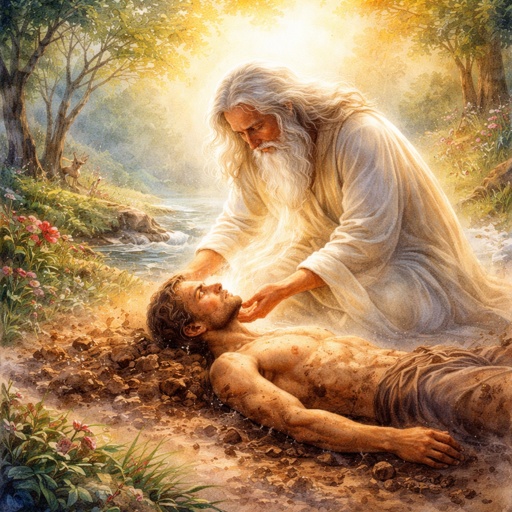
Genesis 2:7

Genesis 2:7 - "And the LORD God formed man of the dust of the ground, and breathed into his nostrils the breath of life; and man became a living soul."

"And the LORD God formed man of the dust of the ground, and breathed into his nostrils the breath of life; and man became a living soul." - Genesis 2:7

Genesis 7:2 - "Of every clean beast thou shalt take to thee by sevens, the male and his female: and of beasts that are not clean by two, the male and his female."

Genesis 24-7

Genesis 25-7

Genesis 20-7

Genesis 22-7

Genesis 23-7

Genesis 29-7

Genesis 3:7

Genesis 18-7

GENESIS 3:7

Genesis 15:7

Genesis 17:7

Genesis 3:7

Genesis 19-7

Genesis 21-7

Genesis 3:7

Genesis 16:7

Genesis 7:7 - "¶ And Noah went in, and his sons, and his wife, and his sons' wives with him, into the ark, because of the waters of the flood."

create image of Genesis 3:7

Genesis 7:24 - "And the waters prevailed upon the earth an hundred and fifty days."

Genesis 7:12 - "And the rain was upon the earth forty days and forty nights."

Genesis 7:5 - "And Noah did according unto all that the LORD commanded him."

Genesis 2:1-2

Genesis 2:1-2

Genesis 19:7 - "And said, I pray you, brethren, do not so wickedly."

Genesis 38:7 - "And Er, Judah's firstborn, was wicked in the sight of the LORD; and the LORD slew him."

Genesis 7:22 - "All in whose nostrils was the breath of life, of all that was in the dry land, died."