What does Genesis 29:10 mean?
"And it came to pass, when Jacob saw Rachel the daughter of Laban his mother's brother, and the sheep of Laban his mother's brother, that Jacob went near, and rolled the stone from the well's mouth, and watered the flock of Laban his mother's brother." - Genesis 29:10
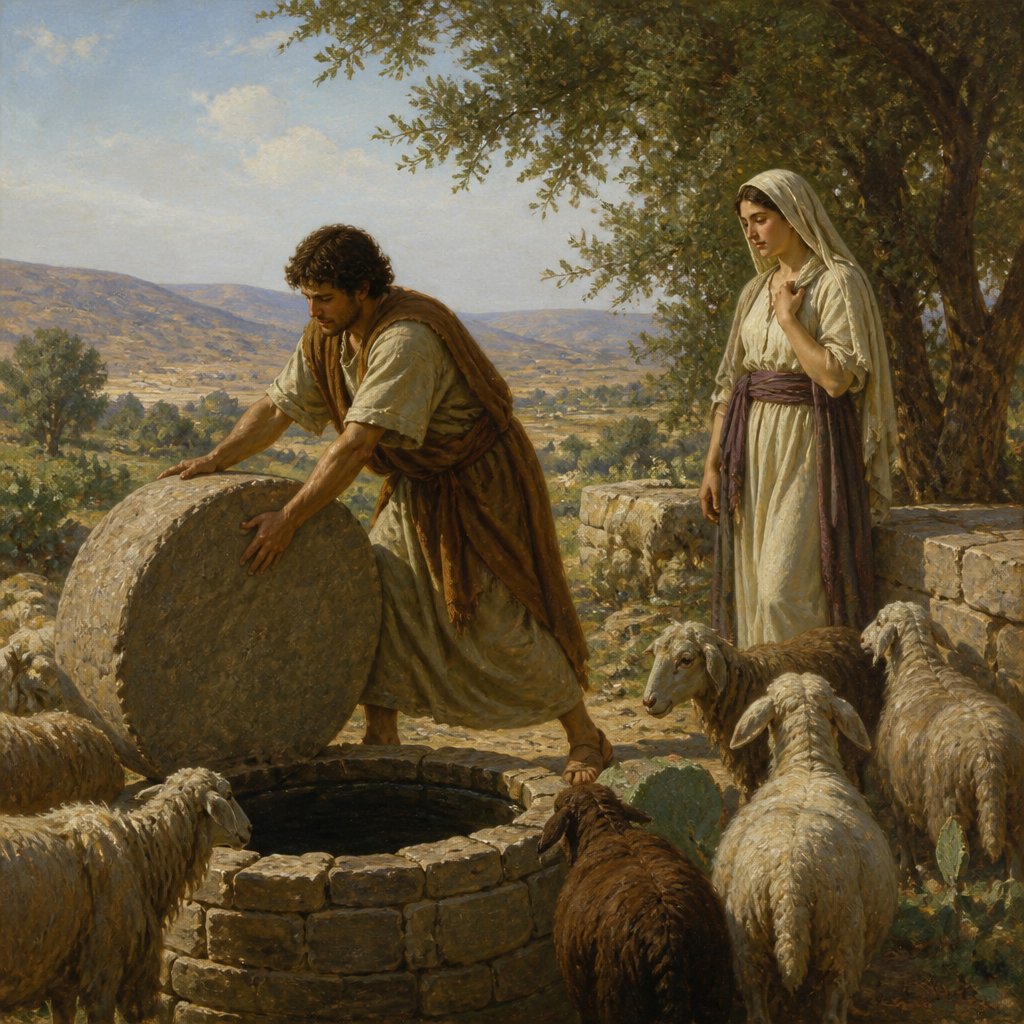
Genesis 29:10 (KJV) reads, "And it came to pass, when Jacob saw Rachel the daughter of Laban his mother's brother, and the sheep of Laban his mother's brother, that Jacob went near, and rolled the stone from the well's mouth, and watered the flock of Laban his mother's brother."
This verse is part of the larger narrative of Jacob's journey to Haran, where he meets Rachel, the woman who will become his wife. At this point in the story, Jacob has arrived at the well where Rachel's father, Laban, keeps his sheep. Jacob sees Rachel and is immediately drawn to her. He then takes it upon himself to roll the stone away from the mouth of the well and water Laban's flock. This act of service and kindness towards Rachel and her family sets the stage for the rest of the story, as Jacob becomes deeply involved with Laban's household.
The themes present in this verse include love, sacrifice, and providence. Jacob's reaction to seeing Rachel is one of love at first sight. He is so taken with her that he takes immediate action to care for her family's flock, showing his deep desire to impress and win the affection of Rachel. This act of service also demonstrates Jacob's willingness to sacrifice and work hard for the woman he loves, a theme that will continue to play out in the story of Jacob and Rachel.
Another theme present in this verse is providence. The meeting of Jacob and Rachel at the well is no coincidence. It is a pivotal moment that sets the stage for the rest of their story. This meeting is the beginning of a journey that will lead to a deep and lasting love, as well as the birth of the twelve tribes of Israel through Jacob and his wives.
In the larger context of the book of Genesis, this verse is part of the story of Jacob's journey to Haran, where he will meet his future wives and begin building his family. It is a story of love, family, and the fulfillment of God's promises to Abraham, Isaac, and Jacob. The meeting of Jacob and Rachel is a crucial moment in the larger narrative of God's plan for the nation of Israel, and it is significant in establishing the lineage of the twelve tribes.
Symbolism is also present in this verse, particularly in the act of rolling the stone away from the mouth of the well. This action can be seen as a symbol of Jacob's strength and determination. It also represents his willingness to work hard and overcome obstacles in order to achieve his goals, in this case, winning the affection of Rachel and eventually marrying her.
Overall, Genesis 29:10 is a significant verse in the story of Jacob and Rachel, as it sets the stage for their relationship and the larger narrative of God's plan for the nation of Israel. It conveys themes of love, sacrifice, providence, and God's faithfulness, and it is rich in symbolism that reflects the character and journey of Jacob. This verse is a testament to the enduring power of love and the importance of faith in God's plan for His people.
Have questions about Genesis 29:10?
Dive deeper into this scripture with Bible Chat — an AI-powered tool for exploring God's Word through conversation. Ask questions, get context, and grow in your understanding of the Bible.
Get Our Apps


Genesis 29:10 Artwork

Genesis 29:10 - "And it came to pass, when Jacob saw Rachel the daughter of Laban his mother's brother, and the sheep of Laban his mother's brother, that Jacob went near, and rolled the stone from the well's mouth, and watered the flock of Laban his mother's brother."
"And it came to pass, when Jacob saw Rachel the daughter of Laban his mother's brother, and the sheep of Laban his mother's brother, that Jacob went near, and rolled the stone from the well's mouth, and watered the flock of Laban his mother's brother." - Genesis 29:10

Genesis 10:29 - "And Ophir, and Havilah, and Jobab: all these were the sons of Joktan."
"And Ophir, and Havilah, and Jobab: all these were the sons of Joktan." - Genesis 10:29

Genesis 29:29 - "And Laban gave to Rachel his daughter Bilhah his handmaid to be her maid."

Genesis 29-2

Genesis 29-6

Genesis 29-5

Genesis 42:29

Genesis 29:1

Genesis 29-7

Genesis 18-29

Genesis 26:29

Genesis 19-29

Genesis 29-8

Genesis 29-3

Genesis 29-4

Genesis 21-29

Genesis 24-29

Genesis 29:16-35

Genesis 29:15-30

Genesis 29:17 - "Leah was tender eyed; but Rachel was beautiful and well favoured."

Genesis 29:11 - "And Jacob kissed Rachel, and lifted up his voice, and wept."

Genesis 29:1 - "Then Jacob went on his journey, and came into the land of the people of the east."

Genesis 29:22 - "And Laban gathered together all the men of the place, and made a feast."

Genesis 25:29 - "And Jacob sod pottage: and Esau came from the field, and he was faint:"

"And Laban gave to Rachel his daughter Bilhah his handmaid to be her maid." - Genesis 29:29

Genesis 41:29 - "Behold, there come seven years of great plenty throughout all the land of Egypt:"

Genesis 29:24 - "And Laban gave unto his daughter Leah Zilpah his maid for an handmaid."

Genesis 29:16 - "And Laban had two daughters: the name of the elder was Leah, and the name of the younger was Rachel."