What does Galatians 5:22 mean?
"But the fruit of the Spirit is love, joy, peace, longsuffering, gentleness, goodness, faith," - Galatians 5:22

Galatians 5:22 in the King James Version reads, “But the fruit of the Spirit is love, joy, peace, longsuffering, gentleness, goodness, faith.” The verse is a portrait of the kind of life that appears when God’s Spirit is not merely acknowledged but actually governs a person from within. It does not present these qualities as a checklist of religious achievements, nor as a personality type that some are born with and others lack, but as the natural produce of a new inward source. The word “But” marks a deliberate contrast with what immediately precedes it in the chapter, where Paul lists “the works of the flesh.” In that contrast is one of the main themes of Galatians: the difference between a life driven by fallen human nature and a life shaped by the Spirit of God, and the difference between outward rule-keeping as a means of righteousness and inward transformation that expresses itself in righteousness.
The immediate context of Galatians 5 is Paul’s defense of Christian liberty against those who wanted to place believers under the yoke of the law—especially circumcision—as though justification and acceptance with God depended on Mosaic observances. Paul insists that believers are called unto liberty, yet he is equally clear that liberty is not an excuse for self-indulgence. Earlier in the chapter he writes, “For, brethren, ye have been called unto liberty; only use not liberty for an occasion to the flesh, but by love serve one another” (Galatians 5:13, KJV). That sentence sets the stage for Galatians 5:22. True freedom, in Paul’s argument, is not autonomy of desire; it is deliverance from the tyranny of desire, so that a person can love and serve rather than consume and dominate. In this same section he gives the controlling principle, “Walk in the Spirit, and ye shall not fulfil the lust of the flesh” (Galatians 5:16, KJV). Galatians 5:22 then describes what that “walk” looks like when it is actually happening.
One of the most significant features of the verse is its metaphor: “fruit.” Paul does not say “works of the Spirit” as though the Spirit and the flesh were two competing labor systems. He says “fruit,” suggesting organic growth rather than mechanical performance. Fruit is living evidence of the nature of the tree and the health of the root; it develops in season, it is nourished from within, and it is recognizable to others. Symbolically, this points to a spirituality that is not a mere external conformity but an inward life that bears visible results. It also implies dependence: fruit does not manufacture itself; it is borne. In the same way, the virtues named are not portrayed as self-produced moralism but as the outcome of the Spirit’s presence and activity. The singular “fruit” followed by a cluster of qualities hints that these virtues belong together as a unified expression of one Spirit, not scattered traits that can be selected according to preference.
The first quality named is “love,” which in Galatians is both the great command fulfilled and the great evidence of life in Christ. Paul has already said, “For all the law is fulfilled in one word, even in this; Thou shalt love thy neighbour as thyself” (Galatians 5:14, KJV). In that light, love is not sentimental warmth alone but the Spirit-formed disposition to seek another’s good, to serve rather than exploit, and to pursue unity rather than devouring rivalry. It is also the safeguard of Christian liberty: when love rules, freedom does not become license.
“Joy” follows, not as superficial cheerfulness, but as the inward gladness that springs from reconciliation with God and from the Spirit’s witness that believers are no longer enslaved to condemnation. In a letter where Paul is fighting for the gospel of grace, joy is a sign that the heart is resting in God’s acceptance rather than striving to earn it. Joy also stands against the bitter atmosphere that legalism and fleshly conflict produce; it is a holy resilience that does not depend on favorable circumstances.
“Peace” is both the peace with God that comes through the gospel and the peace among people that the Spirit cultivates in the community. Galatians contains strong warnings about relational breakdown: “if ye bite and devour one another, take heed that ye be not consumed one of another” (Galatians 5:15, KJV). Peace is therefore not mere quietness; it is the Spirit’s answer to the hostility, suspicion, and factionalism that arise when the flesh is in control. It is also an internal stability that steadies the believer amid controversy, which is especially relevant in Galatia’s turmoil over law and grace.
“Longsuffering” speaks to patience under provocation and endurance over time. In the flow of Galatians 5, it is the opposite of the impulsive, retaliatory patterns that the “works of the flesh” generate. Longsuffering is the Spirit’s power to bear with people’s slowness, to remain steadfast under strain, and to keep charity when pressured. It is particularly meaningful in a church setting, where differences and offenses often test whether faith is merely doctrinal or genuinely spiritual.
“Gentleness” in the KJV carries the sense of kindness in manner and action. It is a Spirit-shaped tenderness that refuses harshness as a way of asserting truth. Galatians is a letter of sharp doctrinal clarity, yet Paul insists that spiritual life does not express itself in brutality. Gentleness is how truth behaves when love is real; it is strength under control, able to correct without crushing.
“Goodness” moves from tone to moral substance: it is benevolence that is not merely polite but actively upright and generous. Goodness is the Spirit’s imprint on the will, leading a person to do what is right for God’s sake and for others’ benefit. In a context where Paul insists that righteousness is not gained by the law’s ceremonies, goodness shows that grace does not weaken morality; it produces it. The gospel does not lower the standard of holiness; it changes the source of holiness, from self-reliant effort to Spirit-enabled life.
“Faith,” as named here, points to trust and fidelity. In Galatians as a whole, faith is central: the letter argues that people are justified by faith, not by the works of the law. Within the “fruit” list, faith also expresses itself as steadiness, reliability, and a continuing dependence on God rather than on self. It is the Spirit’s work to keep the believer anchored in Christ, so that life flows from trust instead of fear, and obedience flows from reliance rather than from anxious striving.
The significance of Galatians 5:22, then, is that it describes Christian character as the visible harvest of an invisible indwelling. It functions in the letter as Paul’s answer to two errors at once. Against legalism, it shows that the goal is not merely external conformity to regulations but the internal life of the Spirit producing virtues that the law pointed toward but could not ultimately create in fallen hearts. Against libertinism, it shows that freedom in Christ is never freedom to serve the flesh, because the Spirit produces a distinct moral and relational beauty that is contrary to fleshly indulgence. The verse therefore stands as a theological and practical summary: when the gospel is believed and the Spirit is followed, the life that emerges is marked by love that serves, joy that endures, peace that reconciles, patience that bears, gentleness that heals, goodness that acts rightly, and faith that rests in God and remains true.
Have questions about Galatians 5:22?
Dive deeper into this scripture with Bible Chat — an AI-powered tool for exploring God's Word through conversation. Ask questions, get context, and grow in your understanding of the Bible.
Get Our Apps


Galatians 5:22 Artwork

Galatians 5:22-23

Galatians 5:22-23

Galatians 5:22-23

Galatians 5:22-23

Galatians 5:22-23

Galatians 5:22 - "But the fruit of the Spirit is love, joy, peace, longsuffering, gentleness, goodness, faith,"

Galatians 5:22-23 - "But the fruit of the Spirit is love, joy, peace, forbearance, kindness, goodness, faithfulness, gentleness and self-control. Against such things there is no law."

"But the fruit of the Spirit is love, joy, peace, longsuffering, gentleness, goodness, faith," - Galatians 5:22
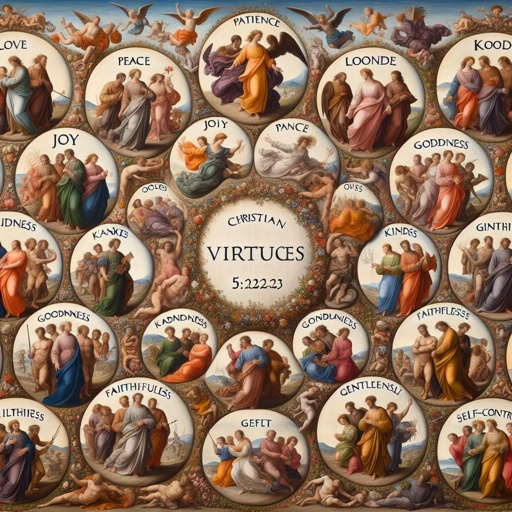
Create an artistic and respectful depiction of the Christian virtues listed in Galatians 5:22-23, as they would be portrayed in a Renaissance painting.

"But the fruit of the Spirit is love, joy, peace, longsuffering, gentleness, goodness, faith," - Galatians 5:22

Galatians5:22-23

Galatians5:22-23

"But the fruit of the Spirit is love, joy, peace, forbearance, kindness, goodness, faithfulness, gentleness and self-control. Against such things there is no law." - Galatians 5:22-23
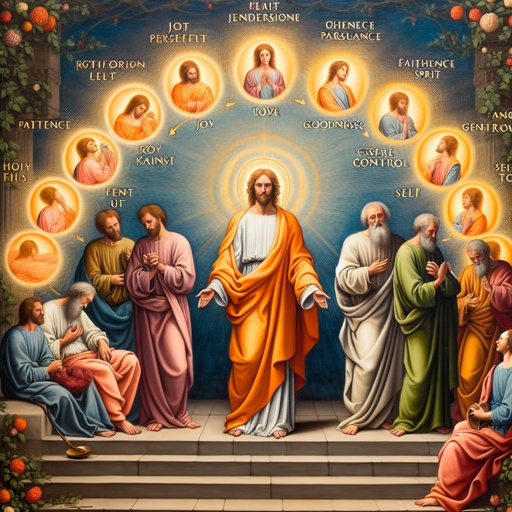
When the Holy Spirit truly leads you, your life will bear unmistakable good fruit, visible in your thoughts, words, and actions. St. Paul outlines these fruits in Galatians: love, joy, peace, patience, kindness, goodness, faithfulness, gentleness, and self-control (Galatians 5:22-23). Imagine what it would be like to consistently embody these qualities—to be loving, joyful, peaceful, patient, and self-controlled. Perhaps you think, “That sounds like Jesus, not me!” Many would feel blessed if even a few of these virtues consistently marked their lives. But such thinking underestimates the Spirit’s transformative power. These fruits that defined Christ’s life are also meant to define ours. The Holy Spirit’s work within us is profound; it is a lifelong process of transformation that aligns us with the very nature of Christ. By allowing the Spirit to guide us, we aren’t just hoping to mirror some aspects of Jesus—we are empowered to grow fully in His likeness. The Spirit’s power is dynamic, reshaping us from within so that, over time, we naturally bear this good fruit, reflecting Christ Himself in all we do. no words

When the Holy Spirit truly leads you, your life will bear unmistakable good fruit, visible in your thoughts, words, and actions. St. Paul outlines these fruits in Galatians: love, joy, peace, patience, kindness, goodness, faithfulness, gentleness, and self-control (Galatians 5:22-23). Imagine what it would be like to consistently embody these qualities—to be loving, joyful, peaceful, patient, and self-controlled. Perhaps you think, “That sounds like Jesus, not me!” Many would feel blessed if even a few of these virtues consistently marked their lives. But such thinking underestimates the Spirit’s transformative power. These fruits that defined Christ’s life are also meant to define ours. Here is the image representing the presence and transformative power of the Holy Spirit in a person's life.

When the Holy Spirit truly leads you, your life will bear unmistakable good fruit, visible in your thoughts, words, and actions. St. Paul outlines these fruits in Galatians: love, joy, peace, patience, kindness, goodness, faithfulness, gentleness, and self-control (Galatians 5:22-23). Imagine what it would be like to consistently embody these qualities—to be loving, joyful, peaceful, patient, and self-controlled. Perhaps you think, “That sounds like Jesus, not me!” Many would feel blessed if even a few of these virtues consistently marked their lives. But such thinking underestimates the Spirit’s transformative power. These fruits that defined Christ’s life are also meant to define ours. Here is the image representing the presence and transformative power of the Holy Spirit in a person's life.

When the Holy Spirit truly leads you, your life will bear unmistakable good fruit, visible in your thoughts, words, and actions. St. Paul outlines these fruits in Galatians: love, joy, peace, patience, kindness, goodness, faithfulness, gentleness, and self-control (Galatians 5:22-23). Imagine what it would be like to consistently embody these qualities—to be loving, joyful, peaceful, patient, and self-controlled. Perhaps you think, “That sounds like Jesus, not me!” Many would feel blessed if even a few of these virtues consistently marked their lives. But such thinking underestimates the Spirit’s transformative power. These fruits that defined Christ’s life are also meant to define ours. The Holy Spirit’s work within us is profound; it is a lifelong process of transformation that aligns us with the very nature of Christ. By allowing the Spirit to guide us, we aren’t just hoping to mirror some aspects of Jesus—we are empowered to grow fully in His likeness. The Spirit’s power is dynamic, reshaping us from within so that, over time, we naturally bear this good fruit, reflecting Christ Himself in all we do.

Galatians 5

Galatians 5:5-6

Galatians 5:16-17

Galatians 5:16-17

Galatians 5:24

Galatians 5:23

Galatians 5:23

Galatians 5:23

Galatians 5:23

Galatians 5:5 - "For we through the Spirit wait for the hope of righteousness by faith."

Galatians 6: 4-5

Galatians 5:23 - "Meekness, temperance: against such there is no law."

Galatians 6: 4-5