What does Ezra 1:10 mean?
"Thirty basons of gold, silver basons of a second sort four hundred and ten, and other vessels a thousand." - Ezra 1:10
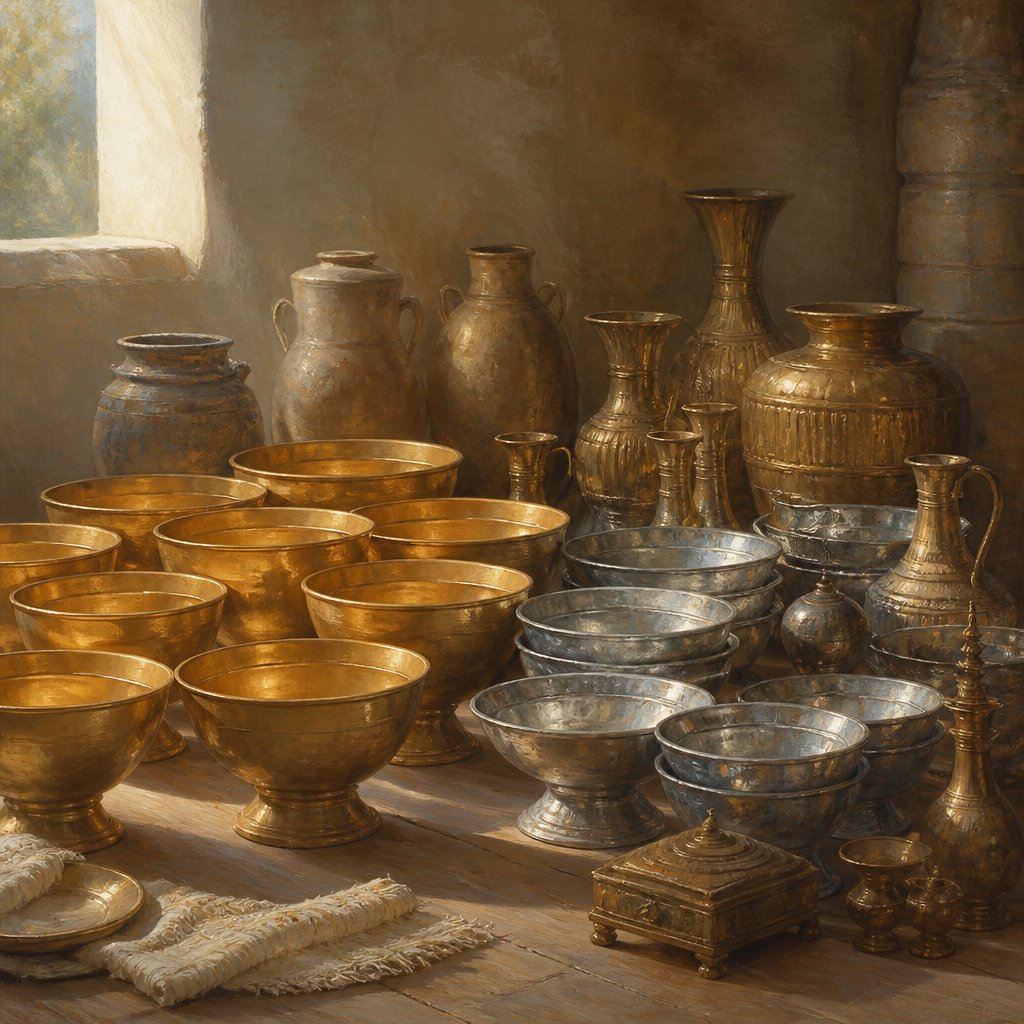
Ezra 1:10 (KJV) says, "Thirty basons of gold, silver basons of a second sort four hundred and ten, and other vessels a thousand."
This verse is part of the historical account of the return of the exiled Jews to Jerusalem as recorded in the book of Ezra. It is a specific listing of some of the treasures that were returned to the Jews by King Cyrus of Persia, who had issued a decree allowing them to return to their homeland and rebuild the temple in Jerusalem.
The context of this verse is essential for understanding its significance. The Jews had been taken into captivity by the Babylonians, and the temple in Jerusalem was destroyed. However, King Cyrus, who had conquered the Babylonians, allowed the Jews to return to their homeland and provided them with the resources needed to rebuild the temple. This verse specifically lists some of the treasures that were returned to the Jews, including 30 gold basins, 410 silver basins, and 1,000 other vessels. These treasures were a significant part of the resources that the Jews needed to rebuild the temple and restore their worship and religious practices.
One theme that can be drawn from this verse is the idea of restoration. The return of the treasures to the Jews symbolizes the restoration of their faith and religious practices. It also signifies the restoration of their identity as a people. The treasures are not just material possessions but represent the spiritual and cultural wealth of the Jewish people. The return of these treasures was a crucial step in the process of rebuilding the temple and reestablishing the worship of God in Jerusalem.
Another theme that can be seen in this verse is the providence of God. The fact that King Cyrus, a pagan ruler, allowed the Jews to return to their homeland and provided them with the resources they needed is a testament to the providence of God. It shows that God can work through unlikely means and individuals to accomplish His purposes. The return of the treasures to the Jews was not just a political decision but a part of God's plan to restore His people and reestablish their worship and relationship with Him.
Symbolically, the treasures mentioned in this verse can represent the spiritual treasures that God restores to His people. They can symbolize the blessings, gifts, and provisions that God provides for His people as they seek to serve Him and fulfill His purposes. The gold and silver basins can symbolize the purity and value of the worship and service offered to God, while the other vessels can represent the various aspects of the Jewish religious practices and traditions.
In conclusion, Ezra 1:10 is a significant verse that captures the historical context of the return of the exiled Jews to Jerusalem and the restoration of their religious practices. It carries themes of restoration, providence, and symbolism of spiritual treasures. It serves as a reminder of God's faithfulness to His people and His ability to provide for their needs and restore what has been lost.
Have questions about Ezra 1:10?
Dive deeper into this scripture with Bible Chat — an AI-powered tool for exploring God's Word through conversation. Ask questions, get context, and grow in your understanding of the Bible.
Get Our Apps


Ezra 1:10 Artwork

Ezra 1:10 - "Thirty basons of gold, silver basons of a second sort four hundred and ten, and other vessels a thousand."
"Thirty basons of gold, silver basons of a second sort four hundred and ten, and other vessels a thousand." - Ezra 1:10

Ezra 10:10-12

Ezra 10:10 - "And Ezra the priest stood up, and said unto them, Ye have transgressed, and have taken strange wives, to increase the trespass of Israel."

Ezra 10:1 - "Now when Ezra had prayed, and when he had confessed, weeping and casting himself down before the house of God, there assembled unto him out of Israel a very great congregation of men and women and children: for the people wept very sore."

Ezra 10:3

Ezra 3:10

Ezra 10:3

Ezra 10:5 - "Then arose Ezra, and made the chief priests, the Levites, and all Israel, to swear that they should do according to this word. And they sware."

Ezra 7:10 - "For Ezra had prepared his heart to seek the law of the LORD, and to do it, and to teach in Israel statutes and judgments."

Ezra 10:38 - "And Bani, and Binnui, Shimei,"

Ezra 10:37 - "Mattaniah, Mattenai, and Jaasau,"

Ezra 10:40 - "Machnadebai, Shashai, Sharai,"

Ezra 10:32 - "Benjamin, Malluch, and Shemariah."

Ezra 10:36 - "Vaniah, Meremoth, Eliashib,"

Ezra 10:35 - "Benaiah, Bedeiah, Chelluh,"

Ezra 10:42 - "Shallum, Amariah, and Joseph."

Ezra 10:41 - "Azareel, and Shelemiah, Shemariah,"

Ezra 10:39 - "And Shelemiah, and Nathan, and Adaiah,"

Ezra 10:20 - "And of the sons of Immer; Hanani, and Zebadiah."

Ezra 10:34 - "Of the sons of Bani; Maadai, Amram, and Uel,"

Ezra 2:10 - "The children of Bani, six hundred forty and two."

Ezra 10:21 - "And of the sons of Harim; Maaseiah, and Elijah, and Shemaiah, and Jehiel, and Uzziah."

Ezra 10:24 - "Of the singers also; Eliashib: and of the porters; Shallum, and Telem, and Uri."

Ezra 10:28 - "Of the sons also of Bebai; Jehohanan, Hananiah, Zabbai, and Athlai."

Ezra 10:31 - "And of the sons of Harim; Eliezer, Ishijah, Malchiah, Shemaiah, Shimeon,"

"Azareel, and Shelemiah, Shemariah," - Ezra 10:41

"And Bani, and Binnui, Shimei," - Ezra 10:38

"And Shelemiah, and Nathan, and Adaiah," - Ezra 10:39

"Vaniah, Meremoth, Eliashib," - Ezra 10:36