What does Exodus 5:1 mean?
"And afterward Moses and Aaron went in, and told Pharaoh, Thus saith the LORD God of Israel, Let my people go, that they may hold a feast unto me in the wilderness." - Exodus 5:1
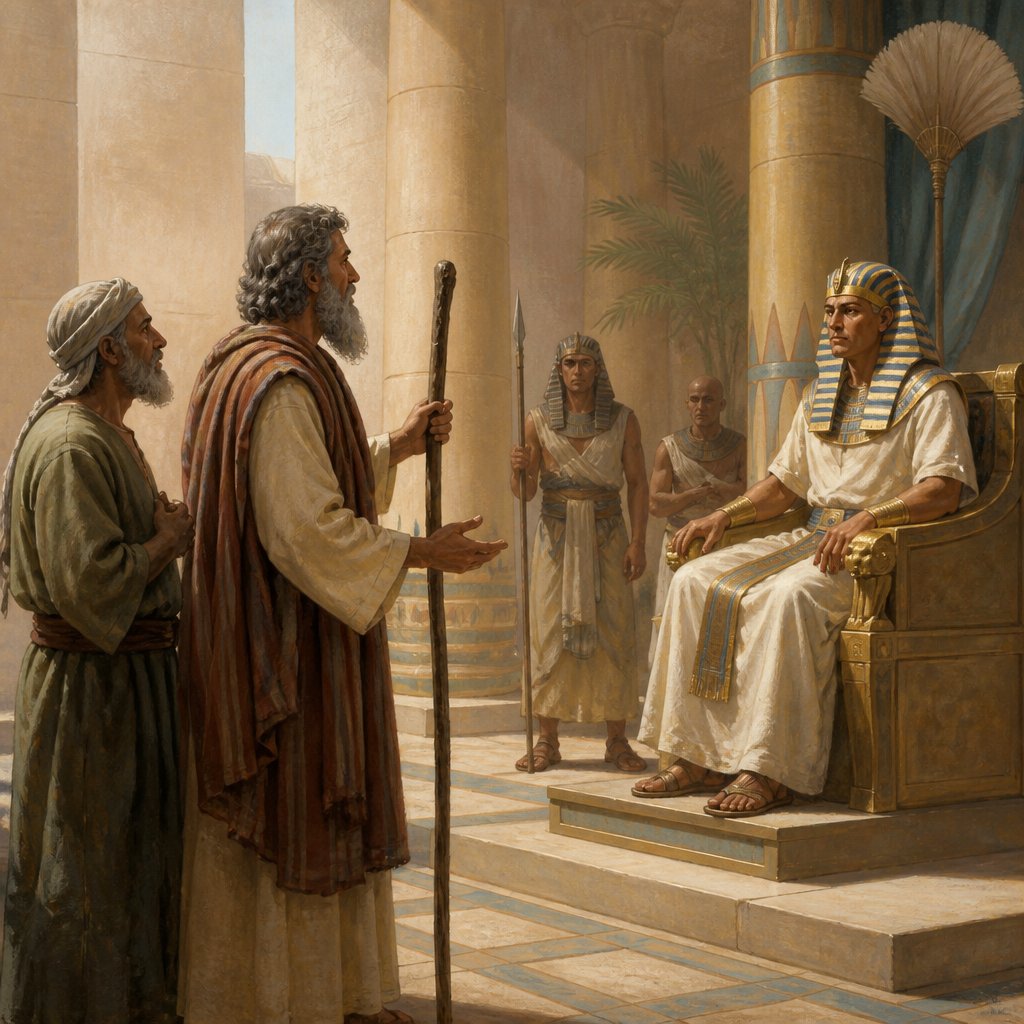
Exodus 5:1 (KJV) states, "And afterward Moses and Aaron went in, and told Pharaoh, Thus saith the LORD God of Israel, Let my people go, that they may hold a feast unto me in the wilderness."
This passage from the book of Exodus is a pivotal moment in the story of the Israelites' exodus from Egypt. It marks the beginning of the confrontation between Moses and Pharaoh, as Moses, with the guidance of God, demands the liberation of the Israelite slaves.
The verse starts with "And afterward Moses and Aaron went in," indicating that this meeting took place after Moses and Aaron had been given their instructions by God. It shows their obedience and courage in approaching Pharaoh, the powerful ruler of Egypt. This demonstrates the first step in the fulfillment of God's promise to deliver the Israelites from their oppression.
When Moses and Aaron "told Pharaoh, Thus saith the LORD God of Israel," they were speaking on behalf of the Almighty. This phrase indicates that the demand for the Israelites' freedom is not a mere human request but a divine mandate. It asserts the authority and power of God over the earthly ruler, setting the stage for the supernatural events that will follow in the narrative.
The message delivered to Pharaoh is clear: "Let my people go." This demand is significant in multiple ways. First, it reflects God's concern for the plight of the Israelite slaves and His desire to see them freed from bondage. It also emphasizes the idea of ownership, as God refers to the Israelites as "my people." This illustrates God's claim over the Israelites and His intention to bring them out of Egypt to serve Him.
Furthermore, the purpose of their release is stated as "that they may hold a feast unto me in the wilderness." This reveals the true nature of their liberation – not simply to escape oppression, but to worship and honor God. The mention of a feast implies a joyous celebration of deliverance and a time of spiritual renewal for the Israelites. It also foreshadows the upcoming Passover, a significant festival in the Jewish tradition that commemorates their liberation from Egypt.
The underlying themes in this verse are freedom, obedience, and worship. The Israelites' freedom from slavery serves as a powerful symbol of God's ability to deliver His people from oppression and bondage. It also highlights the importance of obedience to God's commands, as Moses and Aaron fearlessly carried out His instructions despite the daunting task of confronting Pharaoh. Additionally, the call to hold a feast unto God emphasizes the central role of worship and devotion in the Israelites' journey towards freedom.
In a broader context, this verse exemplifies the ongoing struggle between worldly powers and the authority of God. Pharaoh's initial refusal to release the Israelites sets the stage for a series of confrontations and escalating divine interventions that ultimately lead to their liberation. This narrative serves as a powerful reminder of God's sovereignty and His unwavering commitment to His people, despite the opposition they may face in the world.
Overall, Exodus 5:1 carries profound symbolism and timeless lessons for believers. It underscores the themes of liberation, faithfulness, and worship, while also demonstrating God's supremacy over earthly rulers. In the larger narrative of Exodus, it sets the stage for the miraculous events that will unfold, ultimately leading to the fulfillment of God's promise to deliver His people and establish a covenant with them.
Have questions about Exodus 5:1?
Dive deeper into this scripture with Bible Chat — an AI-powered tool for exploring God's Word through conversation. Ask questions, get context, and grow in your understanding of the Bible.
Get Our Apps


Exodus 5:1 Artwork

Exodus 5:1 - "And afterward Moses and Aaron went in, and told Pharaoh, Thus saith the LORD God of Israel, Let my people go, that they may hold a feast unto me in the wilderness."
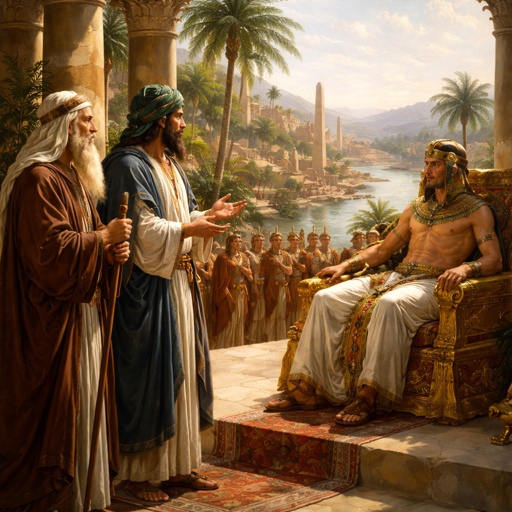
In the context of Exodus 5:1, draw an image of Moses and Aaron standing before a 30 year old Pharaoh and telling him to let the people of Israel go out of Egypt. Pharaoh is sitting on his throne in the open courtyard in Egypt with the Nile River in the background. Moses and Aaron are dressed in Hebrew attire, and Pharaoh is dressed in hid daily Egyptian attire. The time is mid morning.

Exodus 5:1-21 - "Exodus 5:1-21 Afterward Moses and Aaron went to Pharaoh and said, “This is what the Lord, the God of Israel, says: ‘Let my people go, so that they may hold a festival to me in the wilderness.’” Pharaoh said, “Who is the Lord, that I should obey him and let Israel go? I do not know the Lord and I will not let Israel go.” Then they said, “The God of the Hebrews has met with us. Now let us take a three-day journey into the wilderness to offer sacrifices to the Lord our God, or he may strike us with plagues or with the sword.” But the king of Egypt said, “Moses and Aaron, why are you taking the people away from their labor? Get back to your work!” Then Pharaoh said, “Look, the people of the land are now numerous, and you are stopping them from working.” That same day Pharaoh gave this order to the slave drivers and overseers in charge of the people: “You are no longer to supply the people with straw for making bricks; let them go and gather their own straw. But require them to make the same number of bricks as before; don’t reduce the quota. They are lazy; that is why they are crying out, ‘Let us go and sacrifice to our God.’ Make the work harder for the people so that they keep working and pay no attention to lies.” Then the slave drivers and the overseers went out and said to the people, “This is what Pharaoh says: ‘I will not give you any more straw. Go and get your own straw wherever you can find it, but your work will not be reduced at all.’” So the people scattered all over Egypt to gather stubble to use for straw. The slave drivers kept pressing them, saying, “Complete the work required of you for each day, just as when you had straw.” And Pharaoh’s slave drivers beat the Israelite overseers they had appointed, demanding, “Why haven’t you met your quota of bricks yesterday or today, as before?” Then the Israelite overseers went and appealed to Pharaoh: “Why have you treated your servants this way? Your servants are given no straw, yet we are told, ‘Make bricks!’ Your servants are being beaten, but the fault is with your own people.” Pharaoh said, “Lazy, that’s what you are—lazy! That is why you keep saying, ‘Let us go and sacrifice to the Lord.’ Now get to work. You will not be given any straw, yet you must produce your full quota of bricks.” The Israelite overseers realized they were in trouble when they were told, “You are not to reduce the number of bricks required of you for each day.” "
"And afterward Moses and Aaron went in, and told Pharaoh, Thus saith the LORD God of Israel, Let my people go, that they may hold a feast unto me in the wilderness." - Exodus 5:1
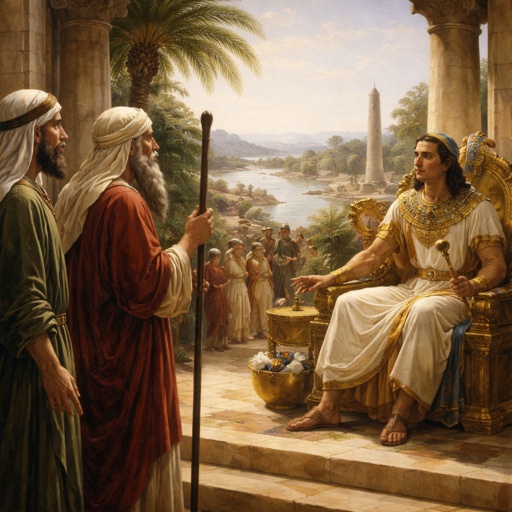
In the context of Exodus 5:1, draw an image of Moses and Aaron standing before a 30 year old Pharaoh and telling him to let the people of Israel go out of Egypt. Pharaoh is sitting on his throne in the open courtyard in Egypt with the Nile River in the background. Moses and Aaron are dressed in Hebrew attire, and Pharaoh is dressed in hid daily Egyptian attire. The time is mid morning. In order to make the narrower than it is high, the view will be looking past Moses and Aaron with Pharaoh's back to the river.
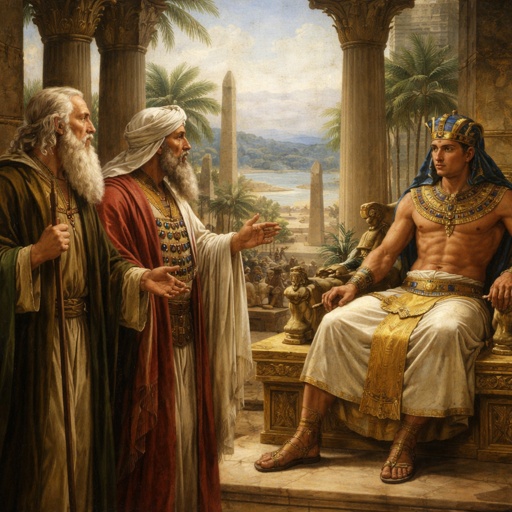
In the context of Exodus 5:1, draw an image of Moses and Aaron standing before a 30 year old Pharaoh and telling him to let the people of Israel go out of Egypt. Pharaoh is sitting on his throne in the open courtyard in Egypt with the Nile River in the background. Moses and Aaron are dressed in Hebrew attire, and Pharaoh is dressed in hid daily Egyptian attire. The time is mid morning. In order to make the narrower than it is high, the view will be looking past Moses and Aaron with Pharaoh's back to the river. Have Moses, Aaron and Pharaoh fill 2/3 of the images' width.
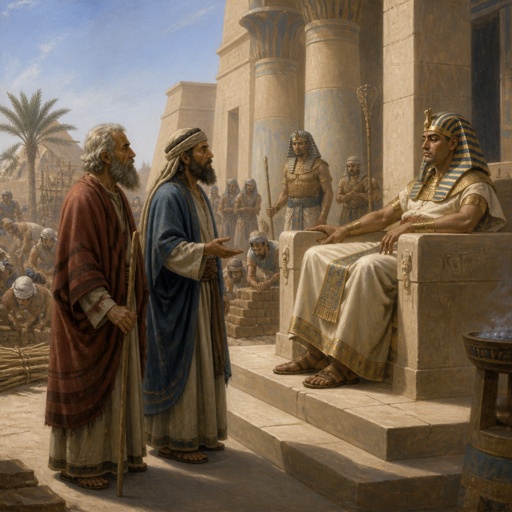
"Exodus 5:1-21 Afterward Moses and Aaron went to Pharaoh and said, “This is what the Lord, the God of Israel, says: ‘Let my people go, so that they may hold a festival to me in the wilderness.’” Pharaoh said, “Who is the Lord, that I should obey him and let Israel go? I do not know the Lord and I will not let Israel go.” Then they said, “The God of the Hebrews has met with us. Now let us take a three-day journey into the wilderness to offer sacrifices to the Lord our God, or he may strike us with plagues or with the sword.” But the king of Egypt said, “Moses and Aaron, why are you taking the people away from their labor? Get back to your work!” Then Pharaoh said, “Look, the people of the land are now numerous, and you are stopping them from working.” That same day Pharaoh gave this order to the slave drivers and overseers in charge of the people: “You are no longer to supply the people with straw for making bricks; let them go and gather their own straw. But require them to make the same number of bricks as before; don’t reduce the quota. They are lazy; that is why they are crying out, ‘Let us go and sacrifice to our God.’ Make the work harder for the people so that they keep working and pay no attention to lies.” Then the slave drivers and the overseers went out and said to the people, “This is what Pharaoh says: ‘I will not give you any more straw. Go and get your own straw wherever you can find it, but your work will not be reduced at all.’” So the people scattered all over Egypt to gather stubble to use for straw. The slave drivers kept pressing them, saying, “Complete the work required of you for each day, just as when you had straw.” And Pharaoh’s slave drivers beat the Israelite overseers they had appointed, demanding, “Why haven’t you met your quota of bricks yesterday or today, as before?” Then the Israelite overseers went and appealed to Pharaoh: “Why have you treated your servants this way? Your servants are given no straw, yet we are told, ‘Make bricks!’ Your servants are being beaten, but the fault is with your own people.” Pharaoh said, “Lazy, that’s what you are—lazy! That is why you keep saying, ‘Let us go and sacrifice to the Lord.’ Now get to work. You will not be given any straw, yet you must produce your full quota of bricks.” The Israelite overseers realized they were in trouble when they were told, “You are not to reduce the number of bricks required of you for each day.” " - Exodus 5:1-21

Exodus 4:1-5

Exodus 22:5

Exodus 22:5

Exodus 22:5

Exodus 1:5 - "And all the souls that came out of the loins of Jacob were seventy souls: for Joseph was in Egypt already."

Exodus 15:5

Exodus 5:5 - "And Pharaoh said, Behold, the people of the land now are many, and ye make them rest from their burdens."
"And all the souls that came out of the loins of Jacob were seventy souls: for Joseph was in Egypt already." - Exodus 1:5

Exodus 15:5 - "The depths have covered them: they sank into the bottom as a stone."

Exodus 34:5 - "And the LORD descended in the cloud, and stood with him there, and proclaimed the name of the LORD."

Exodus 37:5 - "And he put the staves into the rings by the sides of the ark, to bear the ark."

Exodus 28:5 - "And they shall take gold, and blue, and purple, and scarlet, and fine linen."

Exodus 25:5 - "And rams' skins dyed red, and badgers' skins, and shittim wood,"

Exodus 5:6 - "And Pharaoh commanded the same day the taskmasters of the people, and their officers, saying,"

Exodus 30:5 - "And thou shalt make the staves of shittim wood, and overlay them with gold."

Exodus 31:5 - "And in cutting of stones, to set them, and in carving of timber, to work in all manner of workmanship."

Exodus 38:5 - "And he cast four rings for the four ends of the grate of brass, to be places for the staves."

Exodus 5:20 - "¶ And they met Moses and Aaron, who stood in the way, as they came forth from Pharaoh:"

Exodus 9:5 - "And the LORD appointed a set time, saying, To morrow the LORD shall do this thing in the land."

Exodus 27:5 - "And thou shalt put it under the compass of the altar beneath, that the net may be even to the midst of the altar."

Exodus 5:13 - "And the taskmasters hasted them, saying, Fulfil your works, your daily tasks, as when there was straw."

Exodus 24;16

exodus 3