What does Exodus 3:2 mean?
"And the angel of the LORD appeared unto him in a flame of fire out of the midst of a bush: and he looked, and, behold, the bush burned with fire, and the bush was not consumed." - Exodus 3:2
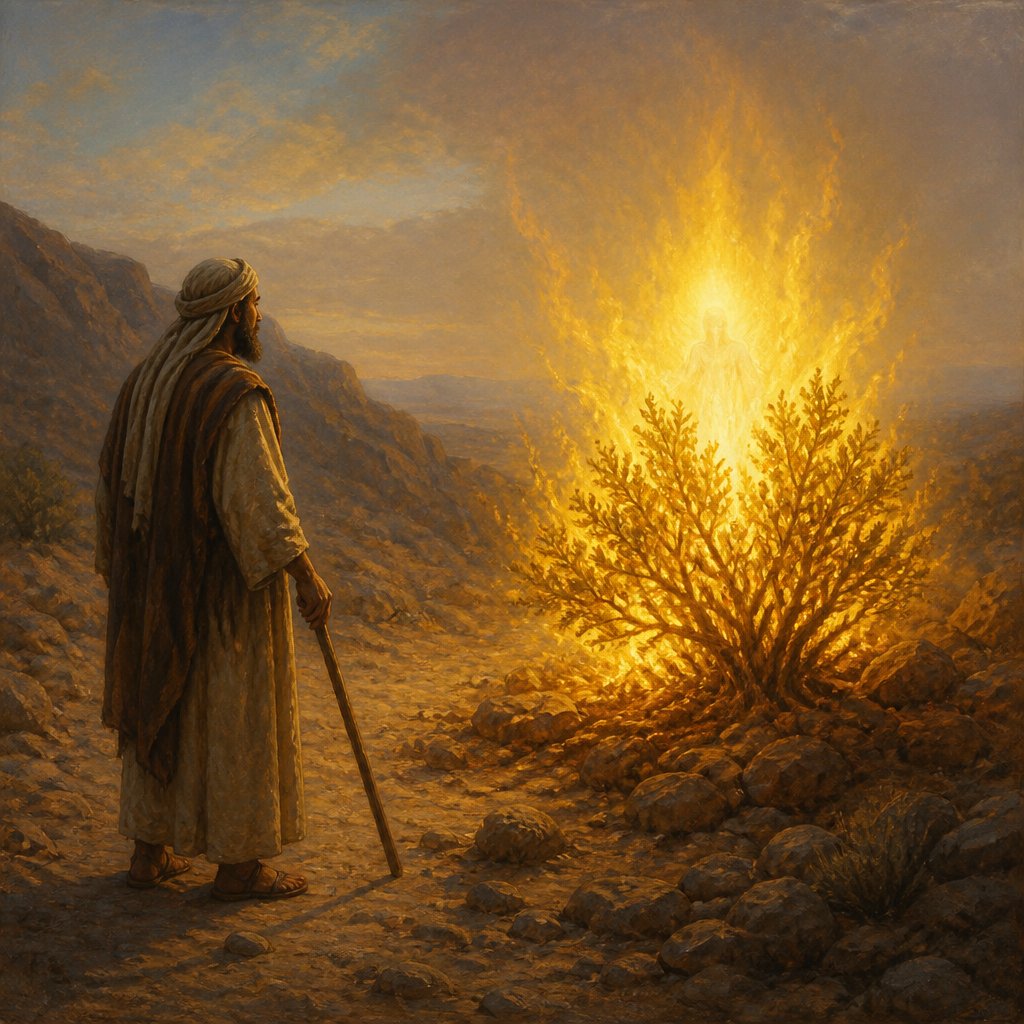
Exodus 3:2 in the KJV reads, “And the angel of the LORD appeared unto him in a flame of fire out of the midst of a bush: and he looked, and, behold, the bush burned with fire, and the bush was not consumed.” The verse stands at the threshold of Moses’ calling, and its meaning is inseparable from the moment in which it occurs. Moses is not in Egypt’s courts anymore but in the wilderness, keeping the flock of Jethro his father in law, on “the backside of the desert” near Horeb, “the mountain of God” (Exodus 3:1). The setting matters: Israel’s deliverance will not begin with human power or political strategy but with divine self-disclosure in a place that emphasizes barrenness, dependence, and God’s initiative. The wilderness is the stage where God forms leaders and reveals His will; Moses is being met where he is, in obscurity, and being drawn into the center of God’s redemptive purpose.
The first striking theme is that God reveals Himself by appearing, not merely by speaking at a distance. The verse says, “the angel of the LORD appeared unto him.” In the KJV, “the angel of the LORD” often signals a messenger who bears God’s own authority and presence in an unusually direct way. As the passage continues, the One who appears as “the angel of the LORD” is also the One who speaks as “the LORD” and identifies Himself as “the God of thy father, the God of Abraham, the God of Isaac, and the God of Jacob” (Exodus 3:4–6). This overlap in the narrative shows that Moses is not dealing with a mere created emissary delivering a detached message, but with a manifestation of the LORD’s presence that is both mediated and immediate: God condescends to be encountered, yet remains God, holy and unapproachable on human terms, as the later command to remove the shoes and recognize “holy ground” makes clear (Exodus 3:5).
The symbol chosen for that appearing is equally significant: “in a flame of fire out of the midst of a bush.” Fire in Scripture regularly signifies God’s presence in holiness, purity, and power. It illuminates, tests, purges, and judges; it also guides and protects. In Exodus, this same divine presence will later be associated with Israel’s guidance as “a pillar of fire” by night (Exodus 13:21). Here, at the outset, fire communicates that Moses is encountering not a gentle religious impression but the living God whose presence is active, awe-inspiring, and morally weighty. Yet the fire is not simply consuming; it is revealing. The flame is “out of the midst of a bush,” and that phrasing presses the reader to notice where God locates His presence. A bush is ordinary, low, unimpressive, easily overlooked, something that can be burned up quickly. God chooses what is small and common to become the site of His self-manifestation, which anticipates the pattern of Exodus itself: the LORD will exalt an enslaved people and confound imperial strength, showing that deliverance comes by His hand, not by natural advantage.
The central wonder of the verse is in the paradox Moses observes: “the bush burned with fire, and the bush was not consumed.” This detail is not decorative; it is the heart of the sign. In nature, fire devours its fuel. Here, the bush remains. The symbolism points in several directions at once, all bound together by the idea that God’s presence is sustaining rather than depleting when He purposes preservation. On one level, the sign hints at Israel’s condition. Israel in Egypt is afflicted, pressed, and “in the furnace of iron” as later language will suggest (compare Deuteronomy 4:20), yet not annihilated. Pharaoh’s oppression has not been able to consume them because God’s covenant purpose preserves them. The burning bush becomes a visual parable: there is real fire—real affliction, real pressure—yet there is also divine keeping that prevents consumption. The LORD is about to declare that He has seen their affliction and has come down to deliver them (Exodus 3:7–8), and the bush provides a living image of a people who can endure flames without being reduced to nothing because God is present to uphold what He intends to redeem.
On another level, the unconsumed bush emphasizes God’s self-sufficiency and sovereign freedom. The fire does not depend on the bush in the ordinary way; it is not a fire that needs fuel to keep existing. This subtly distinguishes the LORD from pagan conceptions in which a deity might be tied to a place, a shrine, or a material source. The LORD can manifest in created things without being contained by them and without being sustained by them. He can be “in the midst” without being limited. The sign teaches Moses that God’s power is not like human power, which burns resources until they are exhausted. God’s presence can dwell and yet not destroy; it can blaze and yet preserve. This becomes essential for Moses, who is being called to confront Pharaoh: the mission will require a power that does not run out, a holiness that does not compromise, and a presence that is not extinguished by resistance.
The verse also sets up the theme of holiness that governs the rest of the encounter. Fire suggests danger as well as beauty, and the coming instruction to keep distance and remove shoes is the ethical and spiritual implication of the sign. The bush is not consumed, but Moses is not invited to treat the event casually. The “angel of the LORD” appears; Moses “looked”; and the narrative soon shows that curiosity must give way to reverence. The unconsumed bush therefore holds together two truths that Exodus will repeatedly affirm: God is near enough to be known and to save, yet holy enough that His presence demands awe and obedience. The deliverance of Israel will be an act of grace, but it will also be a revelation of the LORD’s name, glory, and moral rule; He redeems a people to bring them into covenant life with Himself.
Finally, Exodus 3:2 functions as a hinge in Moses’ story. Moses is a man with a complicated past—raised in Pharaoh’s house, then exiled for violence, now a shepherd in Midian. The burning bush is a summons that reorients his identity. The sign is not only about Israel; it is also about the kind of calling Moses is receiving. Like the bush, Moses is ordinary in his present station and, in his own estimation, inadequate. Yet God’s presence can inhabit what is humble and make it the instrument of deliverance without consuming it. The flame does not destroy the bush; rather, it marks it as the place where God is speaking. In the same way, Moses will not be consumed by the task because the LORD will be with him (Exodus 3:12). The verse therefore announces, in picture form, the reality that will carry the entire Exodus narrative: God’s holy presence enters the low places of the world, confronts oppression, preserves His people in the fire, and calls a servant through whom His covenant purpose advances.
Have questions about Exodus 3:2?
Dive deeper into this scripture with Bible Chat — an AI-powered tool for exploring God's Word through conversation. Ask questions, get context, and grow in your understanding of the Bible.
Get Our Apps


Exodus 3:2 Artwork

Exodus 3:2 – "There the angel of the Lord appeared to him in flames of fire from within a bush."
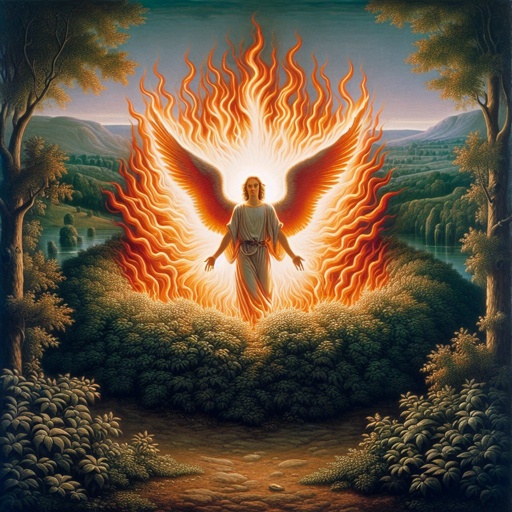
Exodus 3:2 – "There the angel of the Lord appeared to him in flames of fire from within a bush."

Exodus 3:2 - "And the angel of the LORD appeared unto him in a flame of fire out of the midst of a bush: and he looked, and, behold, the bush burned with fire, and the bush was not consumed."
!["And the angel of the LORD appeared unto him in a flame of fire out of the midst of a bush: and he looked, and, behold, the bush burned with fire, and the bush [was] not consumed." - Exodus 3:2](https://media.bible.art/081b36bd-e377-4c22-8da1-9347901f3fe9-thumbnail.jpg)
"And the angel of the LORD appeared unto him in a flame of fire out of the midst of a bush: and he looked, and, behold, the bush burned with fire, and the bush [was] not consumed." - Exodus 3:2
"And the angel of the LORD appeared unto him in a flame of fire out of the midst of a bush: and he looked, and, behold, the bush burned with fire, and the bush was not consumed." - Exodus 3:2
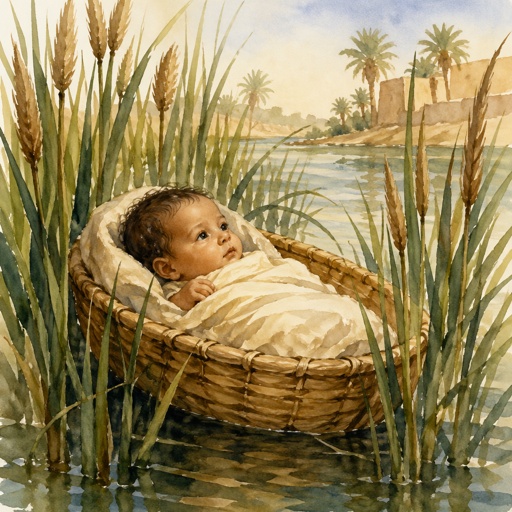
Exodus 2:3 baby Moses in bulrushes

exodus 3

Exodus 2:3 - "And when she could not longer hide him, she took for him an ark of bulrushes, and daubed it with slime and with pitch, and put the child therein; and she laid it in the flags by the river's brink."

Exodus 3:12

Exodus 3:12

Exodus 17:3

Exodus 3:12

Exodus 3:12

Exodus 3:12
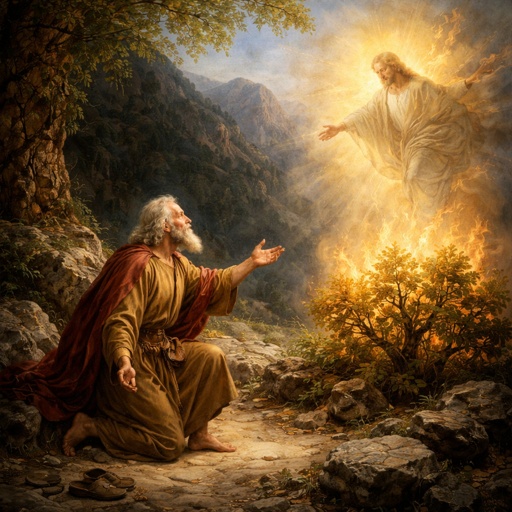
exodus 3:11

Exodus 3:14

Exodus 3:14

Exodus 3:14

exodus 3:14

Exodus 3:14

Exodus 17:3

Exodus 3:12

Exodus 3:12

Exodus 1:3 - "Issachar, Zebulun, and Benjamin,"

exodus 27:3 forks

Exodus 3:3 - "And Moses said, I will now turn aside, and see this great sight, why the bush is not burnt."

Exodus 15:3 - "The LORD is a man of war: the LORD is his name."

Exodus 20:3 - "Thou shalt have no other gods before me."
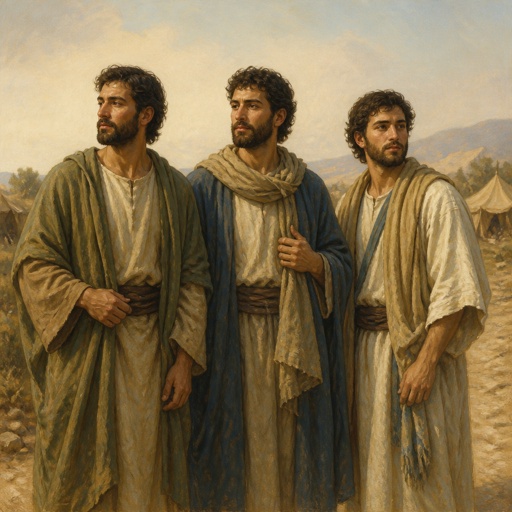
"Issachar, Zebulun, and Benjamin," - Exodus 1:3

Exodus 23:3 - "¶ Neither shalt thou countenance a poor man in his cause."