What does Esther 2:5 mean?
"¶ Now in Shushan the palace there was a certain Jew, whose name was Mordecai, the son of Jair, the son of Shimei, the son of Kish, a Benjamite;" - Esther 2:5
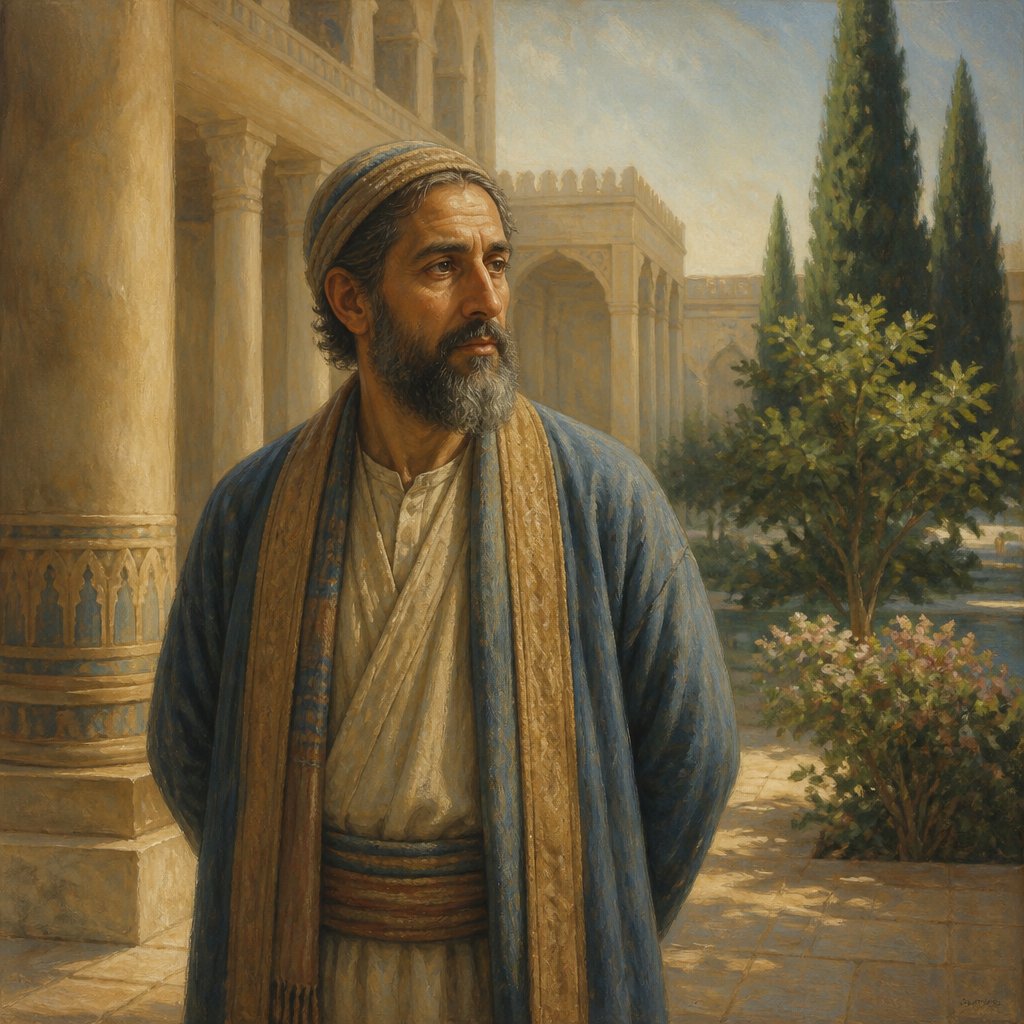
Esther 2:5 in the King James Version of the Bible states, "Now in Shushan the palace there was a certain Jew, whose name was Mordecai, the son of Jair, the son of Shimei, the son of Kish, a Benjamite." This verse appears in the book of Esther, which tells the story of a Jewish girl named Esther who becomes the queen of Persia and uses her position to save the Jewish people from destruction.
The verse introduces Mordecai, a key figure in the book of Esther. It provides us with his genealogy, tracing his lineage back to Kish, a Benjamite. This genealogy serves as a way to establish Mordecai's identity and heritage, affirming his Jewish ancestry and connection to the tribe of Benjamin. It also sets the stage for the events that will unfold in the book of Esther, as Mordecai's role as Esther's cousin and protector becomes crucial to the plot.
The book of Esther is set during the Persian exile, a period in Jewish history when the Jewish people were living as a minority in a foreign land. The mention of Mordecai's Jewish heritage in this verse serves as a reminder of the Jewish identity and faith of the characters in the story. It also emphasizes the importance of preserving their heritage and traditions in a foreign environment.
The genealogy of Mordecai also holds symbolic significance within the context of the book of Esther. In the Bible, genealogies are often used to establish a person's lineage and connection to the covenant God made with the people of Israel. Mordecai's genealogy not only affirms his Jewish identity but also aligns him with the history and promises of God's people. This connection serves to highlight the providential role that Mordecai will play in the salvation of the Jewish people, as well as Esther's role as their deliverer.
Furthermore, the mention of Mordecai as a Benjamite is significant in light of the historical context of the book of Esther. The tribe of Benjamin had a tumultuous history in the Old Testament, including a near extinction following a civil war with the other tribes of Israel (Judges 19-21). The survival and prominence of a Benjamite like Mordecai in the story of Esther can be seen as a symbol of hope and restoration. It underscores the theme of God's faithfulness to His people, even in times of struggle and exile.
In addition, the genealogy of Mordecai connects him to the lineage of Kish, a Benjamite. This might also allude to the fact that Mordecai, like his ancestor Kish, will play a significant role in the salvation of his people. Kish was the father of King Saul, the first king of Israel, and his inclusion in Mordecai's genealogy might foreshadow Mordecai's eventual rise to power and influence within the Persian court.
In conclusion, Esther 2:5 provides important contextual and symbolic significance within the larger narrative of the book of Esther. It serves to establish Mordecai's identity and heritage, emphasizing his Jewish faith and heritage in the midst of a foreign land. The verse also holds broader thematic and symbolic significance, highlighting the providential role of Mordecai and the faithfulness of God to His people, as well as alluding to themes of restoration and hope.
Have questions about Esther 2:5?
Dive deeper into this scripture with Bible Chat — an AI-powered tool for exploring God's Word through conversation. Ask questions, get context, and grow in your understanding of the Bible.
Get Our Apps


Esther 2:5 Artwork

Esther 2:5 - "¶ Now in Shushan the palace there was a certain Jew, whose name was Mordecai, the son of Jair, the son of Shimei, the son of Kish, a Benjamite;"
"¶ Now in Shushan the palace there was a certain Jew, whose name was Mordecai, the son of Jair, the son of Shimei, the son of Kish, a Benjamite;" - Esther 2:5

Esther 5:2

Esther 5:2

Esther 5:2

Esther 5:2 - "And it was so, when the king saw Esther the queen standing in the court, that she obtained favour in his sight: and the king held out to Esther the golden sceptre that was in his hand. So Esther drew near, and touched the top of the sceptre."

Esther 5:2 - "And it was so, when the king saw Esther the queen standing in the court, that she obtained favour in his sight: and the king held out to Esther the golden sceptre that was in his hand. So Esther drew near, and touched the top of the sceptre."

Esther 5:5 - "Then the king said, Cause Haman to make haste, that he may do as Esther hath said. So the king and Haman came to the banquet that Esther had prepared."

Esther 5:7 - "Then answered Esther, and said, My petition and my request is;"

Esther 2:22 - "And the thing was known to Mordecai, who told it unto Esther the queen; and Esther certified the king thereof in Mordecai's name."
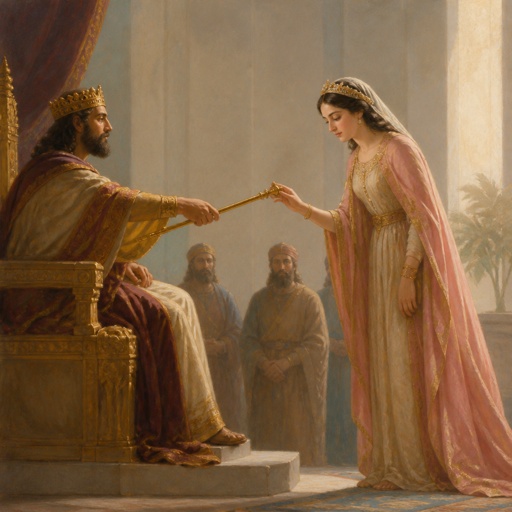
"And it was so, when the king saw Esther the queen standing in the court, that she obtained favour in his sight: and the king held out to Esther the golden sceptre that was in his hand. So Esther drew near, and touched the top of the sceptre." - Esther 5:2
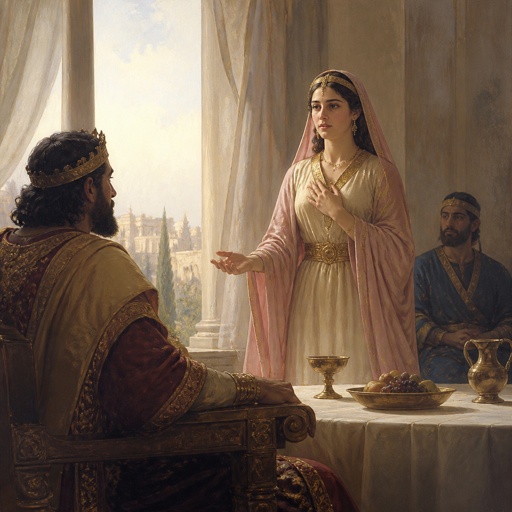
"Then answered Esther, and said, My petition and my request is;" - Esther 5:7

Esther 5:4 - "And Esther answered, If it seem good unto the king, let the king and Haman come this day unto the banquet that I have prepared for him."

Esther 7:5 - "¶ Then the king Ahasuerus answered and said unto Esther the queen, Who is he, and where is he, that durst presume in his heart to do so?"

Esther 5:3 - "Then said the king unto her, What wilt thou, queen Esther? and what is thy request? it shall be even given thee to the half of the kingdom."
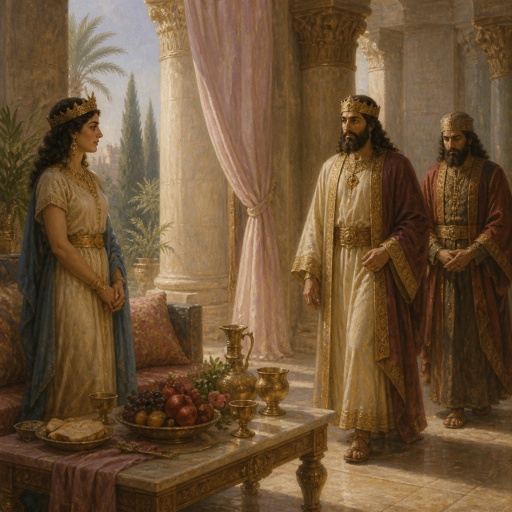
"Then the king said, Cause Haman to make haste, that he may do as Esther hath said. So the king and Haman came to the banquet that Esther had prepared." - Esther 5:5

Esther 4:5 - "Then called Esther for Hatach, one of the king's chamberlains, whom he had appointed to attend upon her, and gave him a commandment to Mordecai, to know what it was, and why it was."

Esther 5:6 - "¶ And the king said unto Esther at the banquet of wine, What is thy petition? and it shall be granted thee: and what is thy request? even to the half of the kingdom it shall be performed."

Esther 2:20 - "Esther had not yet shewed her kindred nor her people; as Mordecai had charged her: for Esther did the commandment of Mordecai, like as when she was brought up with him."

Esther 7:2 - "And the king said again unto Esther on the second day at the banquet of wine, What is thy petition, queen Esther? and it shall be granted thee: and what is thy request? and it shall be performed, even to the half of the kingdom."

Esther 2:11 - "And Mordecai walked every day before the court of the women's house, to know how Esther did, and what should become of her."

Esther 2:10 - "Esther had not shewed her people nor her kindred: for Mordecai had charged her that she should not shew it."

Esther 5:12 - "Haman said moreover, Yea, Esther the queen did let no man come in with the king unto the banquet that she had prepared but myself; and to morrow am I invited unto her also with the king."

"And the thing was known to Mordecai, who told it unto Esther the queen; and Esther certified the king thereof in Mordecai's name." - Esther 2:22

Esther 2:16 - "So Esther was taken unto king Ahasuerus into his house royal in the tenth month, which is the month Tebeth, in the seventh year of his reign."

Esther 8:2 - "And the king took off his ring, which he had taken from Haman, and gave it unto Mordecai. And Esther set Mordecai over the house of Haman."

Esther 3:5 - "And when Haman saw that Mordecai bowed not, nor did him reverence, then was Haman full of wrath."

Esther 5:1 - "Now it came to pass on the third day, that Esther put on her royal apparel, and stood in the inner court of the king's house, over against the king's house: and the king sat upon his royal throne in the royal house, over against the gate of the house."
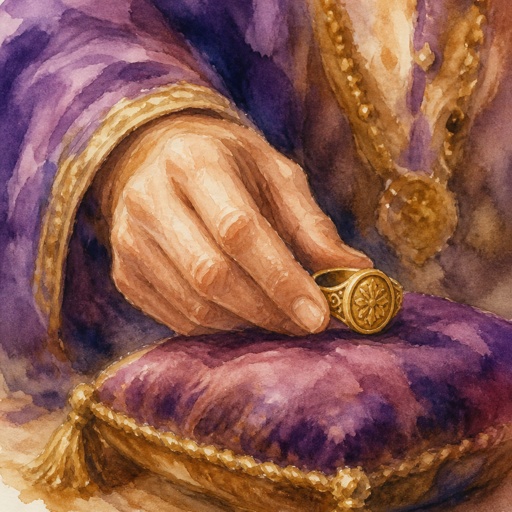
Esther 8:2 focus on the ring

Esther 2:15 - "¶ Now when the turn of Esther, the daughter of Abihail the uncle of Mordecai, who had taken her for his daughter, was come to go in unto the king, she required nothing but what Hegai the king's chamberlain, the keeper of the women, appointed. And Esther obtained favour in the sight of all them that looked upon her."