What does Ecclesiastes 3:4 mean?
"A time to weep, and a time to laugh; a time to mourn, and a time to dance;" - Ecclesiastes 3:4
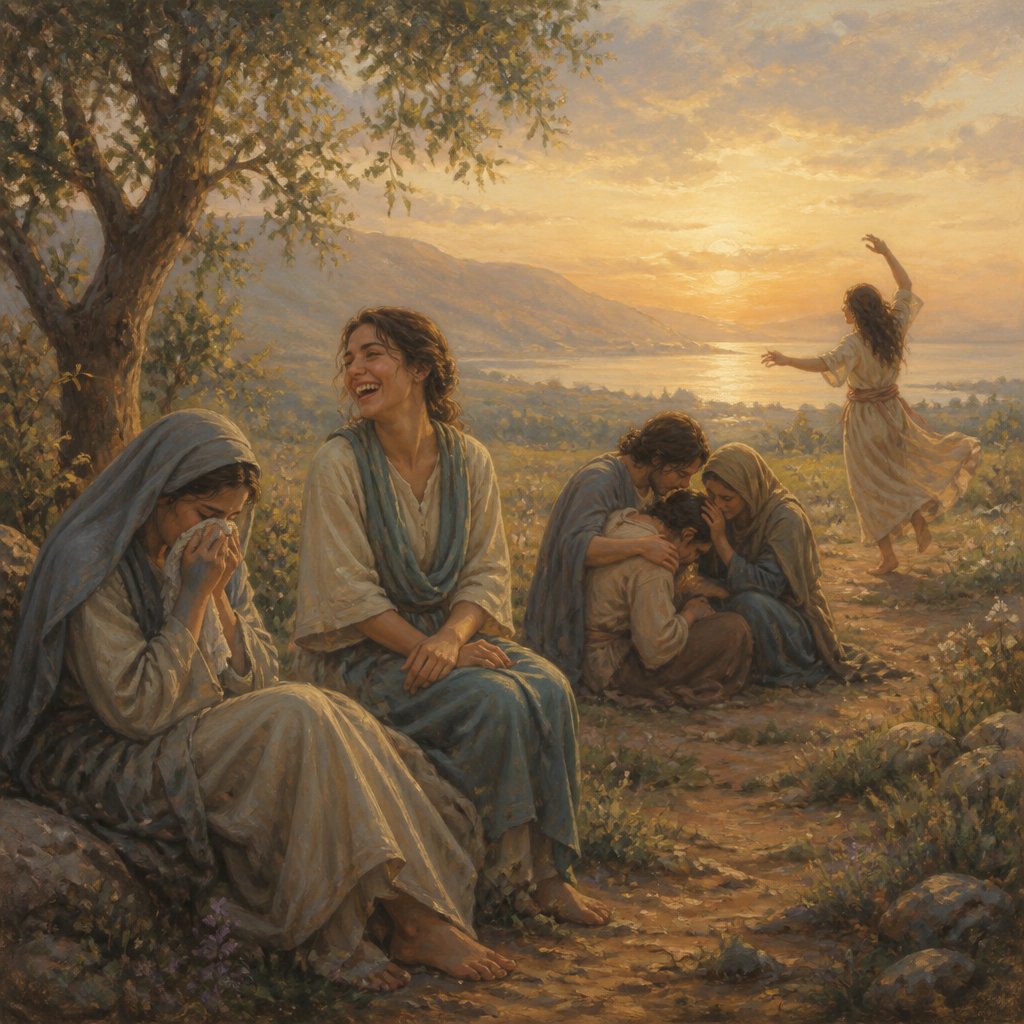
Ecclesiastes 3:4 from the King James Version (KJV) of the Bible reads, "A time to weep, and a time to laugh; a time to mourn, and a time to dance."
This verse is part of a larger passage in the book of Ecclesiastes, which is attributed to King Solomon. The book is a reflection on the meaning of life, the pursuit of wisdom, and the inevitability of death. The passage commonly known as "A Time for Everything" presents a series of dualistic contrasts, suggesting that life is marked by seasons and transitions, both of which are beyond human control. The verse in question specifically addresses the realities of human emotion, casting them as part of the natural ebb and flow of existence.
At its core, Ecclesiastes 3:4 acknowledges the complex and often paradoxical nature of human experience. It reminds readers that life encompasses both joy and sorrow, and that each has its role to play in the larger tapestry of existence. To fully understand the meaning and significance of this verse, it is important to unpack its themes, context, and symbolism.
The overall theme of Ecclesiastes 3:4 can be understood as the dual nature of human emotions. It suggests that weeping and mourning are as essential to the human experience as laughter and dancing. The verse serves as a reminder that life is marked by a wide range of emotions, each of which serves its own purpose. By acknowledging the oscillation between sorrow and joy, the verse asks readers to embrace the full spectrum of human experience.
In its broader context, Ecclesiastes 3:4 is part of a larger passage that outlines the cyclical nature of life. The preceding verses emphasize the inevitability of change and the idea that every season has its appointed time. The verse that follows Ecclesiastes 3:4 continues this reflection on life's cycles, further reinforcing the notion that human emotions, like all things in life, are subject to these natural rhythms.
One of the key symbols in Ecclesiastes 3:4 is the idea of dance. In this context, dance serves as a symbol of celebration and joy. By juxtaposing it with weeping and mourning, the verse highlights the stark contrast between emotions and experiences. The use of symbolism in this verse serves to underscore the dichotomous nature of human existence, encouraging readers to embrace both the light and dark aspects of life.
Furthermore, Ecclesiastes 3:4 can be seen as a reflection on the human condition. It acknowledges the reality of suffering and loss, while also celebrating moments of joy and mirth. In doing so, it offers a profound meditation on the complexities of the human experience, providing readers with a template for navigating life's inevitable highs and lows.
In conclusion, Ecclesiastes 3:4 from the King James Version of the Bible offers a poignant reflection on the dualistic nature of human emotions. It invites readers to embrace the full spectrum of human experience, recognizing that both joy and sorrow are integral parts of life. Through its themes, context, and symbolism, the verse serves as a timeless reminder of the cyclical nature of existence and the importance of accepting life's inevitable changes.
Have questions about Ecclesiastes 3:4?
Dive deeper into this scripture with Bible Chat — an AI-powered tool for exploring God's Word through conversation. Ask questions, get context, and grow in your understanding of the Bible.
Get Our Apps


Ecclesiastes 3:4 Artwork

Ecclesiastes 3:4 - "A time to weep, and a time to laugh; a time to mourn, and a time to dance;"

"A time to weep, and a time to laugh; a time to mourn, and a time to dance;" - Ecclesiastes 3:4

Ecclesiastes 4:3 - "Yea, better is he than both they, which hath not yet been, who hath not seen the evil work that is done under the sun."

Ecclesiastes 3:1

Ecclesiastes 3:3 - "A time to kill, and a time to heal; a time to break down, and a time to build up;"

Ecclesiastes 3:7-8

Ecclesiastes 3:1 – "There is a time for everything, and a season for every activity under the heavens."

Ecclesiastes 4:7 - "Then I returned, and I saw vanity under the sun."

Ecclesiastes 3:9 - "What profit hath he that worketh in that wherein he laboureth?"

Ecclesiastes 3:1 - "To every thing there is a season, and a time to every purpose under the heaven:"

Ecclesiastes 3:8 - "A time to love, and a time to hate; a time of war, and a time of peace."

Ecclesiastes 4:4 - "¶ Again, I considered all travail, and every right work, that for this a man is envied of his neighbour. This is also vanity and vexation of spirit."

Ecclesiastes 3:6 - "A time to get, and a time to lose; a time to keep, and a time to cast away;"

Ecclesiastes 7:3 - "Sorrow is better than laughter: for by the sadness of the countenance the heart is made better."

Ecclesiastes 7:4 - "The heart of the wise is in the house of mourning; but the heart of fools is in the house of mirth."

Ecclesiastes 4:5 - "The fool foldeth his hands together, and eateth his own flesh."

Ecclesiastes 4:9 - "¶ Two are better than one; because they have a good reward for their labour."

Ecclesiastes 6:4 - "For he cometh in with vanity, and departeth in darkness, and his name shall be covered with darkness."

Ecclesiastes 1:4 - "One generation passeth away, and another generation cometh: but the earth abideth for ever."

Ecclesiastes 3:7 - "A time to rend, and a time to sew; a time to keep silence, and a time to speak;"

Ecclesiastes 3:1-4 - "To everything there is a season, and a time to every purpose under the heaven: A time to be born, and a time to die; a time to plant, and a time to pluck up that which is planted; A time to kill, and a time to heal; a time to break down, and a time to build up; A time to weep, and a time to laugh; a time to mourn, and a time to dance."

Ecclesiastes 3:21 - "Who knoweth the spirit of man that goeth upward, and the spirit of the beast that goeth downward to the earth?"

Ecclesiastes 3:2 - "A time to be born, and a time to die; a time to plant, and a time to pluck up that which is planted;"

Ecclesiastes 3:16 - "¶ And moreover I saw under the sun the place of judgment, that wickedness was there; and the place of righteousness, that iniquity was there."

Ecclesiastes 3:20 - "All go unto one place; all are of the dust, and all turn to dust again."

Ecclesiastes 4:6 - "Better is an handful with quietness, than both the hands full with travail and vexation of spirit."

Ecclesiastes 11:4 - "He that observeth the wind shall not sow; and he that regardeth the clouds shall not reap."

Ecclesiastes 9:4 - "¶ For to him that is joined to all the living there is hope: for a living dog is better than a dead lion."

Ecclesiastes 3:12 - "I know that there is no good in them, but for a man to rejoice, and to do good in his life."

Ecclesiastes 5:3 - "For a dream cometh through the multitude of business; and a fool's voice is known by multitude of words."