What does Ecclesiastes 10:8 mean?
"He that diggeth a pit shall fall into it; and whoso breaketh an hedge, a serpent shall bite him." - Ecclesiastes 10:8
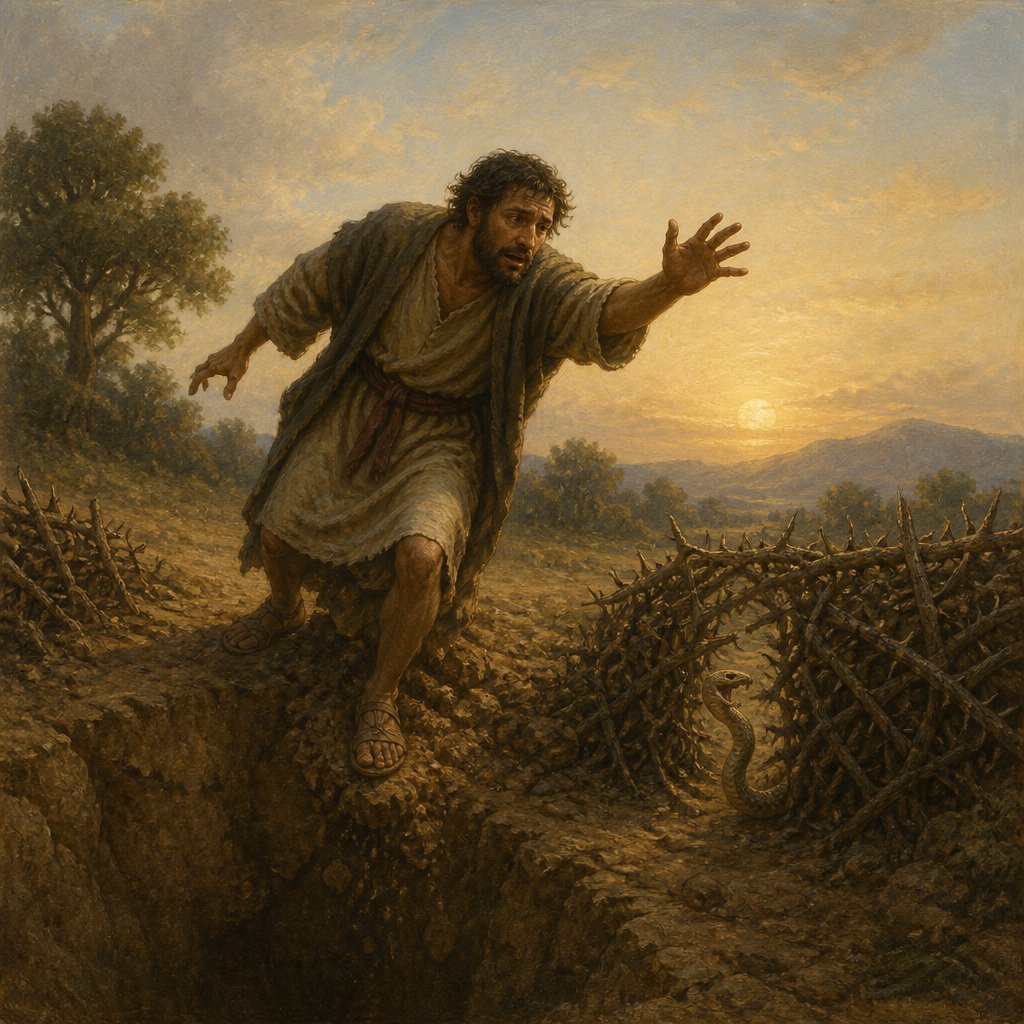
Ecclesiastes 10:8 in the King James Version of the Bible reads:
"He that diggeth a pit shall fall into it; and whoso breaketh an hedge, a serpent shall bite him."
This verse is found within the Book of Ecclesiastes, one of the Wisdom books of the Bible attributed to King Solomon. The Book of Ecclesiastes is known for its philosophical and reflective tone, as it explores the meaning and purpose of life, as well as the human experience. Within this context, Ecclesiastes 10:8 serves as a warning about the consequences of one's actions and the principle of retribution.
The verse begins with "He that diggeth a pit shall fall into it," which can be interpreted as a metaphor for the idea that one's actions can ultimately backfire and result in harm to oneself. This can be understood in both a literal and metaphorical sense. In a literal sense, if one were to dig a pit for the purpose of capturing an animal, they run the risk of falling into the pit themselves. Metaphorically, this can be applied to any situation where one engages in deceit or harmful behaviors, as these actions can ultimately result in negative consequences for the individual who initiated them.
The second part of the verse, "and whoso breaketh an hedge, a serpent shall bite him," reinforces the idea of retribution. The act of breaking a hedge or barrier could lead to encountering danger, such as a serpent. This can be understood as a warning against interfering with boundaries or structures that are meant to provide protection or delineate safety. It highlights the principle that one's actions have consequences, and that disregard for such boundaries can lead to harm or danger.
The overall message of this verse is to caution against engaging in actions that are deceitful or harmful, as these actions can ultimately result in harm to oneself. It serves as a reminder of the importance of considering the potential consequences of one's actions and behaving with integrity and respect for boundaries.
In a broader thematic context, Ecclesiastes 10:8 aligns with the book's exploration of wisdom, folly, and the search for meaning in life. It emphasizes the importance of making wise choices and living with an understanding of the potential outcomes of one's actions. It also speaks to the idea of accountability and justice, suggesting that one's behavior has a direct impact on their own well-being and the well-being of others.
The verse can also be seen as a reflection of the broader biblical theme of reaping what one sows. This principle is expressed throughout the Bible, such as in Galatians 6:7, which states "Do not be deceived: God cannot be mocked. A man reaps what he sows." Ecclesiastes 10:8 underscores the idea that one's actions have consequences and that accountability is an intrinsic part of the human experience.
In terms of symbolism, the imagery of digging a pit and breaking a hedge can be seen as representing actions that disrupt order and safety. The pit and the hedge can be interpreted as symbols of protection and security, and the act of undermining or breaking them represents the violation of these boundaries. The serpent biting in response to this disruption serves as a symbol of the consequential harm that can result from such actions.
Overall, Ecclesiastes 10:8 delivers a powerful message about the importance of mindful and conscientious behavior. It emphasizes the interconnectedness of actions and consequences and serves as a reminder to approach life with wisdom and integrity. Through its imagery and warnings, this verse contributes to the broader themes of wisdom, accountability, and justice within the Book of Ecclesiastes.
Have questions about Ecclesiastes 10:8?
Dive deeper into this scripture with Bible Chat — an AI-powered tool for exploring God's Word through conversation. Ask questions, get context, and grow in your understanding of the Bible.
Get Our Apps


Ecclesiastes 10:8 Artwork

Ecclesiastes 10:8 - "He that diggeth a pit shall fall into it; and whoso breaketh an hedge, a serpent shall bite him."
"He that diggeth a pit shall fall into it; and whoso breaketh an hedge, a serpent shall bite him." - Ecclesiastes 10:8

Ecclesiastes 8:10 - "And so I saw the wicked buried, who had come and gone from the place of the holy, and they were forgotten in the city where they had so done: this is also vanity."

ecclesiastes 12:1-8

ecclesiastes 12:1-8

ecclesiastes 12:1-8

ecclesiastes 12:1-8

Ecclesiastes 3:7-8

ecclesiastes 12:1-8

Ecclesiastes 12:8 - "¶ Vanity of vanities, saith the preacher; all is vanity."

Ecclesiastes 10:10 - "If the iron be blunt, and he do not whet the edge, then must he put to more strength: but wisdom is profitable to direct."

Ecclesiastes 3:8 - "A time to love, and a time to hate; a time of war, and a time of peace."

Ecclesiastes 10:6 - "Folly is set in great dignity, and the rich sit in low place."

Ecclesiastes 10:11 - "Surely the serpent will bite without enchantment; and a babbler is no better."

Ecclesiastes 8:2 - "I counsel thee to keep the king's commandment, and that in regard of the oath of God."

Ecclesiastes 8:7 - "For he knoweth not that which shall be: for who can tell him when it shall be?"

Ecclesiastes 10:18 - "¶ By much slothfulness the building decayeth; and through idleness of the hands the house droppeth through."

Ecclesiastes 10:19 - "¶ A feast is made for laughter, and wine maketh merry: but money answereth all things."

Ecclesiastes 8:6 - "¶ Because to every purpose there is time and judgment, therefore the misery of man is great upon him."

Ecclesiastes 10:12 - "The words of a wise man's mouth are gracious; but the lips of a fool will swallow up himself."

Ecclesiastes 10:13 - "The beginning of the words of his mouth is foolishness: and the end of his talk is mischievous madness."

Ecclesiastes 10:2 - "A wise man's heart is at his right hand; but a fool's heart at his left."

Ecclesiastes 9:8 - "Let thy garments be always white; and let thy head lack no ointment."

Ecclesiastes 8:4 - "Where the word of a king is, there is power: and who may say unto him, What doest thou?"

Ecclesiastes 7:8 - "Better is the end of a thing than the beginning thereof: and the patient in spirit is better than the proud in spirit."

Ecclesiastes 10:5 - "There is an evil which I have seen under the sun, as an error which proceedeth from the ruler:"

Ecclesiastes 12:10 - "The preacher sought to find out acceptable words: and that which was written was upright, even words of truth."

Ecclesiastes 10:15 - "The labour of the foolish wearieth every one of them, because he knoweth not how to go to the city."

Ecclesiastes 10:7 - "I have seen servants upon horses, and princes walking as servants upon the earth."

Ecclesiastes 3:10 - "I have seen the travail, which God hath given to the sons of men to be exercised in it."