What does Deuteronomy 32:50 mean?
"And die in the mount whither thou goest up, and be gathered unto thy people; as Aaron thy brother died in mount Hor, and was gathered unto his people:" - Deuteronomy 32:50
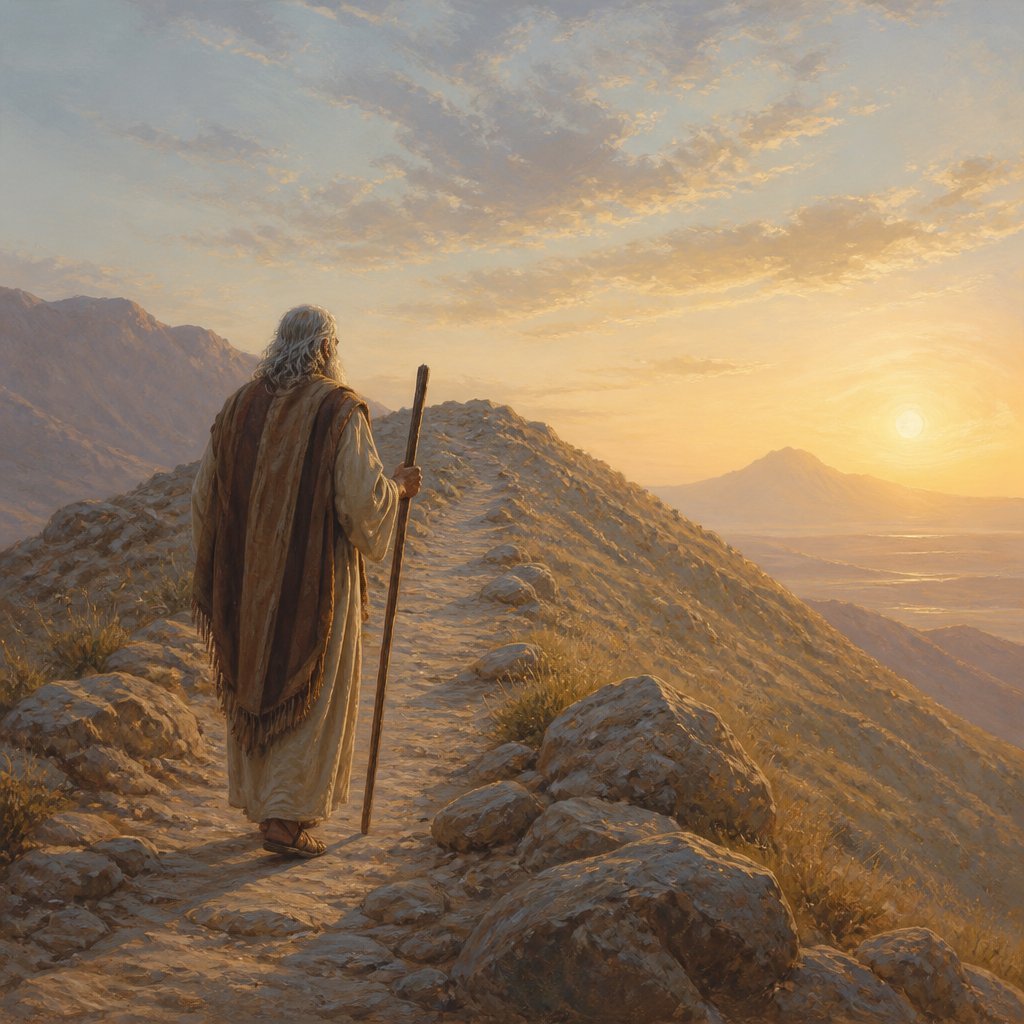
Deuteronomy 32:50 from the King James Version reads: "And die in the mount whither thou goest up, and be gathered unto thy people; as Aaron thy brother died in mount Hor, and was gathered unto his people:"
The book of Deuteronomy is part of the Pentateuch, the first five books of the Bible traditionally ascribed to Moses. It is the fifth book of the Hebrew Bible and of the Old Testament. Deuteronomy is primarily a book of laws and regulations, but it also contains historical and moral exhortations. The verse comes at the end of Moses' life, as he is preparing to pass leadership of the Israelites to Joshua and to be gathered unto his people.
The verse is a reminder of mortality, particularly for Moses, who is being told that he will not enter the Promised Land and will die before reaching it. The theme of death in this verse is significant not only for Moses, but also for the Israelites, who would be mourning the loss of their leader and guide. This verse serves to foreshadow Moses' death, as well as to reinforce the idea of mortality, which is a central theme in the book of Deuteronomy.
The mention of Aaron's death on mount Hor serves as a parallel and a reminder of the mortality of all human beings. This also alludes to the fact that no matter how significant a person is in their community, death is inevitable and is the great equalizer of all human beings. The symbolism of Aaron's death serves to remind the Israelites that just as Aaron died and was gathered unto his people, so will Moses. This is a powerful lesson in the impermanence of life and the importance of passing on wisdom and leadership to the next generation.
The concept of being "gathered unto thy people" carries deep significance in the context of the Israelites' beliefs. It refers to the idea that after death, individuals will be reunited with their ancestors and will join them in the afterlife. This belief in an afterlife is a central tenet of many religious traditions, including Judaism, and it serves as a source of comfort and hope for the Israelites in the face of mortality.
The verse also carries a message of continuity and the passing of the torch from one generation to the next. Moses is being told to die on the mount where he will be gathered unto his people, just as Aaron died and was gathered unto his people. This serves as a reminder that the leadership of the Israelites will continue after Moses, and that the community will endure even in the face of death and loss. This message of continuity is a key theme in Deuteronomy, as Moses imparts wisdom and guidance to the Israelites in preparation for their entry into the Promised Land.
In conclusion, Deuteronomy 32:50 is a poignant reminder of the inevitability of death and the continuity of life. It serves as a message of hope and comfort for the Israelites, as they prepare to move forward without Moses. The verse carries deep symbolism and significance, and it reinforces the central themes of mortality, continuity, and faith in the face of adversity.
Have questions about Deuteronomy 32:50?
Dive deeper into this scripture with Bible Chat — an AI-powered tool for exploring God's Word through conversation. Ask questions, get context, and grow in your understanding of the Bible.
Get Our Apps


Deuteronomy 32:50 Artwork

Deuteronomy 32:50 - "And die in the mount whither thou goest up, and be gathered unto thy people; as Aaron thy brother died in mount Hor, and was gathered unto his people:"
"And die in the mount whither thou goest up, and be gathered unto thy people; as Aaron thy brother died in mount Hor, and was gathered unto his people:" - Deuteronomy 32:50

Deuteronomy 28:50 - "A nation of fierce countenance, which shall not regard the person of the old, nor shew favour to the young:"

Deuteronomy 32:42

Deuteronomy 32:41

Deuteronomy 32:43

Deuteronomy 32:43

Deuteronomy 32:32 - "For their vine is of the vine of Sodom, and of the fields of Gomorrah: their grapes are grapes of gall, their clusters are bitter:"

Jeremiah 50:32 - "And the most proud shall stumble and fall, and none shall raise him up: and I will kindle a fire in his cities, and it shall devour all round about him."

Deuteronomy 32:33 - "Their wine is the poison of dragons, and the cruel venom of asps."

Deuteronomy 32:48 - "And the LORD spake unto Moses that selfsame day, saying,"

Deuteronomy 32:28 - "For they are a nation void of counsel, neither is there any understanding in them."

Deuteronomy 32:9 - "For the LORD'S portion is his people; Jacob is the lot of his inheritance."

Deuteronomy 32:45 - "And Moses made an end of speaking all these words to all Israel:"

Deuteronomy 1:32 - "Yet in this thing ye did not believe the LORD your God,"

Deuteronomy 32:37 - "And he shall say, Where are their gods, their rock in whom they trusted,"

Deuteronomy 32:29 - "O that they were wise, that they understood this, that they would consider their latter end!"

Deuteronomy 32:31 - "For their rock is not as our Rock, even our enemies themselves being judges."

Deuteronomy 32:12 - "So the LORD alone did lead him, and there was no strange god with him."

Deuteronomy 32:34 - "Is not this laid up in store with me, and sealed up among my treasures?"

Deuteronomy 32:16 - "They provoked him to jealousy with strange gods, with abominations provoked they him to anger."

Deuteronomy 32:5 - "They have corrupted themselves, their spot is not the spot of his children: they are a perverse and crooked generation."

Deuteronomy 32:40 - "For I lift up my hand to heaven, and say, I live for ever."

"For their vine is of the vine of Sodom, and of the fields of Gomorrah: their grapes are grapes of gall, their clusters are bitter:" - Deuteronomy 32:32

Deuteronomy 32:18 - "Of the Rock that begat thee thou art unmindful, and hast forgotten God that formed thee."

Deuteronomy 32:3 - "Because I will publish the name of the LORD: ascribe ye greatness unto our God."

Deuteronomy 32:23 - "I will heap mischiefs upon them; I will spend mine arrows upon them."

Deuteronomy 2:32 - "Then Sihon came out against us, he and all his people, to fight at Jahaz."

Deuteronomy 32:44 - "¶ And Moses came and spake all the words of this song in the ears of the people, he, and Hoshea the son of Nun."

Deuteronomy 32:19 - "And when the LORD saw it, he abhorred them, because of the provoking of his sons, and of his daughters."