What does Deuteronomy 25:5 mean?
"¶ If brethren dwell together, and one of them die, and have no child, the wife of the dead shall not marry without unto a stranger: her husband's brother shall go in unto her, and take her to him to wife, and perform the duty of an husband's brother unto her." - Deuteronomy 25:5
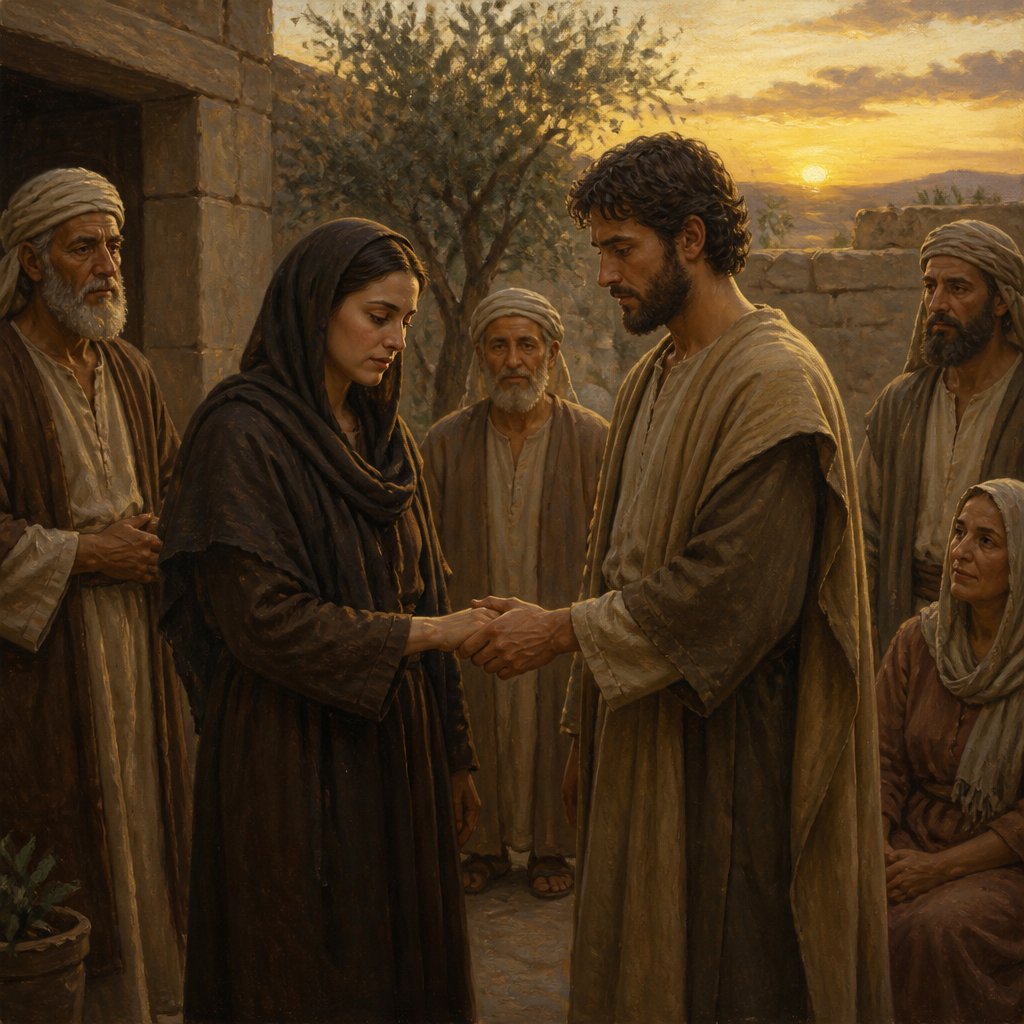
Deuteronomy 25:5 (KJV) states, "If brethren dwell together, and one of them die, and have no child, the wife of the dead shall not marry without unto a stranger: her husband's brother shall go in unto her, and take her to him to wife, and perform the duty of a husband's brother unto her."
This verse from the book of Deuteronomy addresses the concept of levirate marriage, a practice in which, if a man died without leaving a male heir, his brother was expected to marry the widow and produce a child who would carry on the deceased man's line. The obligation of a man to marry his brother's widow was a crucial aspect of ancient Hebrew society and carried significant social and religious implications.
The theme of family duty and responsibility is prominent in this verse. The concept of levirate marriage was rooted in the belief that a man's legacy and lineage were essential, and it was the duty of his surviving relatives to ensure that his family line continued. By marrying his brother's widow and producing an heir, the surviving brother fulfilled his obligation to his deceased sibling and preserved the family's inheritance and name.
The verse also highlights the importance of honoring the deceased and ensuring that their memory and lineage endure. In ancient Hebrew culture, the continuation of one's family line was a central value, and the practice of levirate marriage was a means of fulfilling this responsibility. It also provided security and protection for the widow, ensuring that she would have a provider and protector in her husband's absence.
Furthermore, the verse reflects the communal nature of Hebrew society and the interconnectedness of family members. It underscores the idea that individuals are not isolated, independent entities but are part of a larger familial and societal network. The duty to marry a brother's widow was not just a personal obligation but a communal one, with the wider family and community having a stake in the continuation of the family line.
From a symbolic standpoint, the concept of levirate marriage can be seen as a representation of the enduring nature of family and lineage. It signifies the importance of maintaining continuity and connection across generations, as well as the idea that individuals are part of a broader lineage that extends beyond their own lives.
In a broader context, this verse from Deuteronomy offers insight into the social and cultural norms of ancient Hebrew society. It provides a glimpse into the values, customs, and traditions that guided familial relationships and obligations. It also sheds light on the role of women in this society, emphasizing the importance of their status and welfare in the absence of a male heir.
Overall, Deuteronomy 25:5 encapsulates themes of family duty, continuity, and communal responsibility. It serves as a reminder of the interconnectedness of individuals within a family and community and the significance of preserving one's lineage and honoring the memory of the deceased. While the practice of levirate marriage is no longer prevalent in modern society, the underlying principles of familial obligation and the preservation of heritage continue to resonate in various cultural and religious contexts.
Have questions about Deuteronomy 25:5?
Dive deeper into this scripture with Bible Chat — an AI-powered tool for exploring God's Word through conversation. Ask questions, get context, and grow in your understanding of the Bible.
Get Our Apps


Deuteronomy 25:5 Artwork

Deuteronomy 25:5 - "¶ If brethren dwell together, and one of them die, and have no child, the wife of the dead shall not marry without unto a stranger: her husband's brother shall go in unto her, and take her to him to wife, and perform the duty of an husband's brother unto her."
"¶ If brethren dwell together, and one of them die, and have no child, the wife of the dead shall not marry without unto a stranger: her husband's brother shall go in unto her, and take her to him to wife, and perform the duty of an husband's brother unto her." - Deuteronomy 25:5

Deuteronomy 5:25 - "Now therefore why should we die? for this great fire will consume us: if we hear the voice of the LORD our God any more, then we shall die."

Deuteronomy 25:13 - "¶ Thou shalt not have in thy bag divers weights, a great and a small."

Deuteronomy 25:4 - "¶ Thou shalt not muzzle the ox when he treadeth out the corn."

Deuteronomy 31:25 - "That Moses commanded the Levites, which bare the ark of the covenant of the LORD, saying,"

Deuteronomy 25:14 - "Thou shalt not have in thine house divers measures, a great and a small."

Deuteronomy 33:25 - "Thy shoes shall be iron and brass; and as thy days, so shall thy strength be."

Deuteronomy 25:10 - "And his name shall be called in Israel, The house of him that hath his shoe loosed."

Deuteronomy 25:16 - "For all that do such things, and all that do unrighteously, are an abomination unto the LORD thy God."

Deuteronomy 5:17 - "Thou shalt not kill."

Deuteronomy 27:25 - "Cursed be he that taketh reward to slay an innocent person. And all the people shall say, Amen."

Genesis 25:5

Deuteronomy 34:5-6

Deuteronomy 5:19 - "Neither shalt thou steal."

Deuteronomy 5:18 - "Neither shalt thou commit adultery."

Deuteronomy 25:17 - "¶ Remember what Amalek did unto thee by the way, when ye were come forth out of Egypt;"

Deuteronomy 28:5 - "Blessed shall be thy basket and thy store."

Deuteronomy 3:25 - "I pray thee, let me go over, and see the good land that is beyond Jordan, that goodly mountain, and Lebanon."

Deuteronomy 25:1 - "If there be a controversy between men, and they come unto judgment, that the judges may judge them; then they shall justify the righteous, and condemn the wicked."

Deuteronomy 32:25 - "The sword without, and terror within, shall destroy both the young man and the virgin, the suckling also with the man of gray hairs."
"Now therefore why should we die? for this great fire will consume us: if we hear the voice of the LORD our God any more, then we shall die." - Deuteronomy 5:25

Deuteronomy 5:2 - "The LORD our God made a covenant with us in Horeb."

1 Thessalonians 5:25 - "Brethren, pray for us."

Deuteronomy 25:8 - "Then the elders of his city shall call him, and speak unto him: and if he stand to it, and say, I like not to take her;"

Deuteronomy 22:25 - "¶ But if a man find a betrothed damsel in the field, and the man force her, and lie with her: then the man only that lay with her shall die:"

Deuteronomy 6:25 - "And it shall be our righteousness, if we observe to do all these commandments before the LORD our God, as he hath commanded us."

Deuteronomy 5:30 - "Go say to them, Get you into your tents again."

Deuteronomy 25:6 - "And it shall be, that the firstborn which she beareth shall succeed in the name of his brother which is dead, that his name be not put out of Israel."

"Thou shalt not kill." - Deuteronomy 5:17