What does Daniel 6:10 mean?
"¶ Now when Daniel knew that the writing was signed, he went into his house; and his windows being open in his chamber toward Jerusalem, he kneeled upon his knees three times a day, and prayed, and gave thanks before his God, as he did aforetime." - Daniel 6:10
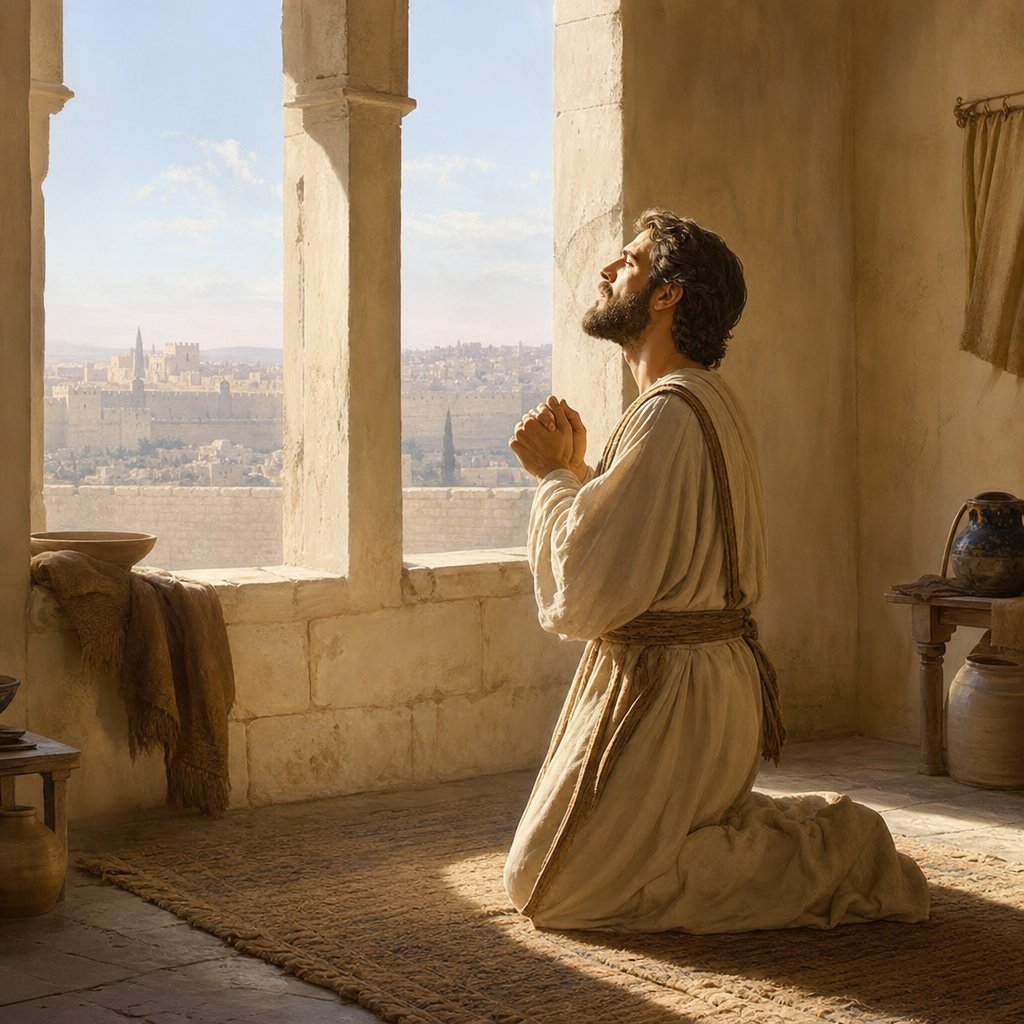
Daniel 6:10 in the King James Version reads, “Now when Daniel knew that the writing was signed, he went into his house; and his windows being open in his chamber toward Jerusalem, he kneeled upon his knees three times a day, and prayed, and gave thanks before his God, as he did aforetime.”
The meaning of the verse is best seen against its immediate setting in Daniel 6. Daniel is an aged Jewish exile serving in the Medo-Persian government under Darius. Because Daniel is preferred above the presidents and princes, they seek “an occasion against Daniel.” Finding no fault in his work, they target his worship, persuading the king to sign a decree that for thirty days no one may ask a petition of any god or man except the king. The “writing” being “signed” is therefore not a mere administrative act; it is the moment law is weaponized to coerce conscience. Daniel “knew” this had happened. The verse emphasizes that his response is neither ignorant nor impulsive. He understands the danger and proceeds anyway, which highlights a central theme of the chapter: faithfulness to God when obedience carries a real cost.
Daniel’s actions in the verse are intentionally ordinary: he “prayed, and gave thanks…as he did aforetime.” The significance lies in that last clause. Daniel does not begin praying in order to stage a protest, nor does he stop praying in order to protect himself. He continues the same pattern of devotion that already marked his life. In the narrative, this steady continuance exposes the contrast between a man governed by long-formed godliness and a kingdom governed by envy and manipulation. It also shows that Daniel’s loyalty is not to his own safety, reputation, or political standing, but to “his God.” The possessive language matters: the verse frames Daniel’s religion as covenantal allegiance, not mere custom.
The open windows “toward Jerusalem” carry both context and symbolism. Jerusalem is the city of the temple, the place associated with God’s name, worship, and the promises given to Israel. For an exile, praying toward Jerusalem signifies hope and orientation: Daniel’s life is physically in a foreign empire, but his heart remains aligned with the LORD’s purposes for his people. It is also an act of remembrance. Exile is meant to dislocate identity; Daniel’s posture resists that spiritual erosion. The open window, meanwhile, does not mean Daniel is seeking danger for its own sake, but it does show that he will not conceal his worship to keep peace with an unjust command. The decree is designed to force secrecy or compromise. Daniel refuses both. What is demanded is not simply outward compliance but inward reordering of devotion; the open window declares that the object of worship will not be changed, even temporarily.
Daniel “kneeled upon his knees,” a phrase that underscores humility and reverence. Kneeling is not presented as a political gesture but as worship. It also underlines dependence: Daniel does not meet the crisis first by strategizing, retaliating, or bargaining, but by bowing before God. In the story’s movement, this kneeling becomes the quiet opposite of the pride of the officials who seek to elevate the king as a substitute object of petition. The officials aim to make Darius function like a god; Daniel kneels only before God.
The pattern “three times a day” emphasizes disciplined constancy. The verse does not present prayer as a last resort but as the normal rhythm of Daniel’s life. This regularity becomes a theme of endurance: true faith is not only shown in spectacular moments like the lions’ den, but also in repeated, unglamorous acts of devotion. In the narrative, that rhythm is what carries Daniel into the trial and through it. The verse also says Daniel “gave thanks” in the very moment he learns the decree is signed. Thanksgiving here is not denial of danger; it is a confession that God remains worthy and sovereign even when circumstances threaten. Gratitude becomes an act of faith that refuses to let fear define reality.
In terms of larger themes, Daniel 6:10 highlights the conflict between the unchangeable “law of the Medes and Persians” and the unchanging God. Human law is portrayed as rigid and, in this case, corruptible by flattery and envy; divine faithfulness is portrayed as stable and life-giving. The verse stands at the hinge of the chapter: after it, Daniel is accused; later he is delivered. But the verse itself is not primarily about the miracle to come; it is about integrity before the miracle. Daniel’s deliverance is not the ground of his devotion; his devotion is the ground on which the story’s witness stands.
Symbolically, the verse also portrays spiritual direction. Daniel’s body faces Jerusalem, his knees bend, his windows are open, his words are prayer and thanks. Everything about the scene points outward from self toward God’s promises. The empire around him tries to redefine reality so that the king becomes the necessary mediator of petitions. Daniel quietly insists that prayer belongs to God alone. That insistence is the real “offense” in the eyes of his enemies, because it denies the state ultimate authority over worship.
The significance of Daniel 6:10, then, is that it captures the heart of faithful living under pressure: conscious obedience, unashamed devotion, disciplined prayer, and gratitude in threat. It shows that Daniel’s exceptional public usefulness rests on a private life ordered toward God. And it teaches that the crisis is not only the lions’ den but the moment the decree is signed and a person must decide whether fear will close the window, silence the prayer, and shift the heart away from Jerusalem—away from the LORD—or whether faith will continue “as he did aforetime.”
Have questions about Daniel 6:10?
Dive deeper into this scripture with Bible Chat — an AI-powered tool for exploring God's Word through conversation. Ask questions, get context, and grow in your understanding of the Bible.
Get Our Apps


Daniel 6:10 Artwork

Daniel 6:10 - "¶ Now when Daniel knew that the writing was signed, he went into his house; and his windows being open in his chamber toward Jerusalem, he kneeled upon his knees three times a day, and prayed, and gave thanks before his God, as he did aforetime."
"¶ Now when Daniel knew that the writing was signed, he went into his house; and his windows being open in his chamber toward Jerusalem, he kneeled upon his knees three times a day, and prayed, and gave thanks before his God, as he did aforetime." - Daniel 6:10

Nehemiah 10:6 - "Daniel, Ginnethon, Baruch,"

"Daniel, Ginnethon, Baruch," - Nehemiah 10:6

Daniel 10:2 - "In those days I Daniel was mourning three full weeks."

Daniel 6:28 - "So this Daniel prospered in the reign of Darius, and in the reign of Cyrus the Persian."

Daniel 10

Daniel 6:21 - "Then said Daniel unto the king, O king, live for ever."

Daniel 1:6 - "Now among these were of the children of Judah, Daniel, Hananiah, Mishael, and Azariah:"
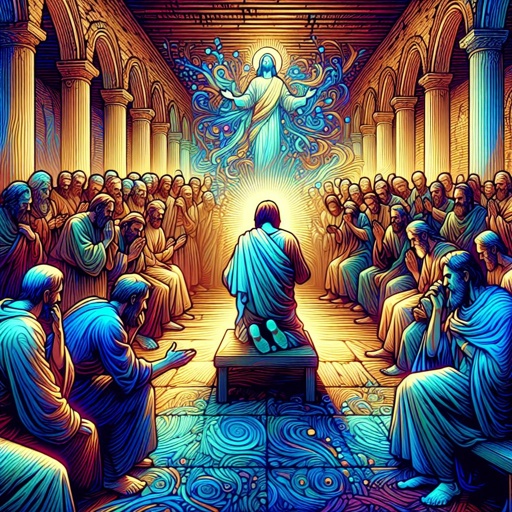
Daniel 6:11 - "Then these men assembled, and found Daniel praying and making supplication before his God."

Daniel 10:5

Daniel 10:5

Daniel 10:6 - "His body also was like the beryl, and his face as the appearance of lightning, and his eyes as lamps of fire, and his arms and his feet like in colour to polished brass, and the voice of his words like the voice of a multitude."

Daniel 6:3-4 - "Daniel 6:3-4: Then this Daniel was preferred above the presidents and princes, because an excellent spirit was in him; and the king thought to set him over the whole realm. So the presidents and princes sought to find occasion against Daniel concerning the kingdom; but they could find none occasion nor fault; forasmuch as he was faithful, neither was there any error or fault found in him."

Daniel 6:16 - "Then the king commanded, and they brought Daniel, and cast him into the den of lions. Now the king spake and said unto Daniel, Thy God whom thou servest continually, he will deliver thee."

Daniel 7: 9-10

Daniel 7:9-10

Daniel 7:9-10

Daniel 6:20 - "And when he came to the den, he cried with a lamentable voice unto Daniel: and the king spake and said to Daniel, O Daniel, servant of the living God, is thy God, whom thou servest continually, able to deliver thee from the lions?"

Daniel 7:9-10

Daniel fasting in chapter 10

Daniel 4:10-14

Daniel 6:2 - "And over these three presidents; of whom Daniel was first: that the princes might give accounts unto them, and the king should have no damage."

Daniel 6:27 - "He delivereth and rescueth, and he worketh signs and wonders in heaven and in earth, who hath delivered Daniel from the power of the lions."

Daniel 6:3 - "Then this Daniel was preferred above the presidents and princes, because an excellent spirit was in him; and the king thought to set him over the whole realm."

"In those days I Daniel was mourning three full weeks." - Daniel 10:2

Purpose of the vision from Daniel 10

Daniel 6:23 - "Then was the king exceeding glad for him, and commanded that they should take Daniel up out of the den. So Daniel was taken up out of the den, and no manner of hurt was found upon him, because he believed in his God."

Daniel 6:5 - "Then said these men, We shall not find any occasion against this Daniel, except we find it against him concerning the law of his God."

"Then said Daniel unto the king, O king, live for ever." - Daniel 6:21