What does Daniel 5:9 mean?
"Then was king Belshazzar greatly troubled, and his countenance was changed in him, and his lords were astonied." - Daniel 5:9
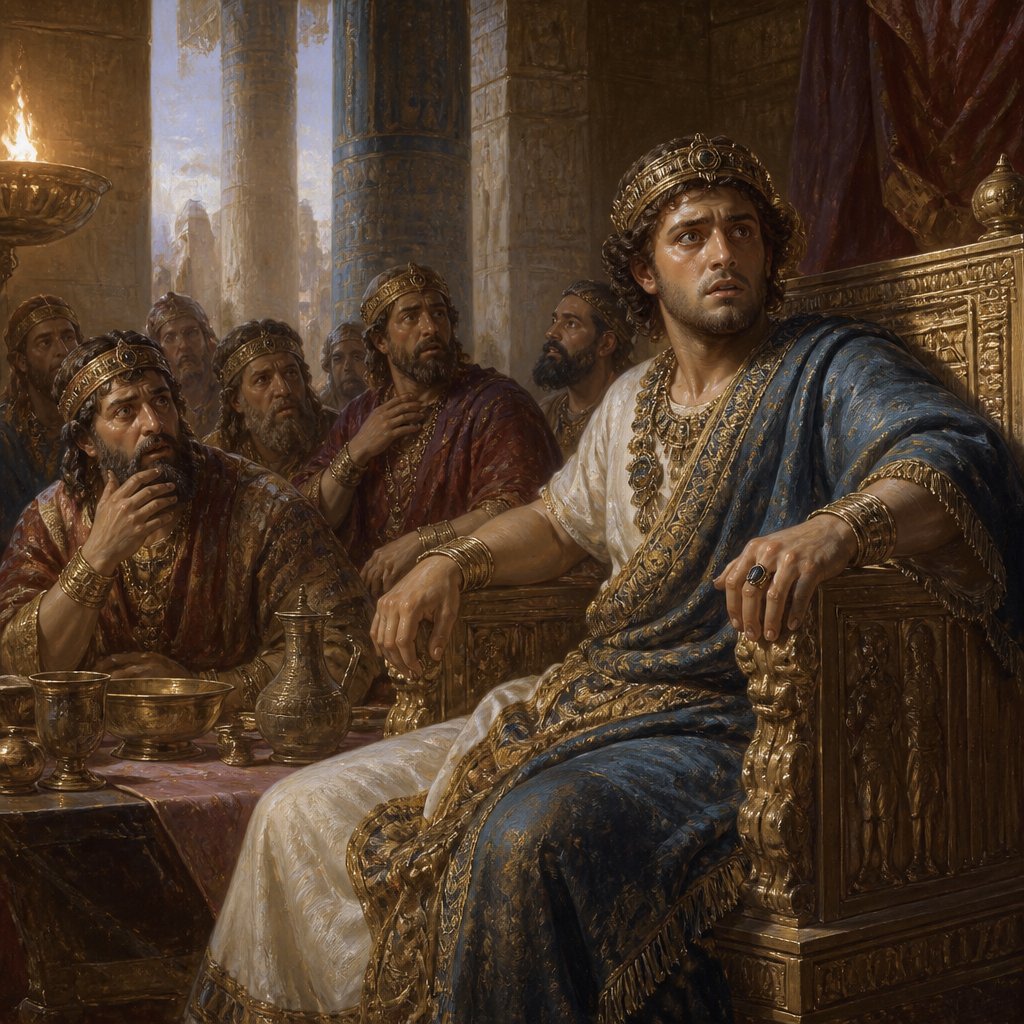
The Bible verse Daniel 5:9 from the King James Version (KJV) states, "Then was king Belshazzar greatly troubled, and his countenance was changed in him, and his lords were astonied." This verse comes from the Book of Daniel in the Old Testament and is part of a well-known story about the writing on the wall, which occurs during the Babylonian captivity of the Jewish people.
In order to understand the full meaning and commentary of this verse, it is important to provide some context. King Belshazzar was the last ruler of the Neo-Babylonian Empire, and he was holding a great feast for a thousand of his lords when the events described in this verse took place. During the feast, King Belshazzar made the bold decision to bring out the gold and silver vessels that had been taken from the temple in Jerusalem, which had been plundered by his predecessor, King Nebuchadnezzar. As the king and his guests drank from these sacred vessels and praised their own false gods, a hand appeared and wrote a mysterious message on the wall of the palace.
When King Belshazzar saw the writing on the wall, he was "greatly troubled," and his "countenance was changed in him." This demonstrates how the king's outward appearance reflected the inner turmoil and fear he was experiencing. The immediate response of the king and his lords was one of astonishment and fear. This verse captures the sense of dread and confusion that filled the room as they struggled to comprehend the significance of the cryptic message.
From a thematic standpoint, this verse speaks to the theme of divine judgment. Throughout the Bible, there are numerous instances where individuals or nations are held accountable for their actions by God. In this particular case, the sacred vessels taken from the temple in Jerusalem were a symbol of disrespect and blasphemy, as they were used to praise false gods. This act of defiance and disrespect ultimately led to the divine intervention and the appearance of the mysterious writing on the wall.
Additionally, the verse touches on the theme of the consequences of pride and arrogance. King Belshazzar's actions were driven by a sense of arrogance and hubris, as he flaunted the sacred vessels and praised false gods in the presence of his lords. This act of pride ultimately led to his downfall, as he was faced with the terrifying message on the wall and the impending judgment from God.
From a symbolic perspective, the writing on the wall represents a direct message from God to King Belshazzar. The fact that the message appeared in the presence of the king and his lords indicates its significance and the divine nature of its origin. The writing was a manifestation of God's power and authority, serving as a warning to King Belshazzar and a revelation of the impending judgment.
In conclusion, Daniel 5:9 from the King James Version captures a pivotal moment in the biblical narrative, where King Belshazzar and his lords are faced with a divine message that fills them with fear and astonishment. This verse carries significant thematic and symbolic weight, addressing the themes of divine judgment, consequences of pride, and the symbolic significance of the writing on the wall. It serves as a powerful reminder of the importance of humility and reverence in the presence of God, as well as the consequences of defying his will.
Have questions about Daniel 5:9?
Dive deeper into this scripture with Bible Chat — an AI-powered tool for exploring God's Word through conversation. Ask questions, get context, and grow in your understanding of the Bible.
Get Our Apps


Daniel 5:9 Artwork

Daniel 5:9 - "Then was king Belshazzar greatly troubled, and his countenance was changed in him, and his lords were astonied."
"Then was king Belshazzar greatly troubled, and his countenance was changed in him, and his lords were astonied." - Daniel 5:9

Daniel 9:5 - "We have sinned, and have committed iniquity, and have done wickedly, and have rebelled, even by departing from thy precepts and from thy judgments:"

daniel 5:5

Daniel 5:5

Daniel 1:9 - "Now God had brought Daniel into favour and tender love with the prince of the eunuchs."

Daniel 5:13 - "Then was Daniel brought in before the king. And the king spake and said unto Daniel, Art thou that Daniel, which art of the children of the captivity of Judah, whom the king my father brought out of Jewry?"

Daniel 1:9

Daniel 12:9 - "And he said, Go thy way, Daniel: for the words are closed up and sealed till the time of the end."

Daniel 10:5

Daniel 7:5

Daniel 7:5

Daniel 5:4

Daniel 5:3

Daniel 7:5

Daniel 10:5

Daniel 7: 9-10

Daniel 7:9-10

Daniel 7:9-10

Daniel 7:9-10

Daniel 12:5 - "¶ Then I Daniel looked, and, behold, there stood other two, the one on this side of the bank of the river, and the other on that side of the bank of the river."

Daniel 9:22 - "And he informed me, and talked with me, and said, O Daniel, I am now come forth to give thee skill and understanding."

Daniel 9:9 - "To the Lord our God belong mercies and forgivenesses, though we have rebelled against him;"

Daniel 5:12 - "Forasmuch as an excellent spirit, and knowledge, and understanding, interpreting of dreams, and shewing of hard sentences, and dissolving of doubts, were found in the same Daniel, whom the king named Belteshazzar: now let Daniel be called, and he will shew the interpretation."

Daniel 6:5 - "Then said these men, We shall not find any occasion against this Daniel, except we find it against him concerning the law of his God."
Daniel 6:9 - "Wherefore king Darius signed the writing and the decree."

Daniel 5:30 - "¶ In that night was Belshazzar the king of the Chaldeans slain."

Daniel 5:25 - "¶ And this is the writing that was written, MENE, MENE, TEKEL, UPHARSIN."

Daniel 5:29 - "Then commanded Belshazzar, and they clothed Daniel with scarlet, and put a chain of gold about his neck, and made a proclamation concerning him, that he should be the third ruler in the kingdom."

Daniel 5:24 - "Then was the part of the hand sent from him; and this writing was written."