What does Colossians 2:9-10 mean?
"For in him dwelleth all the fulness of the Godhead bodily. And ye are complete in him, which is the head of all principality and power." - Colossians 2:9-10
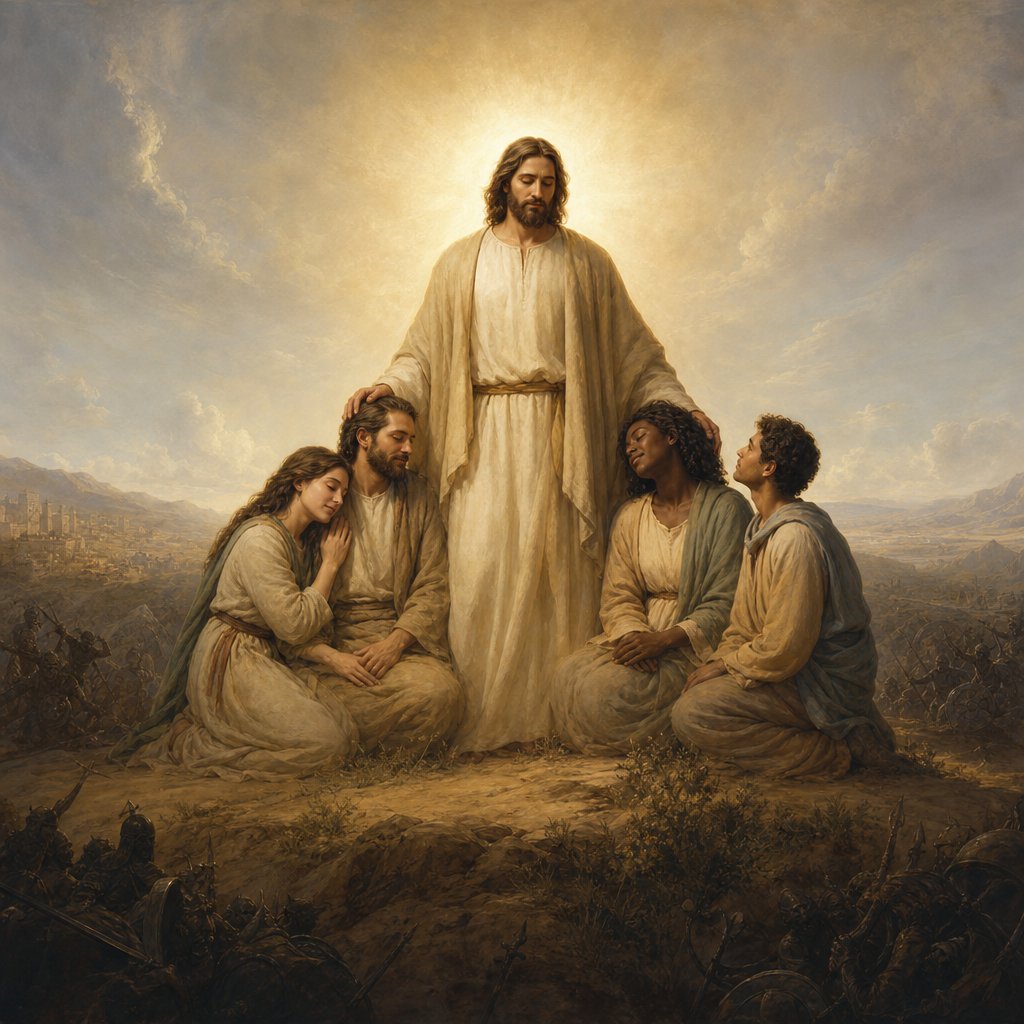
Colossians 2:9–10 (KJV) stands near the heart of Paul’s warning to the church at Colosse against teachings that sounded spiritual and impressive but, in practice, pulled believers away from the sufficiency of Christ. In the surrounding passage Paul is concerned that Christians not be “spoiled” through “philosophy and vain deceit,” through “tradition of men,” and through “rudiments of the world,” rather than living by Christ himself (Colossians 2:8, KJV). Into that setting come these two sentences, which are both a confession about who Jesus is and a declaration about what believers already possess in him.
“For in him dwelleth all the fulness of the Godhead bodily” (Colossians 2:9, KJV). The verse begins with “For,” tying it directly to the warning in verse 8: the reason believers must not be captured by substitutes is that nothing is lacking in Christ. “In him” points to the person of Jesus Christ, not merely his teaching or example, but his very identity. The word “dwelleth” speaks of settled, ongoing residence, not a temporary visitation. Paul is not saying that God merely acted through Jesus at certain moments, nor that divine power rested on him for a season, but that the reality described is constant and abiding.
The phrase “all the fulness” intensifies the claim: not some portion of God, not a partial manifestation, not a lesser emanation, but the whole plenitude. This matters in the Colossian context because false spirituality often promises additional “fullness” through special knowledge, extra mediators, ascetic practices, angelic involvement, or adherence to man-made rules. Paul answers that the fullness people seek is not found by climbing a ladder of spiritual techniques; it is already present in Christ.
“The Godhead” (KJV) names the divine nature itself. Paul’s point is not simply that Jesus is Godlike, or divinely inspired, but that the fullness of deity is in him. And then he adds “bodily,” which anchors this divine fullness in the reality of Christ’s incarnation. The divine fullness is not remote, abstract, or only “spiritual” in the sense of being detached from material life; it is present in the embodied Christ. In a world where some religious philosophies treated matter as unworthy, or imagined salvation as escape from bodily existence, “bodily” is decisive. It declares that God’s saving self-revelation is not a denial of creation, but God entering creation in the person of Jesus Christ. The symbol and significance here are profound: the body of Christ is not a barrier to deity but the chosen vessel in which the fullness of God truly dwells. This guards the faith against any teaching that diminishes either Christ’s true deity or his true humanity, because Paul holds both together.
“And ye are complete in him, which is the head of all principality and power” (Colossians 2:10, KJV). Having declared Christ’s fullness, Paul turns to the believer’s condition. “And ye” brings the doctrine home personally and corporately to the church: this is not merely a statement to admire but a reality that defines them. “Are complete” means that, in relation to God’s saving purpose, believers are not lacking some essential spiritual ingredient that must be supplied by another system. Paul is not claiming Christians cannot grow in holiness, wisdom, or maturity; rather, he is insisting that their standing and sufficiency before God are found in union with Christ, not in additions to Christ. The completeness of the believer is grounded in the fullness of Christ: because all the fullness dwells in him, those who are “in him” share in what is needed for life with God.
The words “in him” are again central. They point to union and participation, the New Testament reality that believers belong to Christ and are identified with him. The verse does not say believers are complete in themselves, or in their religious achievements, but “in him.” This preserves both assurance and humility: assurance, because the believer’s completeness rests on Christ’s fullness rather than fragile self-effort; humility, because the source of that completeness is wholly in Christ.
Paul then strengthens this claim by describing Christ’s authority: he is “the head of all principality and power.” In Colossians, “head” is a rich image. It conveys supremacy, source, and governing authority. Whatever “principality and power” includes—earthly structures, spiritual ranks, unseen authorities that people might fear or seek to placate—Christ stands above them as their head. This directly answers any impulse to look for security through intermediary beings or cosmic forces. If Christ is head over every principality and power, then believers do not need to bargain with lesser powers, nor be intimidated by them, nor treat them as necessary channels to reach God. The symbolism of “head” also connects with the idea of the body: if Christ is the head, then his people belong to him and receive life and direction from him rather than from competing authorities. The believer’s completeness, therefore, is not only a private inward feeling; it is a status under a victorious Lord who outranks every rival.
Taken together, Colossians 2:9–10 (KJV) proclaims that the fullness of God is truly present in the embodied Christ, and that believers, joined to him, possess a real completeness that cannot be improved by man-made systems or spiritual add-ons. In its context, the passage is a safeguard against teachings that diminish Christ by suggesting he is not enough. In its themes, it exalts the deity of Christ, affirms the incarnation with its “bodily” emphasis, anchors the believer’s sufficiency “in him,” and declares Christ’s supremacy over all powers that might compete for loyalty or inspire fear. The significance is that Christianity is not a quest to assemble fullness from many sources; it is the reception of fullness in the one in whom “all the fulness of the Godhead” dwells, and the lived reality that “ye are complete in him.”
Have questions about Colossians 2:9-10?
Dive deeper into this scripture with Bible Chat — an AI-powered tool for exploring God's Word through conversation. Ask questions, get context, and grow in your understanding of the Bible.
Get Our Apps


Colossians 2:9-10 Artwork

Colossians 2:9-10 - "For in him dwelleth all the fulness of the Godhead bodily. And ye are complete in him, which is the head of all principality and power."
"For in him dwelleth all the fulness of the Godhead bodily. And ye are complete in him, which is the head of all principality and power." - Colossians 2:9-10

Colossians 2:9

Colossians 2:10

Colossians 2:9 - "For in him dwelleth all the fulness of the Godhead bodily."

Titus 2:9-10

Titus 2:9-10

Colossians 2:10 - "And ye are complete in him, which is the head of all principality and power:"

"For in him dwelleth all the fulness of the Godhead bodily." - Colossians 2:9

"And ye are complete in him, which is the head of all principality and power:" - Colossians 2:10

Colossians 3:9-10 - "Do not lie to each other, since you have taken off your old self with its practices and have put on the new self, which is being renewed in knowledge in the image of its Creator."

Colossians 3:2

Colossians 3:2

Colossians 2:19

Colossians 2:19

Colossians 2:21 - "(Touch not; taste not; handle not;"

Colossians 3:9 - "Lie not one to another, seeing that ye have put off the old man with his deeds;"

Colossians 3:10 - "And have put on the new man, which is renewed in knowledge after the image of him that created him:"

Colossians 4:2 - "Continue in prayer, and watch in the same with thanksgiving;"
2 Corinthians 12:9-10

Colossians 2:3 - "In whom are hid all the treasures of wisdom and knowledge."

Colossians 2:17 - "Which are a shadow of things to come; but the body is of Christ."

Colossians 3:2 - "Set your affection on things above, not on things on the earth."
"(Touch not; taste not; handle not;" - Colossians 2:21

Colossians 1:10 - "That ye might walk worthy of the Lord unto all pleasing, being fruitful in every good work, and increasing in the knowledge of God;"

Colossians 2:22 - "Which all are to perish with the using;) after the commandments and doctrines of men?"

2 Corinthians 10:9 - "That I may not seem as if I would terrify you by letters."

Colossians 4:9 - "With Onesimus, a faithful and beloved brother, who is one of you. They shall make known unto you all things which are done here."

Colossians 1:9-10 - "For this reason, since the day we heard about you, we have not stopped praying for you. We continually ask God to fill you with the knowledge of his will through all the wisdom and understanding that the Spirit gives, so that you may live a life worthy of the Lord and please him in every way: bearing fruit in every good work, growing in the knowledge of God."

Colossians 2:4 - "And this I say, lest any man should beguile you with enticing words."