What does Acts 8:30 mean?
"And Philip ran thither to him, and heard him read the prophet Esaias, and said, Understandest thou what thou readest?" - Acts 8:30
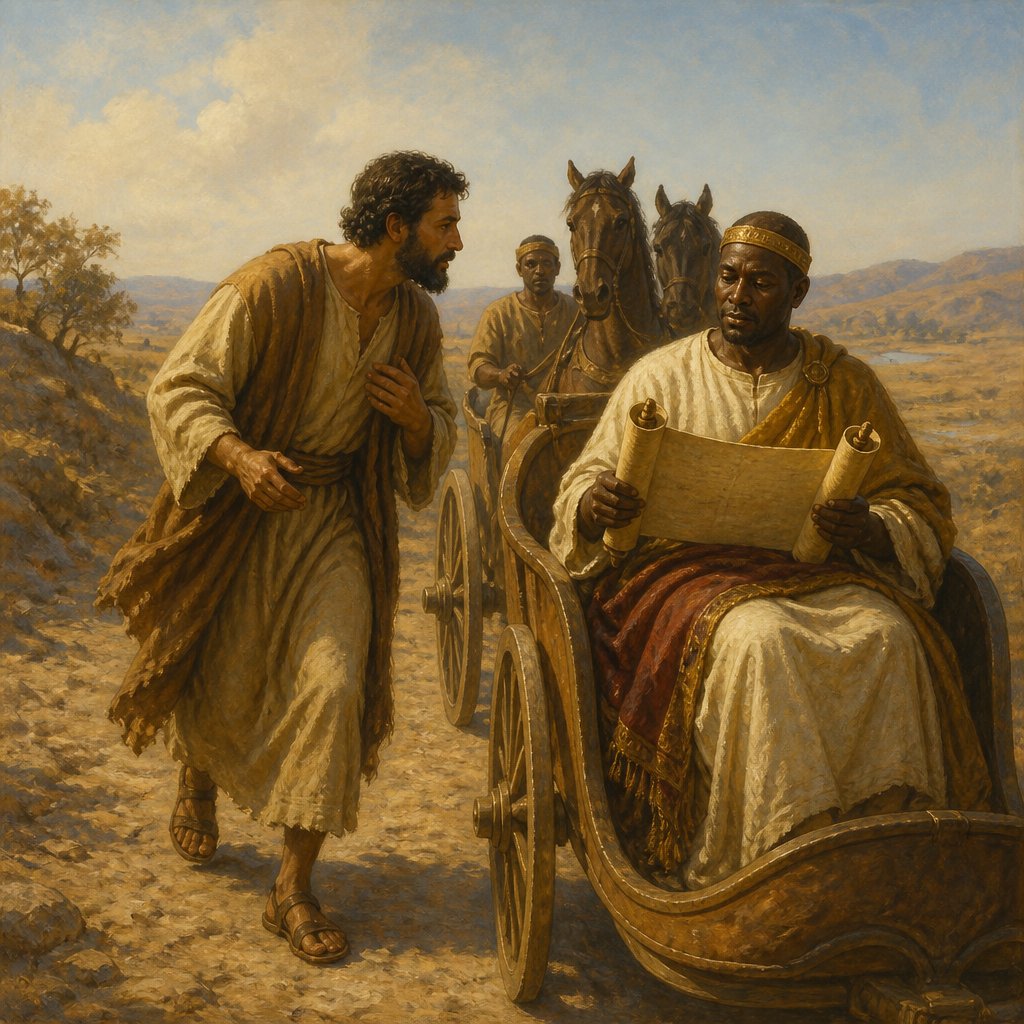
The Bible verse Acts 8:30 from the King James Version (KJV) reads, "And Philip ran thither to him, and heard him read the prophet Esaias, and said, Understandest thou what thou readest?"
This verse is part of a larger passage that tells the story of Philip and the Ethiopian eunuch. In the previous verses, we see that Philip, who was one of the seven chosen to serve the early church, is directed by an angel of the Lord to go south on the desert road from Jerusalem to Gaza. There he comes across an Ethiopian eunuch, who was an important official in charge of all the treasury of the Kandake, or Candace, queen of the Ethiopians. The eunuch had been to Jerusalem to worship and was now on his way home, sitting in his chariot and reading the book of Isaiah the prophet.
Philip, being obedient to the Holy Spirit’s guidance, ran to the chariot and heard the eunuch reading from the prophet Isaiah. He then asks the eunuch if he understands what he is reading. This interaction sets the stage for the eunuch’s conversion to Christianity, which occurs through further discussion and teaching from Philip.
The themes present in this verse and the surrounding passage include obedience to the leading of the Holy Spirit, evangelism, and the accessibility of the gospel to all people, regardless of nationality or social status. The story of Philip and the Ethiopian eunuch demonstrates the power of divine appointments and the role of believers in sharing the message of salvation with those who are seeking.
The historical and cultural context of this passage is also significant. The encounter takes place in the aftermath of Jesus’ death and resurrection, during a time of great expansion and growth for the early Christian church. The Ethiopian eunuch’s reading of the prophet Isaiah is particularly noteworthy, as it reflects the inclusion of Gentiles in the message of salvation and the fulfillment of Old Testament prophecy through the person and work of Jesus Christ.
The symbolism present in this verse and passage is rich and layered. Philip’s running to the eunuch’s chariot serves as a metaphor for the urgency and zeal with which believers should engage in the work of preaching the gospel and making disciples. The eunuch’s reading of the prophet Isaiah represents the seeking heart of someone who is earnestly searching for truth and understanding. Philip’s question, “Understandest thou what thou readest?” is a prompt for the eunuch to reflect on the deeper meaning of the words he is reading, and it opens the door for further dialogue and instruction.
The chariot itself can be seen as a symbol of the eunuch’s position and authority, as well as his journey of faith. The desert road on which the encounter takes place may symbolize the spiritual wilderness that the eunuch is traversing, and Philip’s arrival as a guide and teacher points to the divine provision and guidance that God gives to those who are sincerely seeking Him.
In conclusion, Acts 8:30 from the King James Version (KJV) offers a powerful and timeless message about the importance of obedience to the leading of the Holy Spirit, the accessibility of the gospel to all people, and the transformative impact of sharing the message of salvation with those who are seeking. The historical context and rich symbolism in this passage further enhance its significance, making it a source of inspiration and encouragement for believers throughout the ages.
Have questions about Acts 8:30?
Dive deeper into this scripture with Bible Chat — an AI-powered tool for exploring God's Word through conversation. Ask questions, get context, and grow in your understanding of the Bible.
Get Our Apps


Acts 8:30 Artwork

ACTS 8:30 Philip and the Ethiopian

Acts 8:30 - "And Philip ran thither to him, and heard him read the prophet Esaias, and said, Understandest thou what thou readest?"
"And Philip ran thither to him, and heard him read the prophet Esaias, and said, Understandest thou what thou readest?" - Acts 8:30

Acts 4:30

Acts 4:30

Acts 4:30

Acts 4:30

Acts 13:30 - "But God raised him from the dead:"

Acts 8:8 - "And there was great joy in that city."

Acts 11:30 - "Which also they did, and sent it to the elders by the hands of Barnabas and Saul."

Leviticus 8:30

Acts 19:30 - "And when Paul would have entered in unto the people, the disciples suffered him not."

Acts 16:30 - "And brought them out, and said, Sirs, what must I do to be saved?"

Acts 17:30 - "And the times of this ignorance God winked at; but now commandeth all men every where to repent:"

Acts 5:30 - "The God of our fathers raised up Jesus, whom ye slew and hanged on a tree."

Acts 9:30 - "Which when the brethren knew, they brought him down to Caesarea, and sent him forth to Tarsus."

"But God raised him from the dead:" - Acts 13:30

Acts 26:30 - "And when he had thus spoken, the king rose up, and the governor, and Bernice, and they that sat with them:"

"And there was great joy in that city." - Acts 8:8

Acts 1:8

Acts 8:33

Acts 15:30 - "So when they were dismissed, they came to Antioch: and when they had gathered the multitude together, they delivered the epistle:"

Acts 4:30 - "By stretching forth thine hand to heal; and that signs and wonders may be done by the name of thy holy child Jesus."

Acts 28:30 - "And Paul dwelt two whole years in his own hired house, and received all that came in unto him,"

John 8:30 - "As he spake these words, many believed on him."

Acts 20:30 - "Also of your own selves shall men arise, speaking perverse things, to draw away disciples after them."

Acts 4:8-12

Acts 7:30 - "And when forty years were expired, there appeared to him in the wilderness of mount Sina an angel of the Lord in a flame of fire in a bush."

Mark 8:30 - "And he charged them that they should tell no man of him."

Exodus 8:30 - "And Moses went out from Pharaoh, and intreated the LORD."