What does Acts 27:26 mean?
"Howbeit we must be cast upon a certain island." - Acts 27:26

The Bible verse Acts 27:26 from the King James Version (KJV) reads, "Howbeit we must be cast upon a certain island." This verse comes from the New Testament and is found in the book of Acts, which was written by the apostle Luke. This particular verse is part of a larger narrative that describes Paul's journey to Rome as a prisoner.
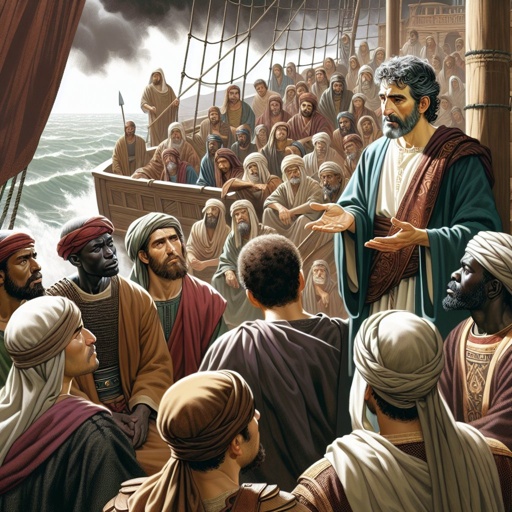
In Acts 27, we find Paul and several other prisoners, as well as soldiers and sailors, on a ship traveling to Rome. The journey is treacherous, and they encounter a severe storm that threatens to sink the ship. In the midst of this turmoil, an angel appears to Paul and assures him that he and his fellow travelers will be spared, but that they will be shipwrecked on a specific island.
The verse itself is a declaration of the angel's message to Paul, stating that they will indeed be cast upon a certain island. This declaration is significant in several ways and carries a number of themes, context, and symbolism that are worth exploring in depth.
One of the key themes in this verse is the idea of divine providence and protection. The fact that an angel appears to Paul to deliver this message underscores the belief that God is in control of the situation and is actively working to ensure the safety of His people. This theme is a recurring one throughout the Bible, emphasizing the idea that God is sovereign and that His plans will ultimately come to fruition, even in the midst of adversity and tumultuous circumstances.
The verse also speaks to the concept of faith and trust in God's promises. Paul and the others on the ship are facing a dire situation, but the angel's message serves to strengthen their faith and resolve. It reminds them that they are not alone, and that God's promises can be trusted, even in the face of seemingly insurmountable odds. This theme of faith in the midst of adversity is a powerful and encouraging one, reminding believers that God is always present and active, even in the most difficult circumstances.
In terms of context, this verse is part of a larger narrative that emphasizes the sovereignty of God and the fulfillment of His purposes. Throughout the book of Acts, we see numerous examples of God's intervention and guidance, leading His people to carry out His plans and spread the message of the Gospel. In this particular instance, the message conveyed to Paul serves as a testament to the fact that God's purposes cannot be thwarted, and that He will see His people safely through even the most perilous situations.
The symbolism in this verse is also worth considering. The idea of being "cast upon a certain island" can be interpreted in a number of ways. On a literal level, it speaks to the physical destination that Paul and the others will ultimately reach after the shipwreck. However, it can also be seen as a metaphor for the idea of finding refuge and safety in the midst of life's storms. The island represents a place of rest and security, a haven from the chaos and danger of the open sea. This symbolism serves as a powerful reminder that God is our refuge and strength, a present help in times of trouble.
In conclusion, Acts 27:26 is a verse that is rich in themes, context, and symbolism. It speaks to the ideas of divine providence, faith, and trust in God's promises, and serves as a powerful reminder of God's sovereignty and protection. It is a verse that offers hope and encouragement to believers, reminding them that God is always present and active, even in the midst of life's storms.
Have questions about Acts 27:26?
Dive deeper into this scripture with Bible Chat — an AI-powered tool for exploring God's Word through conversation. Ask questions, get context, and grow in your understanding of the Bible.
Get Our Apps


Acts 27:26 Artwork

Acts 27:26 - "Howbeit we must be cast upon a certain island."

"Howbeit we must be cast upon a certain island." - Acts 27:26

Acts 26:27 - "King Agrippa, believest thou the prophets? I know that thou believest."

"King Agrippa, believest thou the prophets? I know that thou believest." - Acts 26:27

James 1:26-27 - "James 1:26-27: If anyone considers himself religious and yet does not keep a tight rein on his tongue, he deceives himself and his religion is worthless. Religion that God our Father accepts as pure and faultless is this: to look after orphans and widows in their distress and to keep oneself from being polluted by the world."

Acts 17:27

Matthew 27:26

Matthew 27:26

Romans 1:26-27 - "For this reason God gave them up to dishonorable passions. For their women exchanged natural relations for those that are contrary to nature; and the men likewise gave up natural relations with women and were consumed with passion for one another, men committing shameless acts with men and receiving in themselves the due penalty for their error."

Proverbs 7:26-27

Acts 17:26-27 - "And he made from one man every nation of mankind to live on all the face of the earth, having determined allotted periods and the boundaries of their dwelling place, that they should seek God, and perhaps feel their way toward him and find him. Yet he is actually not far from each one of us."

John 19:26-27

Proverbs 27:26 - "The lambs are for thy clothing, and the goats are the price of the field."

Acts 27:27 - "But when the fourteenth night was come, as we were driven up and down in Adria, about midnight the shipmen deemed that they drew near to some country;"

Acts 11:27 - "¶ And in these days came prophets from Jerusalem unto Antioch."

Acts 26:27-30 (KJVA) 27 King Agrippa, believest thou the prophets? I know that thou believest. 28 Then Agrippa said unto Paul, Almost thou persuadest me to be a Christian. 29 And Paul said, I would to God, that not only thou, but also all that hear me this day, were both almost, and altogether such as I am, except these bonds. 30 And when he had thus spoken, the king rose up, and the governor, and Bernice, and they that sat with them:

Acts 27:36 - "Then were they all of good cheer, and they also took some meat."

Acts 27:14 - "But not long after there arose against it a tempestuous wind, called Euroclydon."

Acts 27:32 - "Then the soldiers cut off the ropes of the boat, and let her fall off."

Leviticus 26:27 - "And if ye will not for all this hearken unto me, but walk contrary unto me;"

Acts 27:18 - "And we being exceedingly tossed with a tempest, the next day they lightened the ship;"

Acts 27:37 - "And we were in all in the ship two hundred threescore and sixteen souls."

Acts 20:27 - "For I have not shunned to declare unto you all the counsel of God."

Acts 26:26 - "For the king knoweth of these things, before whom also I speak freely: for I am persuaded that none of these things are hidden from him; for this thing was not done in a corner."

Acts 26:19 - "Whereupon, O king Agrippa, I was not disobedient unto the heavenly vision:"

Acts 27:38 - "And when they had eaten enough, they lightened the ship, and cast out the wheat into the sea."

Acts 27:19 - "And the third day we cast out with our own hands the tackling of the ship."
Acts 27:31 - "Paul said to the centurion and to the soldiers, Except these abide in the ship, ye cannot be saved."

Acts 10:27 - "And as he talked with him, he went in, and found many that were come together."

Acts 15:26 - "Men that have hazarded their lives for the name of our Lord Jesus Christ."