What does Acts 25:9 mean?
"But Festus, willing to do the Jews a pleasure, answered Paul, and said, Wilt thou go up to Jerusalem, and there be judged of these things before me?" - Acts 25:9
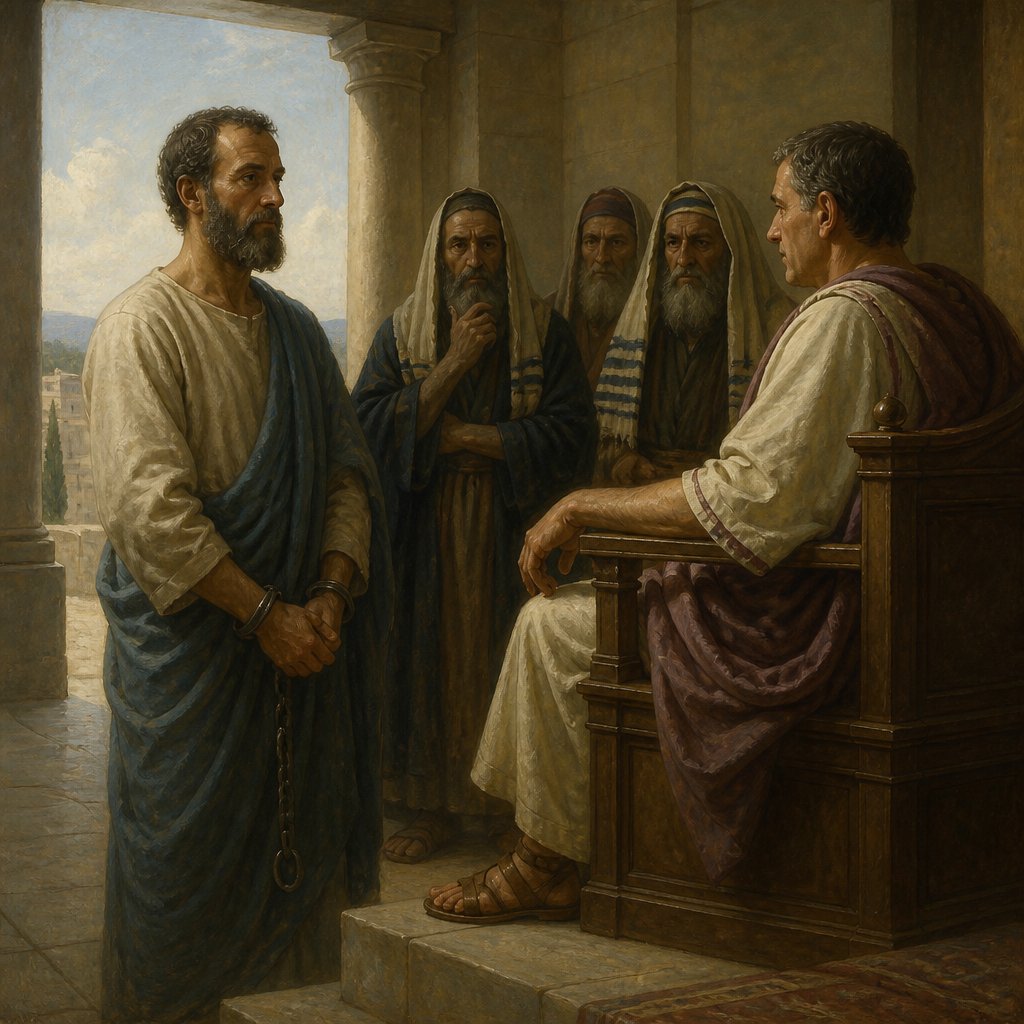
The Bible verse Acts 25:9 from the King James Version (KJV) states, "But Festus, willing to do the Jews a pleasure, answered Paul, and said, Wilt thou go up to Jerusalem, and there be judged of these things before me?" This verse is part of the account of Paul’s trial before Festus, the Roman governor, after being accused by the Jews. Through this verse, we can explore themes of justice, integrity, and political motivations, as well as the symbolic significance of Paul's imprisonment and trial.
In this verse, Festus is depicted as being willing to do the Jews a favor, indicating that his motivations are not necessarily aligned with the pursuit of justice. The pressure to please the Jewish leaders and maintain peace among the people likely plays a significant role in his willingness to accommodate their request to try Paul in Jerusalem. This highlights the complex political dynamics at play during the time, as well as the challenges of maintaining order and balance in a diverse and often contentious society.
The verse also raises questions about integrity and the search for truth. Despite Festus's willingness to please the Jews, we see that Paul is unyielding in his pursuit of justice and fairness. His commitment to standing up for what is right and refusing to be swayed by political motivations speaks to the deeper themes of moral courage and conviction. This aspect of the verse invites reflection on the importance of remaining steadfast in one's beliefs and principles, even in the face of external pressures and challenges.
Furthermore, the verse serves as a reminder of the trials and tribulations faced by Paul, as well as the broader issue of religious persecution. Paul's imprisonment and subsequent trial are symbolic of the hardships endured by early Christians, who often faced persecution and opposition for their beliefs. His unwavering commitment to his faith and his willingness to stand up for the truth despite the adversity he faced serves as an inspiration for all believers, highlighting the importance of remaining steadfast in one's faith even during difficult times.
Symbolically, Paul's trial can also be seen as a representation of the broader struggles and challenges encountered in the pursuit of justice and righteousness. His confrontation with Festus and the Jewish leaders reflects the larger societal tensions and conflicts that can arise when competing interests and beliefs clash. This serves as a powerful reminder of the importance of upholding moral and ethical principles, even in the face of opposition and adversity.
In its broader context, the verse is part of the book of Acts, which chronicles the early history of the Christian church and the spread of the gospel. The entire book is filled with accounts of the challenges and triumphs experienced by the early followers of Jesus, making it a source of inspiration and guidance for believers throughout the ages. This verse, in particular, serves as a poignant reminder of the need to remain steadfast in one's faith and commitment to justice, even in the face of adversity and opposition.
In conclusion, Acts 25:9 from the King James Version offers a rich and complex exploration of themes such as justice, integrity, and religious persecution. It serves as a powerful reminder of the challenges faced by early Christians and the importance of remaining steadfast in one's faith and commitment to righteousness. Through its portrayal of the trials faced by Paul and the political dynamics at play, the verse offers valuable insights into the moral and ethical complexities of the human experience, and serves as a source of inspiration and guidance for believers today.
Have questions about Acts 25:9?
Dive deeper into this scripture with Bible Chat — an AI-powered tool for exploring God's Word through conversation. Ask questions, get context, and grow in your understanding of the Bible.
Get Our Apps


Acts 25:9 Artwork

Acts 25:9 - "But Festus, willing to do the Jews a pleasure, answered Paul, and said, Wilt thou go up to Jerusalem, and there be judged of these things before me?"

"But Festus, willing to do the Jews a pleasure, answered Paul, and said, Wilt thou go up to Jerusalem, and there be judged of these things before me?" - Acts 25:9

Acts 9:25 - "Then the disciples took him by night, and let him down by the wall in a basket."

"Then the disciples took him by night, and let him down by the wall in a basket." - Acts 9:25

Acts 23:25 - "And he wrote a letter after this manner:"

Acts 11:25 - "Then departed Barnabas to Tarsus, for to seek Saul:"

Acts 14:25 - "And when they had preached the word in Perga, they went down into Attalia:"

Acts 25:25 - "But when I found that he had committed nothing worthy of death, and that he himself hath appealed to Augustus, I have determined to send him."

1 Corinthians 9:25-27

1 Corinthians 9:25-27

1 Corinthians 9:25-27

1 Corinthians 9:25-27

Genesis 25-9

Acts 25:2 - "Then the high priest and the chief of the Jews informed him against Paul, and besought him,"

Acts 9:9 - "And he was three days without sight, and neither did eat nor drink."

Acts 16:25 - "¶ And at midnight Paul and Silas prayed, and sang praises unto God: and the prisoners heard them."

Acts 25:27 - "For it seemeth to me unreasonable to send a prisoner, and not withal to signify the crimes laid against him."

Acts 10:25 - "And as Peter was coming in, Cornelius met him, and fell down at his feet, and worshipped him."

Acts 25:13 - "And after certain days king Agrippa and Bernice came unto Caesarea to salute Festus."

Acts 27:25 - "Wherefore, sirs, be of good cheer: for I believe God, that it shall be even as it was told me."

Acts 9:1-20

Acts 9:1-20

Genesis 9:24-25

Acts 25:4 - "But Festus answered, that Paul should be kept at Caesarea, and that he himself would depart shortly thither."

"And he wrote a letter after this manner:" - Acts 23:25

"Then departed Barnabas to Tarsus, for to seek Saul:" - Acts 11:25

Acts 25:18 - "Against whom when the accusers stood up, they brought none accusation of such things as I supposed:"

Acts 25:1 - "Now when Festus was come into the province, after three days he ascended from Caesarea to Jerusalem."

Acts 8:25 - "And they, when they had testified and preached the word of the Lord, returned to Jerusalem, and preached the gospel in many villages of the Samaritans."

2 Chronicles 25:26 - "Now the rest of the acts of Amaziah, first and last, behold, are they not written in the book of the kings of Judah and Israel?"