What does Acts 25:8 mean?
"While he answered for himself, Neither against the law of the Jews, neither against the temple, nor yet against Caesar, have I offended any thing at all." - Acts 25:8
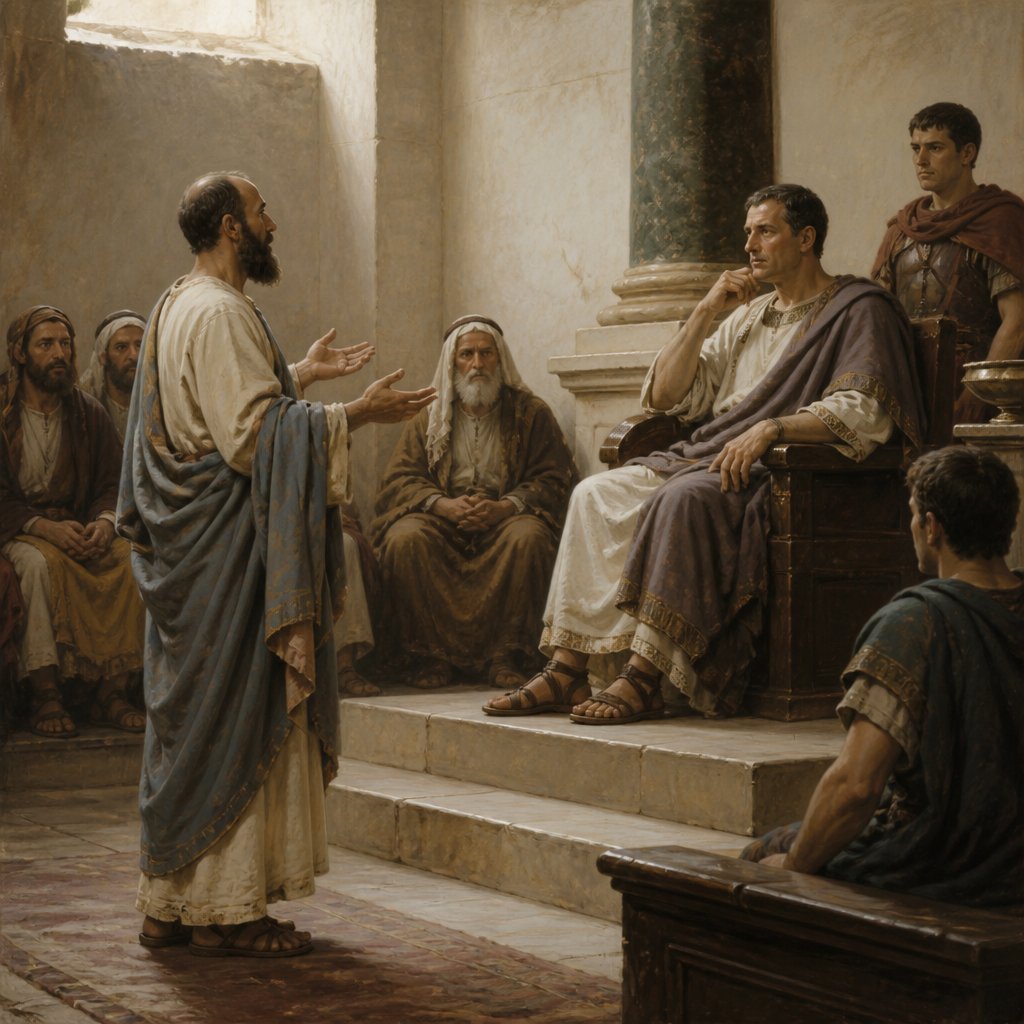
The Bible verse Acts 25:8 in the King James Version reads, "While he answered for himself, Neither against the law of the Jews, neither against the temple, nor yet against Caesar, have I offended any thing at all." This verse is a part of the larger context of the book of Acts, which is the fifth book in the New Testament. Acts is a historical account of the early Christian church and the spread of the gospel after Jesus' ascension. The verse in question is part of the narrative of the apostle Paul's imprisonment and subsequent trial before the Roman governor, Porcius Festus.
In Acts 25:1-12, we find Paul standing trial before Festus, who had recently succeeded Felix as the Roman governor in Judea. The Jews, who were seeking to bring charges against Paul, asked Festus to bring Paul to Jerusalem so that they could ambush and kill him. However, Paul refused, knowing that he would not receive a fair trial there. Instead, Paul appealed to Caesar, which was his right as a Roman citizen, and Festus granted his request. In response to the accusations brought against him, Paul declared his innocence before Festus, affirming that he had not violated Jewish law or temple etiquette, nor had he committed any offense against Caesar.
The themes of justice, truth, and righteousness are central to this verse. Paul's defense underscores his commitment to upholding the law and his conscience. Throughout his ministry, Paul preached the importance of obeying both the laws of God and the secular authorities, as exemplified in his letter to the Romans where he wrote, "Let every person be subject to the governing authorities. For there is no authority except from God, and those that exist have been instituted by God" (Romans 13:1). Here, Paul's steadfast adherence to the law serves as a model for Christian conduct in the face of adversity and persecution, demonstrating that one can be faithful to God while also respecting the laws of the land.
The cultural and historical context of Acts 25:8 is equally important. During this time, the tension between the Jewish religious leaders and the Roman authorities was palpable. The Jews sought to maintain their religious traditions and customs, which often resulted in clashes with the Roman occupation. In his defense before Festus, Paul navigated the delicate balance between honoring Jewish traditions and respecting Roman law. This context provides insight into the challenges faced by early Christians living in a society that did not share their beliefs and values.
Symbolism also permeates this verse, particularly in the mention of the law of the Jews, the temple, and Caesar. The law of the Jews represents the religious and moral code by which the Jewish people lived, emphasizing the importance of obedience to God's commandments. The temple symbolizes the sacred space and worship practices central to Jewish faith, reflecting the reverence for God and the spiritual significance of the Jewish identity. Finally, Caesar symbolizes the secular authority and the Roman legal system, highlighting the political and social framework in which Paul operated. Each of these symbols underscores the multifaceted nature of Paul's identity as a Jew, a Christian, and a Roman citizen, shedding light on the complex dynamics of his trial and the broader issues at play.
In conclusion, Acts 25:8 is a rich and multifaceted passage that offers profound insights into the themes of justice, truth, and righteousness from a historical and cultural perspective. Paul's unwavering commitment to the law, his defense of his faith, and his interaction with the Roman authorities serve as a source of inspiration and guidance for Christians navigating the complexities of a diverse and ever-changing world. As we reflect on this verse, we are reminded of the enduring relevance of these themes and the timeless truths found in the biblical narrative.
Have questions about Acts 25:8?
Dive deeper into this scripture with Bible Chat — an AI-powered tool for exploring God's Word through conversation. Ask questions, get context, and grow in your understanding of the Bible.
Get Our Apps


Acts 25:8 Artwork
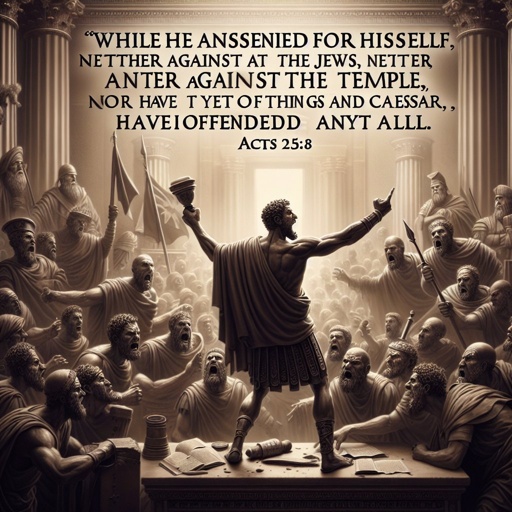
Acts 25:8 - "While he answered for himself, Neither against the law of the Jews, neither against the temple, nor yet against Caesar, have I offended any thing at all."
"While he answered for himself, Neither against the law of the Jews, neither against the temple, nor yet against Caesar, have I offended any thing at all." - Acts 25:8

Acts 8:25 - "And they, when they had testified and preached the word of the Lord, returned to Jerusalem, and preached the gospel in many villages of the Samaritans."

"And they, when they had testified and preached the word of the Lord, returned to Jerusalem, and preached the gospel in many villages of the Samaritans." - Acts 8:25

Acts 8:8 - "And there was great joy in that city."

Acts 23:25 - "And he wrote a letter after this manner:"

Acts 11:25 - "Then departed Barnabas to Tarsus, for to seek Saul:"

Acts 14:25 - "And when they had preached the word in Perga, they went down into Attalia:"

Acts 25:25 - "But when I found that he had committed nothing worthy of death, and that he himself hath appealed to Augustus, I have determined to send him."

"And there was great joy in that city." - Acts 8:8

Acts 1:8

Acts 9:25 - "Then the disciples took him by night, and let him down by the wall in a basket."

Acts 8:33

Exodus 25:8

numbers 25:8

numbers 25:8

Genesis 25-8

Acts 25:2 - "Then the high priest and the chief of the Jews informed him against Paul, and besought him,"

Acts 16:25 - "¶ And at midnight Paul and Silas prayed, and sang praises unto God: and the prisoners heard them."

Acts 25:27 - "For it seemeth to me unreasonable to send a prisoner, and not withal to signify the crimes laid against him."

Acts 10:25 - "And as Peter was coming in, Cornelius met him, and fell down at his feet, and worshipped him."

Acts 27:25 - "Wherefore, sirs, be of good cheer: for I believe God, that it shall be even as it was told me."

Acts 25:13 - "And after certain days king Agrippa and Bernice came unto Caesarea to salute Festus."

Acts 4:8-12

Acts 25:4 - "But Festus answered, that Paul should be kept at Caesarea, and that he himself would depart shortly thither."

"And he wrote a letter after this manner:" - Acts 23:25

"Then departed Barnabas to Tarsus, for to seek Saul:" - Acts 11:25

Acts 25:18 - "Against whom when the accusers stood up, they brought none accusation of such things as I supposed:"

Acts 25:1 - "Now when Festus was come into the province, after three days he ascended from Caesarea to Jerusalem."

2 Chronicles 25:26 - "Now the rest of the acts of Amaziah, first and last, behold, are they not written in the book of the kings of Judah and Israel?"