What does Acts 1:9 mean?
"And when he had spoken these things, while they beheld, he was taken up; and a cloud received him out of their sight." - Acts 1:9
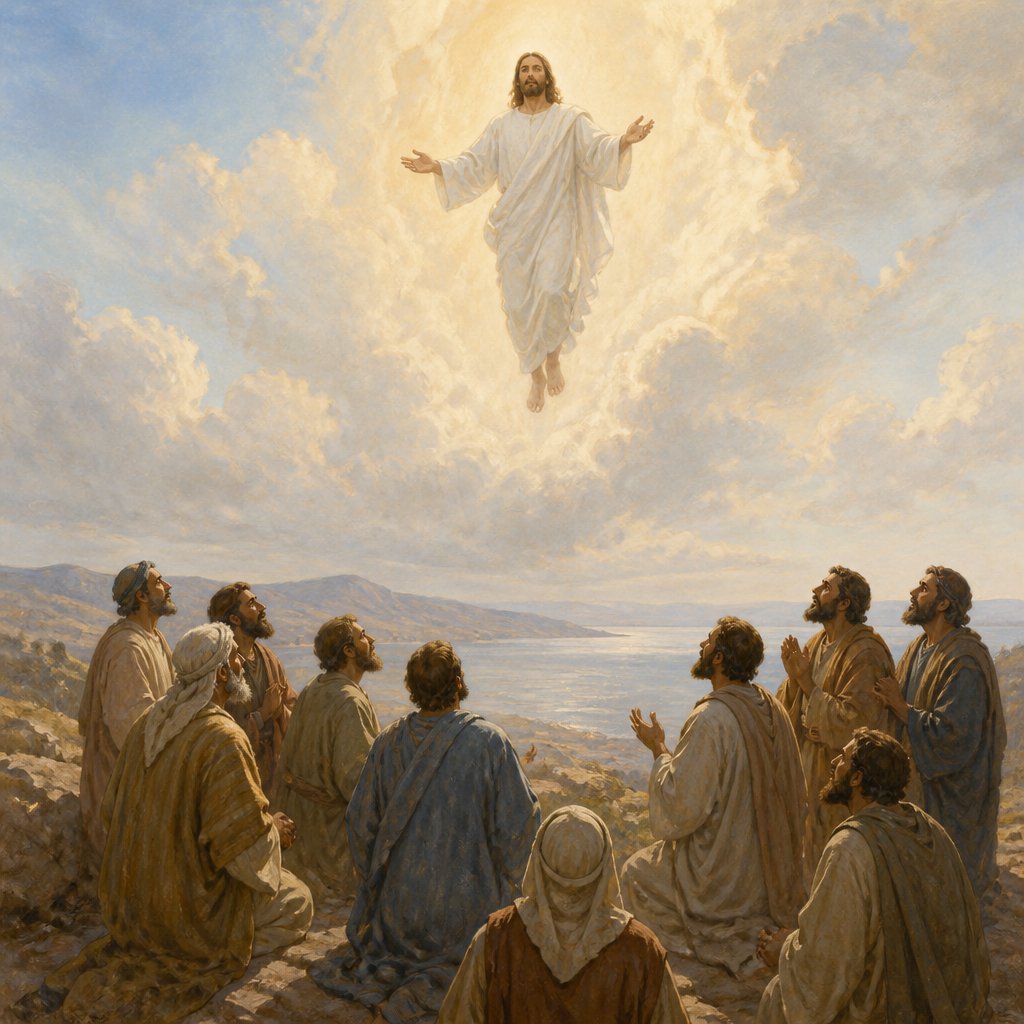
Acts 1:9 in the King James Version reads, “And when he had spoken these things, while they beheld, he was taken up; and a cloud received him out of their sight.” The verse stands at a hinge in the story of Christ and the story of the church. It is not merely a report of Jesus departing; it is the crowning scene of His resurrection appearances and the opening scene of the apostles’ witness to the world. Luke’s language stresses public reality and theological meaning at the same time: the ascension is something the disciples “beheld,” and yet it is also something heaven itself seals and interprets.
The immediate context is crucial. Just before this moment Jesus has spoken “these things,” namely His final instructions about the coming of the Holy Ghost and the calling of the disciples to be witnesses: “ye shall receive power, after that the Holy Ghost is come upon you: and ye shall be witnesses unto me…” (Acts 1:8, KJV). Acts 1:9 therefore functions like a divine punctuation mark. Christ’s earthly appearances are not meant to continue indefinitely; His bodily departure establishes that the mission will now advance by the Spirit’s power, not by Jesus remaining physically present among them in the same way as before. The church’s life in Acts is framed by this transition: the Lord ascends, the Spirit descends, and the apostles are sent.
The phrase “while they beheld” underscores the historical and communal nature of the event. This is not a private vision, not an inward feeling, and not a symbolic story detached from time and place. The disciples are eyewitnesses to a real change of Jesus’ visible location: He is “taken up.” The passive wording matters. Jesus does not simply drift away; He is taken up, indicating divine action and divine purpose. The ascension is God’s act of exalting the Son, completing the movement that began with the incarnation and humiliation and now rises into heavenly glory. In the KJV’s narrative flow, it is the visible confirmation that the crucified and risen Jesus is also the enthroned Lord.
“He was taken up” also carries the theme of completion. The resurrection is not the end of Christ’s work but the beginning of a new phase of it. In the story that follows, Jesus remains active, yet now He acts from heaven, ruling, sending, and saving through the Spirit and through the gospel. Acts continually presents Jesus as living and reigning, not absent in the sense of being uninvolved. Acts 1:9 establishes that His presence among His people will no longer be by ordinary sight, but it does not suggest abandonment. Rather, it prepares the reader for a church that is guided, empowered, corrected, and commissioned by the risen Lord who reigns from above.
The “cloud” is one of the most important symbols in the verse. Scripture frequently uses a cloud as the sign of divine presence and majesty. In the Old Testament, a cloud is bound up with God’s glory and His holy concealment: God is truly present, yet not fully grasped by human eyes. When Acts says “a cloud received him out of their sight,” it portrays the ascension as entry into the sphere of God’s glory. The cloud is not merely weather; it functions as a veil and a chariot-like sign that heaven is claiming Christ publicly. The disciples watch Him rise until the cloud intervenes, meaning their sight reaches its limit, not because Christ ceases to exist or becomes unreal, but because He passes into the realm where God’s glory is not ordinarily seen by mortal eyes.
That same cloud also communicates continuity with the whole biblical story of God dwelling with His people. The Lord who once made His presence known with cloud and glory now receives the Son into that divine presence. The symbolism teaches that Jesus’ ascension is not escape from the world but enthronement over it, a movement from visible fellowship with a small circle to sovereign lordship over all nations, which is exactly the scope promised in Acts 1:8.
The detail “out of their sight” speaks to the experience of faith in the age of the church. The apostles will not rely on seeing Jesus with their natural eyes as the basis of their mission; they will rely on the promise, the Spirit, and the word they are commissioned to bear. Acts 1:9 thus explains why the rest of Acts is not a record of Jesus walking around Palestine again, but a record of His gospel advancing through witnesses. The physical sight of Christ gives way to testimony about Christ, and that testimony is empowered from heaven.
The verse also carries a quiet note of assurance. Jesus is not removed in chaos or in defeat, but in a deliberate, witnessed, exalted departure. The disciples are left not with a corpse to mourn but with a risen Lord who is taken up in glory. The cloud that ends their seeing is also a sign that God is in this moment, receiving and affirming His Son. For a church that will soon face persecution, delay, and suffering, Acts 1:9 anchors hope: the Lord they preach is not merely a teacher of the past but the exalted Christ.
In short, Acts 1:9 is the decisive transition from Christ’s resurrection appearances to His heavenly reign and the Spirit-empowered mission of the church. Its themes are eyewitness reality, divine exaltation, the mystery of God’s glory signified by the cloud, and the shift from sight to faith-filled witness. It teaches that Jesus’ departure is not the end of His work but the manner by which His work becomes universal, as He is received into glory and His people are sent to testify “unto the uttermost part of the earth.”
Have questions about Acts 1:9?
Dive deeper into this scripture with Bible Chat — an AI-powered tool for exploring God's Word through conversation. Ask questions, get context, and grow in your understanding of the Bible.
Get Our Apps


Acts 1:9 Artwork

Acts 1:9 - "And when he had spoken these things, while they beheld, he was taken up; and a cloud received him out of their sight."

"And when he had spoken these things, while they beheld, he was taken up; and a cloud received him out of their sight." - Acts 1:9
"And when he had spoken these things, while they beheld, he was taken up; and a cloud received him out of their sight." - Acts 1:9

Acts 9:1-20

Acts 9:1-20

Acts 9:1 - "And Saul, yet breathing out threatenings and slaughter against the disciples of the Lord, went unto the high priest,"

Acts 9:9 - "And he was three days without sight, and neither did eat nor drink."

Acts 9:28 - "And he was with them coming in and going out at Jerusalem."

Acts 3:9 - "And all the people saw him walking and praising God:"

Acts 24:9 - "And the Jews also assented, saying that these things were so."

Acts 9:42 - "And it was known throughout all Joppa; and many believed in the Lord."

Acts 9:35 - "And all that dwelt at Lydda and Saron saw him, and turned to the Lord."

Acts 15:9 - "And put no difference between us and them, purifying their hearts by faith."

Acts 9:20 - "And straightway he preached Christ in the synagogues, that he is the Son of God."

Acts 7:9 - "And the patriarchs, moved with envy, sold Joseph into Egypt: but God was with him,"
"And Saul, yet breathing out threatenings and slaughter against the disciples of the Lord, went unto the high priest," - Acts 9:1

Acts 21:9 - "And the same man had four daughters, virgins, which did prophesy."

Acts 17:9 - "And when they had taken security of Jason, and of the other, they let them go."

Acts 9:25 - "Then the disciples took him by night, and let him down by the wall in a basket."

Acts 2:9 - "Parthians, and Medes, and Elamites, and the dwellers in Mesopotamia, and in Judaea, and Cappadocia, in Pontus, and Asia,"

Acts 9:43 - "And it came to pass, that he tarried many days in Joppa with one Simon a tanner."

Acts 9:24 - "But their laying await was known of Saul. And they watched the gates day and night to kill him."

Acts 9:7 - "And the men which journeyed with him stood speechless, hearing a voice, but seeing no man."

Acts 9:23 - "¶ And after that many days were fulfilled, the Jews took counsel to kill him:"

Acts 18:9 - "Then spake the Lord to Paul in the night by a vision, Be not afraid, but speak, and hold not thy peace:"

Acts 28:9 - "So when this was done, others also, which had diseases in the island, came, and were healed:"

Acts 22:9 - "And they that were with me saw indeed the light, and were afraid; but they heard not the voice of him that spake to me."

"And he was three days without sight, and neither did eat nor drink." - Acts 9:9

Acts 9:14 - "And here he hath authority from the chief priests to bind all that call on thy name."

Acts 9:16 - "For I will shew him how great things he must suffer for my name's sake."