What does Acts 12:10 mean?
"When they were past the first and the second ward, they came unto the iron gate that leadeth unto the city; which opened to them of his own accord: and they went out, and passed on through one street; and forthwith the angel departed from him." - Acts 12:10
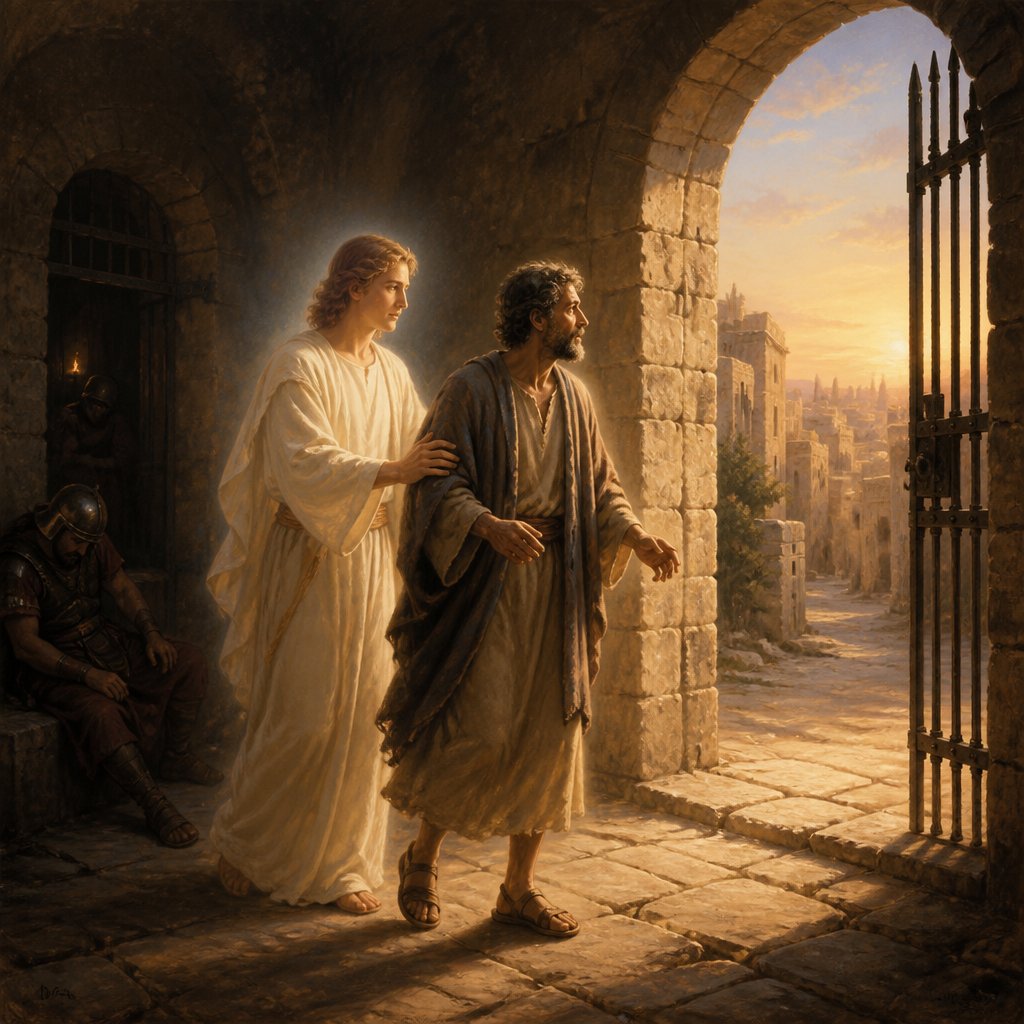
The Bible verse Acts 12:10 in the King James Version (KJV) reads, "When they were past the first and the second ward, they came unto the iron gate that leadeth unto the city; which opened to them of his own accord: and they went out, and passed on through one street; and forthwith the angel departed from him." This verse is part of the larger story of Peter's miraculous escape from prison, which is found in Acts 12:1-11.
In the preceding verses, King Herod had arrested the apostle Peter and put him in prison, intending to bring him out for public trial after the Passover. This was a time of intense persecution for the early church, and Peter's imprisonment was a cause of great distress and concern for the believers. However, in Acts 12:5, we are told that fervent prayer was made for Peter by the church.
In Acts 12:6-9, we read about how an angel of the Lord appeared to Peter in prison, struck him on the side to wake him up, and miraculously released him from his chains. The angel then instructed Peter to dress himself and follow him. At this point, we come to the verse in question, Acts 12:10, which describes Peter's journey out of the prison and into the city.
The imagery in this verse is rich with significance. The fact that they passed the first and second ward without detection is a testament to the power and protection of God. The iron gate, typically an obstacle to freedom and escape, opens of its own accord, signifying divine intervention and supernatural deliverance. This is a powerful testament to the truth that "with God, all things are possible" (Matthew 19:26).
The angel's departure from Peter also holds symbolic significance. This signifies that Peter was now free and in full possession of his faculties. The departure of the angel indicates that the immediate danger has passed and that Peter is now able to carry out his mission on his own.
The broader theme of this passage is the power of prayer and the faithfulness of God in delivering His people from impossible situations. The believers were fervently praying for Peter, and their prayers were answered in a miraculous way. This serves as a reminder to believers of the power of intercessory prayer and the faithfulness of God to hear and answer the cries of His people.
Furthermore, this passage also speaks to the reality of persecution and the sovereignty of God in the midst of it. The early church faced intense opposition and persecution, yet God was still at work, delivering His people from harm and advancing His kingdom in the face of adversity. This serves as a source of encouragement and hope for believers facing similar trials and tribulations.
The overarching message of Acts 12:10 and the entire narrative of Peter's escape is one of hope, divine intervention, and the sovereignty of God. It serves as a powerful reminder that God is able to deliver His people from any situation, no matter how impossible it may seem. It also underscores the importance of faith, prayer, and trust in God's faithfulness.
In conclusion, Acts 12:10 in the King James Version of the Bible speaks to the power of God to deliver His people from impossible situations, the importance of fervent prayer, and the sovereignty of God in the midst of persecution. The imagery and symbolism in this verse serve to reinforce these timeless truths, providing encouragement and hope for believers throughout the ages.
Have questions about Acts 12:10?
Dive deeper into this scripture with Bible Chat — an AI-powered tool for exploring God's Word through conversation. Ask questions, get context, and grow in your understanding of the Bible.
Get Our Apps


Acts 12:10 Artwork

Acts 12:10 - "When they were past the first and the second ward, they came unto the iron gate that leadeth unto the city; which opened to them of his own accord: and they went out, and passed on through one street; and forthwith the angel departed from him."
"When they were past the first and the second ward, they came unto the iron gate that leadeth unto the city; which opened to them of his own accord: and they went out, and passed on through one street; and forthwith the angel departed from him." - Acts 12:10

Acts 10:12 - "Wherein were all manner of fourfooted beasts of the earth, and wild beasts, and creeping things, and fowls of the air."

"Wherein were all manner of fourfooted beasts of the earth, and wild beasts, and creeping things, and fowls of the air." - Acts 10:12

Acts 28:12

Acts 18:12

Acts 18:12

Acts 4:8-12

acts 20:7-12

Acts 12:24 - "¶ But the word of God grew and multiplied."

acts 10:44-46

Acts 10:10 - "And he became very hungry, and would have eaten: but while they made ready, he fell into a trance,"

Acts 12:2 - "And he killed James the brother of John with the sword."

Acts 28:12 - "And landing at Syracuse, we tarried there three days."

Ezra 10:10-12

Acts 12:22 - "And the people gave a shout, saying, It is the voice of a god, and not of a man."

Acts 20:12 - "And they brought the young man alive, and were not a little comforted."

Acts 10:16 - "This was done thrice: and the vessel was received up again into heaven."

Acts 6:10 - "And they were not able to resist the wisdom and the spirit by which he spake."

Acts 10:46 - "For they heard them speak with tongues, and magnify God. Then answered Peter,"

Acts 12:13 - "And as Peter knocked at the door of the gate, a damsel came to hearken, named Rhoda."

Acts 14:12 - "And they called Barnabas, Jupiter; and Paul, Mercurius, because he was the chief speaker."

Acts 26:12 - "Whereupon as I went to Damascus with authority and commission from the chief priests,"

Acts 11:10 - "And this was done three times: and all were drawn up again into heaven."

Acts 10:40 - "Him God raised up the third day, and shewed him openly;"

Acts 10:35 - "But in every nation he that feareth him, and worketh righteousness, is accepted with him."

"¶ But the word of God grew and multiplied." - Acts 12:24

Acts 10:18 - "And called, and asked whether Simon, which was surnamed Peter, were lodged there."

Acts 12:12 - "And when he had considered the thing, he came to the house of Mary the mother of John, whose surname was Mark; where many were gathered together praying."

Acts 2:12 - "And they were all amazed, and were in doubt, saying one to another, What meaneth this?"