What does 2 Samuel 5:2 mean?
"Also in time past, when Saul was king over us, thou wast he that leddest out and broughtest in Israel: and the LORD said to thee, Thou shalt feed my people Israel, and thou shalt be a captain over Israel." - 2 Samuel 5:2
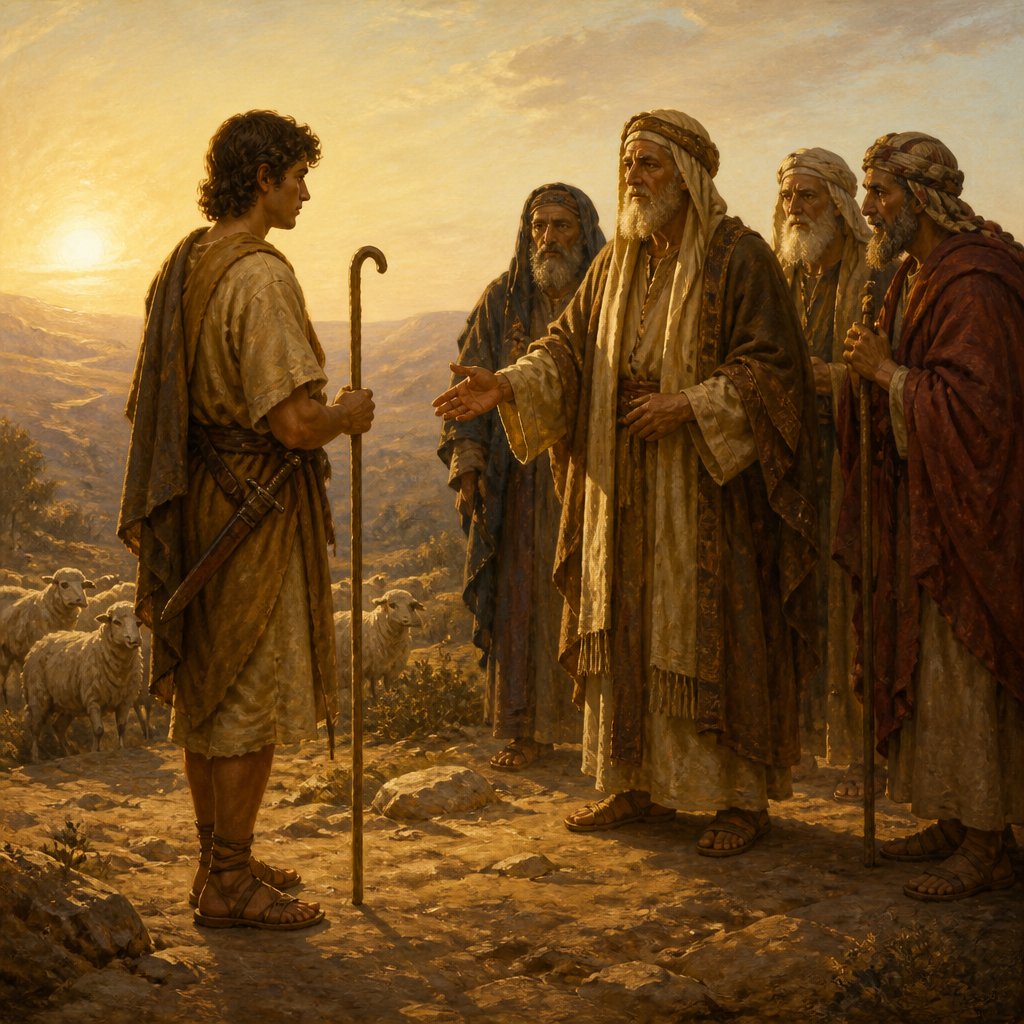
2 Samuel 5:2 (KJV) reads, "Also in time past, when Saul was king over us, thou wast he that leddest out and broughtest in Israel: and the Lord said to thee, Thou shalt feed my people Israel, and thou shalt be a captain over Israel."
This verse comes from the Old Testament book of 2 Samuel. It is a significant moment in the history of Israel, as it marks the end of a tumultuous period and the beginning of a new era of leadership under King David.
The verse begins by referencing the reign of King Saul, who ruled over Israel before David. During Saul's reign, there was discord and conflict within the nation, and the people of Israel suffered greatly. This sets the stage for the transition of power to David, who is being acknowledged as the one who led the people in and out, indicating his prowess in military leadership and guidance. This acknowledgment sets the historical context of the verse, as it marks a pivotal moment in the establishment of David as the rightful leader of Israel.
The verse then refers to a divine proclamation from the Lord to David. The Lord declares that David will "feed" His people Israel and will be a "captain" over them. This statement holds deep significance, as it signifies David's appointment as the shepherd and protector of the Israelite people. The term "feed" implies that David is to provide for the physical, spiritual, and emotional needs of the people, much like a shepherd caring for his flock. Additionally, the term "captain" indicates that David is to lead, guide, and protect the nation with strength and authority.
The themes present in this verse are the sovereignty of God, divine calling, and the responsibility of leadership. The verse highlights the belief that God plays an active role in the appointment and anointing of leaders. In the case of David, it demonstrates that his ascension to kingship is a result of God's divine will and plan for the nation of Israel. Furthermore, it emphasizes the weight and responsibility that comes with leadership, as David is called to "feed" and "captain" God's people, signifying his duty to care for and guide them.
Symbolism can also be observed in this verse. The imagery of David as a shepherd leading his flock draws parallels to the role of Jesus Christ as the Good Shepherd in the New Testament. It foreshadows the kind of leadership that David is to embody – one characterized by compassion, protection, and selflessness. The idea of "feeding" the people can also be seen as a metaphor for providing spiritual nourishment and guidance, alluding to David's role as a spiritual leader in addition to a political one.
In a broader context, this verse is emblematic of the transition from a period of unrest and turmoil to a time of stability and prosperity under the leadership of David. It serves as a reminder of God's faithfulness to His people and His commitment to raising up leaders who will serve His purposes. Additionally, it sets the stage for David's reign as king, laying the foundation for the golden age of Israel and the establishment of the Davidic dynasty.
In conclusion, 2 Samuel 5:2 (KJV) holds profound significance in the biblical narrative, as it marks the moment of David's anointing as the shepherd and captain of Israel by the Lord. It emphasizes the divine calling and responsibility of leadership, while also incorporating symbolism that points to the qualities of a true and noble leader. The verse serves as a pivotal moment in Israel's history, signifying the beginning of a new era under the rule of King David and laying the groundwork for the fulfillment of God's plan for His people.
Have questions about 2 Samuel 5:2?
Dive deeper into this scripture with Bible Chat — an AI-powered tool for exploring God's Word through conversation. Ask questions, get context, and grow in your understanding of the Bible.
Get Our Apps


2 Samuel 5:2 Artwork

2 Samuel 5:2 - "Also in time past, when Saul was king over us, thou wast he that leddest out and broughtest in Israel: and the LORD said to thee, Thou shalt feed my people Israel, and thou shalt be a captain over Israel."
"Also in time past, when Saul was king over us, thou wast he that leddest out and broughtest in Israel: and the LORD said to thee, Thou shalt feed my people Israel, and thou shalt be a captain over Israel." - 2 Samuel 5:2

2 Samuel 5:12

2 Samuel 5:16 - "And Elishama, and Eliada, and Eliphalet."

2 Samuel 5:15 - "Ibhar also, and Elishua, and Nepheg, and Japhia,"

2 Samuel 5:21 - "And there they left their images, and David and his men burned them."

2 Samuel 5:18 - "The Philistines also came and spread themselves in the valley of Rephaim."

2 Samuel 5:7 - "Nevertheless David took the strong hold of Zion: the same is the city of David."

2 Samuel 5:10 - "And David went on, and grew great, and the LORD God of hosts was with him."

2 Samuel 11:5 - "And the woman conceived, and sent and told David, and said, I am with child."

2 Samuel 5:22 - "¶ And the Philistines came up yet again, and spread themselves in the valley of Rephaim."

"And Elishama, and Eliada, and Eliphalet." - 2 Samuel 5:16

2 Samuel 3:5 - "And the sixth, Ithream, by Eglah David's wife. These were born to David in Hebron."

1 Samuel 5:2 - "When the Philistines took the ark of God, they brought it into the house of Dagon, and set it by Dagon."

2 Samuel 22:5 - "When the waves of death compassed me, the floods of ungodly men made me afraid;"

2 Samuel 5:14 - "And these be the names of those that were born unto him in Jerusalem; Shammua, and Shobab, and Nathan, and Solomon,"

2 Samuel 5:4 - "¶ David was thirty years old when he began to reign, and he reigned forty years."

2 Samuel 5:5 - "In Hebron he reigned over Judah seven years and six months: and in Jerusalem he reigned thirty and three years over all Israel and Judah."

2 Samuel 5:11 - "¶ And Hiram king of Tyre sent messengers to David, and cedar trees, and carpenters, and masons: and they built David an house."

2 Samuel 9:5 - "¶ Then king David sent, and fetched him out of the house of Machir, the son of Ammiel, from Lo-debar."

2 Samuel 1:5 - "And David said unto the young man that told him, How knowest thou that Saul and Jonathan his son be dead?"

2 Samuel 2:5 - "¶ And David sent messengers unto the men of Jabesh-gilead, and said unto them, Blessed be ye of the LORD, that ye have shewed this kindness unto your lord, even unto Saul, and have buried him."

"Ibhar also, and Elishua, and Nepheg, and Japhia," - 2 Samuel 5:15

2 Samuel 5:9 - "So David dwelt in the fort, and called it the city of David. And David built round about from Millo and inward."

2 Samuel 17:5 - "Then said Absalom, Call now Hushai the Archite also, and let us hear likewise what he saith."

2 Samuel 24:5 - "¶ And they passed over Jordan, and pitched in Aroer, on the right side of the city that lieth in the midst of the river of Gad, and toward Jazer:"

2 Samuel 5:25 - "And David did so, as the LORD had commanded him; and smote the Philistines from Geba until thou come to Gazer."

2 Samuel 7:5 - "Go and tell my servant David, Thus saith the LORD, Shalt thou build me an house for me to dwell in?"

2 Samuel 5:1 - "Then came all the tribes of Israel to David unto Hebron, and spake, saying, Behold, we are thy bone and thy flesh."

2 Samuel 8:5 - "And when the Syrians of Damascus came to succour Hadadezer king of Zobah, David slew of the Syrians two and twenty thousand men."