What does 2 Samuel 3:25 mean?
"Thou knowest Abner the son of Ner, that he came to deceive thee, and to know thy going out and thy coming in, and to know all that thou doest." - 2 Samuel 3:25
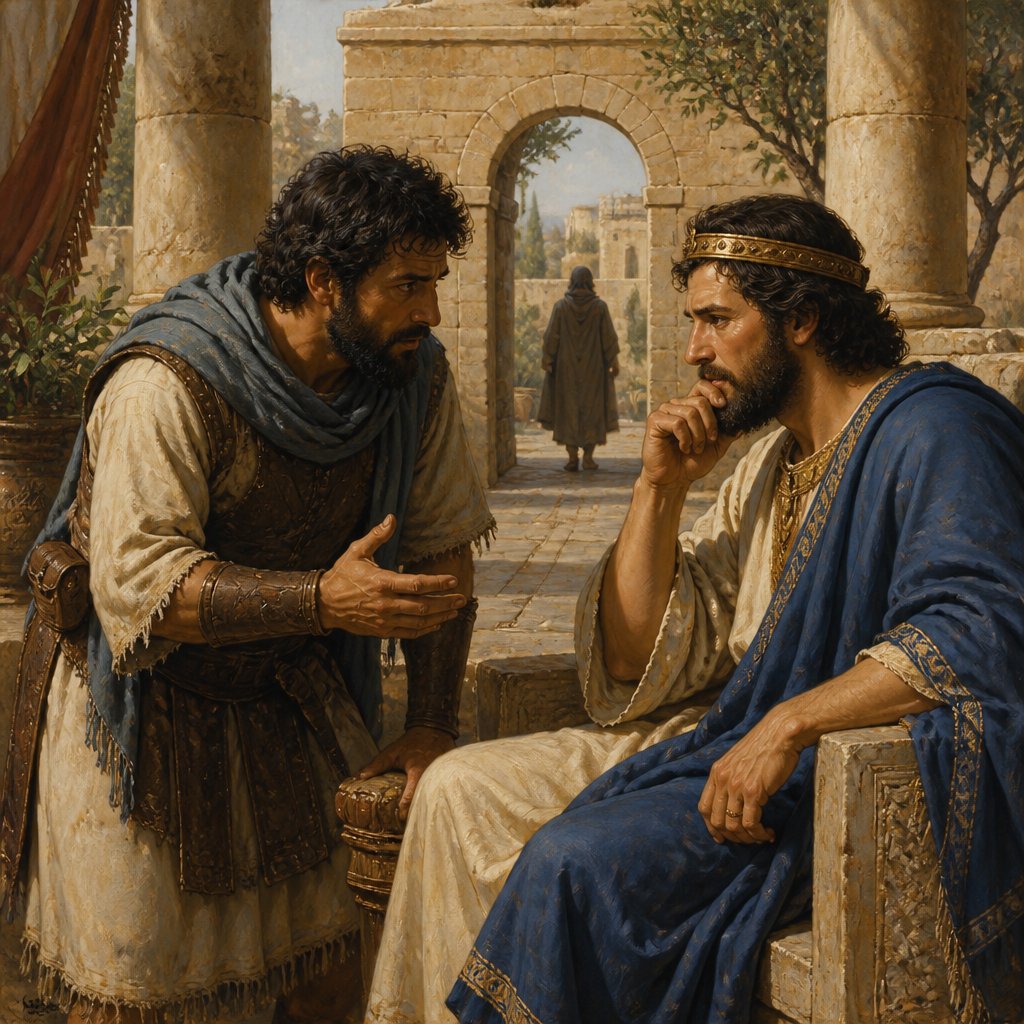
The verse 2 Samuel 3:25 from the King James Version reads, "Thou knowest Abner the son of Ner, that he came to deceive thee, and to know thy going out and thy coming in, and to know all that thou doest." This passage is part of the larger narrative of the aftermath of King Saul's death and David's ascension to the throne of Israel.
In this verse, the speaker is Joab, the commander of David's army, who is addressing David about the recent murder of Abner, the former commander of Saul's army. To fully understand the meaning and commentary of this verse, it is important to look at the themes, context, and symbolism within 2 Samuel 3.
One of the central themes of 2 Samuel 3 is the struggle for power and authority. After Saul's death, there were multiple contenders for the throne, including Ishbosheth, Saul's son, and David, who had been anointed by Samuel to be the future king of Israel. This power struggle led to conflict and violence, as different factions vied for control of the kingdom. The murder of Abner, as referenced in the verse, is a direct result of this struggle for power. Abner had switched his allegiance from Ishbosheth to David, and this betrayal ultimately led to his death at the hands of Joab.
Another important theme in 2 Samuel 3 is the complex and often tumultuous relationships between the key players in the narrative. The verse 2 Samuel 3:25 captures the underlying tension and suspicion that existed between Joab and Abner. Joab accuses Abner of coming to deceive David, to spy on his movements, and to undermine his authority. This passage highlights the deep-seated animosity and lack of trust that characterized the relationships between the different factions in the kingdom at that time.
The context of this verse is also critical to understanding its deeper meaning. At this point in the narrative, David is consolidating his power and solidifying his position as the rightful king of Israel. The murder of Abner, a prominent figure in Saul's administration, was a significant event that threatened to destabilize David's rule. Joab's accusation against Abner is an attempt to justify his actions and to reinforce David's trust in him as the leader of the army.
The verse is also symbolic of the broader themes of loyalty and betrayal that run throughout the biblical narrative. Abner's betrayal of Ishbosheth and his subsequent murder at the hands of Joab illustrate the consequences of disloyalty and the ruthless pursuit of power. Furthermore, this passage underscores the importance of discernment and wisdom in dealing with the challenges of leadership and governance.
In conclusion, 2 Samuel 3:25 is a powerful and poignant verse that sheds light on the complex dynamics of power, loyalty, and betrayal in the biblical narrative. Through its themes, context, and symbolism, this verse offers valuable insights into the intricacies of human relationships and the challenges of leadership. It invites readers to reflect on the timeless truths and enduring relevance of these themes in their own lives and in the broader scope of history.
Have questions about 2 Samuel 3:25?
Dive deeper into this scripture with Bible Chat — an AI-powered tool for exploring God's Word through conversation. Ask questions, get context, and grow in your understanding of the Bible.
Get Our Apps


2 Samuel 3:25 Artwork

2 Samuel 3:25 - "Thou knowest Abner the son of Ner, that he came to deceive thee, and to know thy going out and thy coming in, and to know all that thou doest."
"Thou knowest Abner the son of Ner, that he came to deceive thee, and to know thy going out and thy coming in, and to know all that thou doest." - 2 Samuel 3:25

2 Samuel 23:25 - "Shammah the Harodite, Elika the Harodite,"

2 Samuel 20:25 - "And Sheva was scribe: and Zadok and Abiathar were the priests:"

2 Samuel 2:25 - "¶ And the children of Benjamin gathered themselves together after Abner, and became one troop, and stood on the top of an hill."

"Shammah the Harodite, Elika the Harodite," - 2 Samuel 23:25

2 Samuel 12:25 - "And he sent by the hand of Nathan the prophet; and he called his name Jedidiah, because of the LORD."

2 Samuel 1:25 - "How are the mighty fallen in the midst of the battle! O Jonathan, thou wast slain in thine high places."

2 Samuel 22:25 - "Therefore the LORD hath recompensed me according to my righteousness; according to my cleanness in his eye sight."

2 Samuel 5:25 - "And David did so, as the LORD had commanded him; and smote the Philistines from Geba until thou come to Gazer."

2 Samuel 3:2 - "¶ And unto David were sons born in Hebron: and his firstborn was Amnon, of Ahinoam the Jezreelitess;"

"And Sheva was scribe: and Zadok and Abiathar were the priests:" - 2 Samuel 20:25

2 Samuel 18:25 - "And the watchman cried, and told the king. And the king said, If he be alone, there is tidings in his mouth. And he came apace, and drew near."

2 Samuel 4:3 - "And the Beerothites fled to Gittaim, and were sojourners there until this day.)"

1 Samuel 25:3 - "Now the name of the man was Nabal; and the name of his wife Abigail: and she was a woman of good understanding, and of a beautiful countenance: but the man was churlish and evil in his doings; and he was of the house of Caleb."

2 Samuel 19:25 - "And it came to pass, when he was come to Jerusalem to meet the king, that the king said unto him, Wherefore wentest not thou with me, Mephibosheth?"

2 Kings 25:3 - "And on the ninth day of the fourth month the famine prevailed in the city, and there was no bread for the people of the land."

2 Samuel 3:4 - "And the fourth, Adonijah the son of Haggith; and the fifth, Shephatiah the son of Abital;"

2 Samuel 3:3 - "And his second, Chileab, of Abigail the wife of Nabal the Carmelite; and the third, Absalom the son of Maacah the daughter of Talmai king of Geshur;"

2 Samuel 3:11 - "And he could not answer Abner a word again, because he feared him."

2 Samuel 24:25 - "And David built there an altar unto the LORD, and offered burnt offerings and peace offerings. So the LORD was intreated for the land, and the plague was stayed from Israel."

2 Samuel 3:33 - "And the king lamented over Abner, and said, Died Abner as a fool dieth?"

2 Samuel 3:5 - "And the sixth, Ithream, by Eglah David's wife. These were born to David in Hebron."

2 Samuel 14:25 - "¶ But in all Israel there was none to be so much praised as Absalom for his beauty: from the sole of his foot even to the crown of his head there was no blemish in him."

2 Samuel 2:3 - "And his men that were with him did David bring up, every man with his household: and they dwelt in the cities of Hebron."

2 Samuel 7:3 - "And Nathan said to the king, Go, do all that is in thine heart; for the LORD is with thee."
2 Samuel 7:25 - "And now, O LORD God, the word that thou hast spoken concerning thy servant, and concerning his house, establish it for ever, and do as thou hast said."

2 Samuel 3:37 - "For all the people and all Israel understood that day that it was not of the king to slay Abner the son of Ner."

1 Samuel 25:2 - "And there was a man in Maon, whose possessions were in Carmel; and the man was very great, and he had three thousand sheep, and a thousand goats: and he was shearing his sheep in Carmel."

2 Samuel 3:15 - "And Ish-bosheth sent, and took her from her husband, even from Phaltiel the son of Laish."