What does 2 Samuel 1:14 mean?
"And David said unto him, How wast thou not afraid to stretch forth thine hand to destroy the LORD'S anointed?" - 2 Samuel 1:14
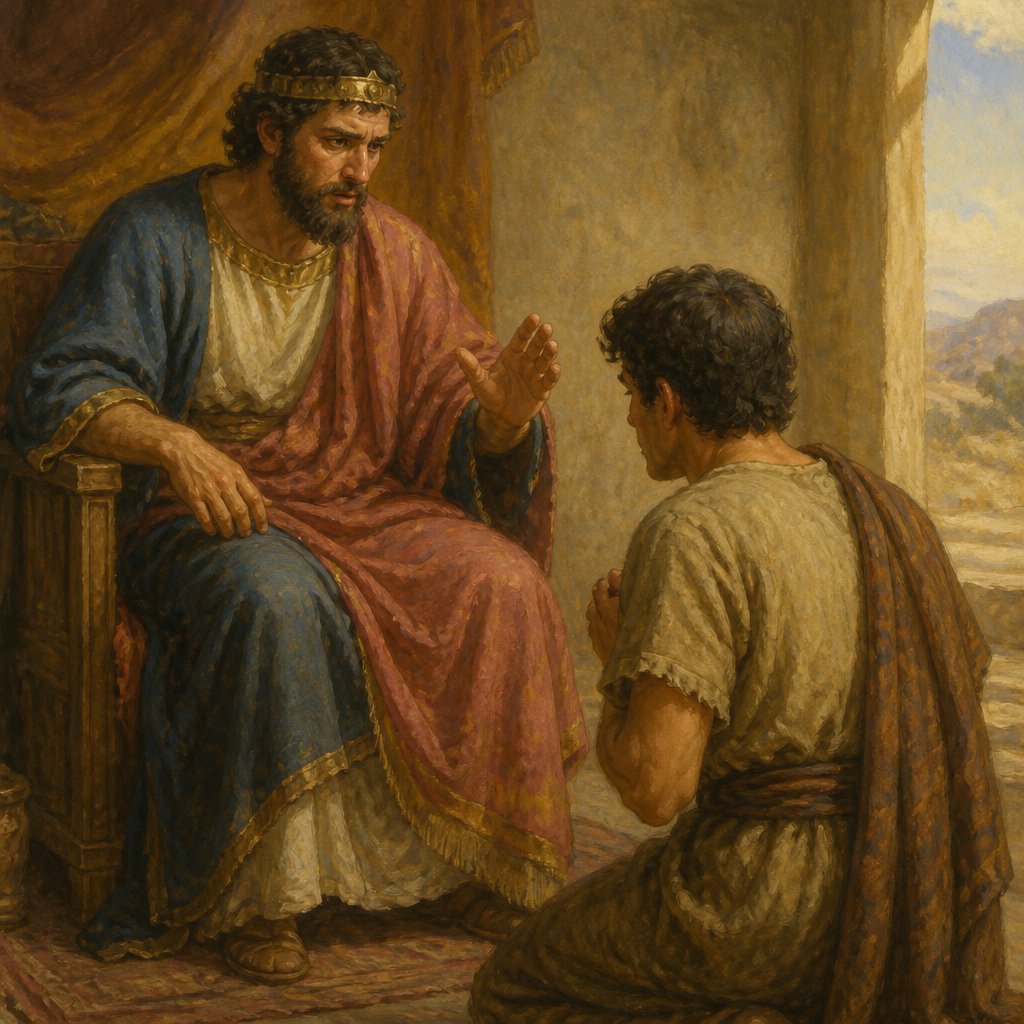
The Bible verse 2 Samuel 1:14 from the King James Version (KJV) states: "And David said unto him, How wast thou not afraid to stretch forth thine hand to destroy the Lord's anointed?" This verse is part of a larger narrative in which David mourns the death of King Saul and his son Jonathan, showing respect for the Lord's anointed and demonstrating a deep sense of honor and reverence for God's chosen leaders.
The context of this verse is important to understanding its deeper meaning. In the previous verses, an Amalekite came to David with the news that he had killed King Saul at Saul's request. The Amalekite believed that by claiming responsibility for Saul's death, he would gain favor with David, who was widely regarded as the next king of Israel. However, this plan backfired, as David was deeply grieved by the news of Saul's death and mourned for him and Jonathan. This verse is part of David's response to the Amalekite's claim, in which he questions the man's audacity to harm the Lord's anointed leader.
One of the key themes of this verse is the concept of honoring and respecting God's chosen leaders. In the Bible, anointing is a sacred act that sets apart individuals for a specific purpose and signifies divine approval and authority. Kings, prophets, and priests were anointed with oil as a symbol of being chosen and called by God to fulfill their respective roles. By referring to Saul as "the Lord's anointed," David acknowledges the special status and authority that Saul held as the king of Israel, despite their complicated relationship and past conflicts.
This verse also reflects the biblical principle of not seeking vengeance or taking matters into one's own hands. David's question to the Amalekite implies that he was appalled by the man's lack of fear and reverence for God in presuming to kill the king. This aligns with the overarching message of the Bible to trust in God's justice and to refrain from seeking retribution or retaliation on one's own. It also serves as a reminder that leaders, regardless of their flaws or shortcomings, are appointed by God, and it is not the place of individuals to usurp that authority or take actions that undermine it.
Furthermore, this verse highlights the importance of humility and submission to God's will. David's response to the news of Saul's death reveals his humility and his willingness to accept God's sovereignty, even in circumstances that may have seemed advantageous to him. Rather than seizing the opportunity to assert his claim to the throne, David grieves for Saul and Jonathan, expressing a genuine sense of loss and respect for their positions as the Lord's anointed.
Symbolically, this verse can be seen as a reflection of the larger biblical narrative of God's providence and the fulfillment of His purposes through flawed and imperfect human leaders. It also underscores the divine principle of honoring authority and acknowledging the sovereignty of God in all things. Overall, 2 Samuel 1:14 encapsulates timeless themes of respect, humility, and submission to God's will, providing valuable insights for individuals and communities seeking to live in accordance with biblical principles.
Have questions about 2 Samuel 1:14?
Dive deeper into this scripture with Bible Chat — an AI-powered tool for exploring God's Word through conversation. Ask questions, get context, and grow in your understanding of the Bible.
Get Our Apps


2 Samuel 1:14 Artwork

2 Samuel 1:14 - "And David said unto him, How wast thou not afraid to stretch forth thine hand to destroy the LORD'S anointed?"
"And David said unto him, How wast thou not afraid to stretch forth thine hand to destroy the LORD'S anointed?" - 2 Samuel 1:14

2 Samuel 6:14

2 Samuel 14:1 - "Now Joab the son of Zeruiah perceived that the king's heart was toward Absalom."

2 Samuel 1:4 - "And David said unto him, How went the matter? I pray thee, tell me. And he answered, That the people are fled from the battle, and many of the people also are fallen and dead; and Saul and Jonathan his son are dead also."

1 Samuel 14:2 - "And Saul tarried in the uttermost part of Gibeah under a pomegranate tree which is in Migron: and the people that were with him were about six hundred men;"

2 Samuel 1. 17-27

1 Samuel 14:6

1 Samuel 1:14 - "And Eli said unto her, How long wilt thou be drunken? put away thy wine from thee."

1 Samuel 14:27

1 Samuel 14:7

1 Samuel 11:14 - "Then said Samuel to the people, Come, and let us go to Gilgal, and renew the kingdom there."

2 Samuel 6:14–22

1 Samuel 2:14 - "And he struck it into the pan, or kettle, or caldron, or pot; all that the fleshhook brought up the priest took for himself. So they did in Shiloh unto all the Israelites that came thither."

2 Samuel 23:14 - "And David was then in an hold, and the garrison of the Philistines was then in Beth-lehem."
"Now Joab the son of Zeruiah perceived that the king's heart was toward Absalom." - 2 Samuel 14:1

1 Samuel 17:14 - "And David was the youngest: and the three eldest followed Saul."

1 Samuel 15:14 - "And Samuel said, What meaneth then this bleating of the sheep in mine ears, and the lowing of the oxen which I hear?"

2 Samuel 14:23 - "So Joab arose and went to Geshur, and brought Absalom to Jerusalem."

1 Samuel 14:51 - "And Kish was the father of Saul; and Ner the father of Abner was the son of Abiel."

1 Samuel 14:25 - "And all they of the land came to a wood; and there was honey upon the ground."

2 Samuel 22:14 - "The LORD thundered from heaven, and the most High uttered his voice."

2 Samuel 16:14 - "And the king, and all the people that were with him, came weary, and refreshed themselves there."

2 Samuel 1:27 - "How are the mighty fallen, and the weapons of war perished!"

1 Samuel 9:14 - "And they went up into the city: and when they were come into the city, behold, Samuel came out against them, for to go up to the high place."

2 Samuel 14:28 - "¶ So Absalom dwelt two full years in Jerusalem, and saw not the king's face."

2 Samuel 11:14 - "¶ And it came to pass in the morning, that David wrote a letter to Joab, and sent it by the hand of Uriah."

1 Samuel 19:14 - "And when Saul sent messengers to take David, she said, He is sick."

1 Samuel 14:46 - "Then Saul went up from following the Philistines: and the Philistines went to their own place."

2 Samuel 2:14 - "And Abner said to Joab, Let the young men now arise, and play before us. And Joab said, Let them arise."