What does 2 Samuel 19:25 mean?
"And it came to pass, when he was come to Jerusalem to meet the king, that the king said unto him, Wherefore wentest not thou with me, Mephibosheth?" - 2 Samuel 19:25
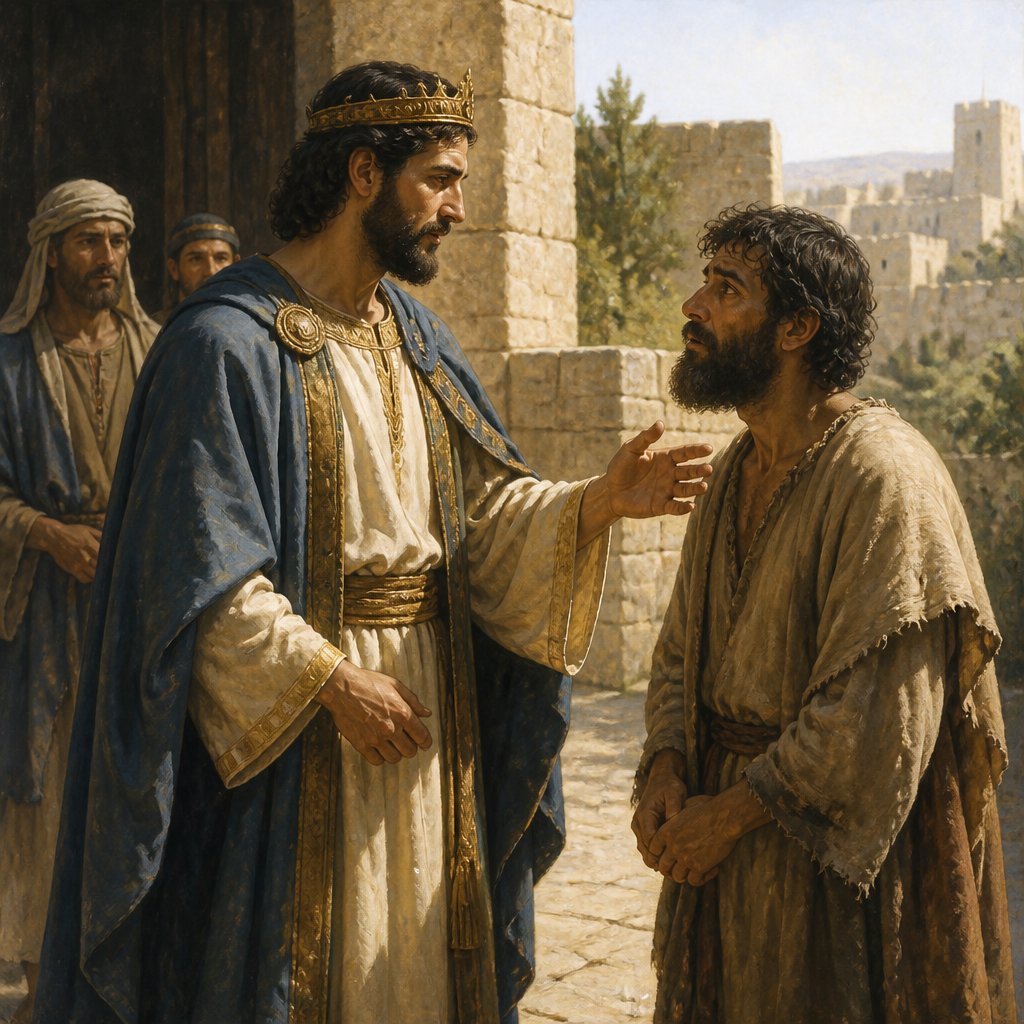
The verse 2 Samuel 19:25 in the King James Version reads: "And it came to pass, when he was come to Jerusalem to meet the king, that the king said unto him, Wherefore wentest not thou with me, Mephibosheth?"
This verse is a part of the Old Testament narrative which describes the events that occurred after the rebellion of Absalom, the son of King David. Absalom had led a revolt against his father, seeking to overthrow him and take the throne for himself. In the ensuing conflict, Absalom was killed, and David was eventually restored to his position as king of Israel. The verse 2 Samuel 19:25 takes place in the aftermath of these events.
The verse specifically mentions Mephibosheth, who was the son of Jonathan and the grandson of King Saul. Mephibosheth was disabled, and he had been shown kindness by King David, who had welcomed him to his palace and provided for him after the death of his father and grandfather. However, during Absalom's rebellion, Mephibosheth had remained in Jerusalem, and he had not joined David as he fled from Absalom.
The verse reflects a conversation between Mephibosheth and King David upon David's return to Jerusalem. David asks Mephibosheth why he did not join him during his time of exile, expressing disappointment that Mephibosheth had not shown his loyalty by following him. This interaction reveals David's concern for the loyalty of those around him, particularly in the face of a rebellion from within his own family.
This verse can be seen as a reflection of the themes of loyalty, betrayal, and forgiveness. Mephibosheth's absence during David's exile could be interpreted as a lack of faithfulness or a lack of confidence in David's ability to retain his throne. This may have been particularly hurtful to David, considering the kindness and generosity he had shown to Mephibosheth in the past. This interaction between David and Mephibosheth serves as a reminder of the complexities of human relationships, and the difficulties of maintaining loyalty and trust in the midst of political and personal turmoil.
The verse can also be considered in the context of the broader themes of the biblical narrative, particularly the theme of forgiveness and reconciliation. Despite his disappointment, David's reaction to Mephibosheth's absence is not one of anger or retribution. Instead, David's question to Mephibosheth can be interpreted as an invitation to reconcile and to reaffirm their relationship. This reflects David's capacity for forgiveness and his desire to rebuild the bonds of loyalty and trust among his followers.
Symbolically, Mephibosheth can be seen as representative of those who may have faltered or failed in their loyalty to God or to their leaders. His actions (or lack thereof) reflect the human tendency to prioritize self-preservation or personal interests over loyalty and fidelity. However, David's response to Mephibosheth's absence serves as a model of the forgiveness and grace that is offered by God, even in the face of our own failures and shortcomings.
In conclusion, the verse 2 Samuel 19:25 provides a glimpse into the complexities of human relationships and the challenges of maintaining loyalty and trust in the midst of political and personal turmoil. It also highlights the themes of forgiveness, reconciliation, and the redemptive power of grace. Through this interaction between Mephibosheth and King David, the verse encourages readers to reflect on their own capacity for loyalty and forgiveness and to consider the ways in which they can strive to embody these values in their own lives.
Have questions about 2 Samuel 19:25?
Dive deeper into this scripture with Bible Chat — an AI-powered tool for exploring God's Word through conversation. Ask questions, get context, and grow in your understanding of the Bible.
Get Our Apps


2 Samuel 19:25 Artwork

2 Samuel 19:25 - "And it came to pass, when he was come to Jerusalem to meet the king, that the king said unto him, Wherefore wentest not thou with me, Mephibosheth?"
"And it came to pass, when he was come to Jerusalem to meet the king, that the king said unto him, Wherefore wentest not thou with me, Mephibosheth?" - 2 Samuel 19:25

2 Samuel 23:25 - "Shammah the Harodite, Elika the Harodite,"

2 Samuel 19:8

2 Samuel 19:8

2 Samuel 19:8

2 Samuel 19:8

2 Samuel 19:24

2 Samuel 20:25 - "And Sheva was scribe: and Zadok and Abiathar were the priests:"
1 Samuel 25:19 - "And she said unto her servants, Go on before me; behold, I come after you. But she told not her husband Nabal."

2 Samuel 2:25 - "¶ And the children of Benjamin gathered themselves together after Abner, and became one troop, and stood on the top of an hill."

2 Samuel 19:1 - "And it was told Joab, Behold, the king weepeth and mourneth for Absalom."

2 Samuel 22:19 - "They prevented me in the day of my calamity: but the LORD was my stay."

"Shammah the Harodite, Elika the Harodite," - 2 Samuel 23:25

2 Samuel 24:19 - "And David, according to the saying of Gad, went up as the LORD commanded."

2 Samuel 12:25 - "And he sent by the hand of Nathan the prophet; and he called his name Jedidiah, because of the LORD."

2 Samuel 2:19 - "And Asahel pursued after Abner; and in going he turned not to the right hand nor to the left from following Abner."

2 Samuel 1:25 - "How are the mighty fallen in the midst of the battle! O Jonathan, thou wast slain in thine high places."

2 Samuel 1:19 - "The beauty of Israel is slain upon thy high places: how are the mighty fallen!"

2 Samuel 19:2 - "And the victory that day was turned into mourning unto all the people: for the people heard say that day how the king was grieved for his son."

2 Samuel 22:25 - "Therefore the LORD hath recompensed me according to my righteousness; according to my cleanness in his eye sight."

2 Samuel 5:25 - "And David did so, as the LORD had commanded him; and smote the Philistines from Geba until thou come to Gazer."

2 Samuel 19:23 - "Therefore the king said unto Shimei, Thou shalt not die. And the king sware unto him."

"And Sheva was scribe: and Zadok and Abiathar were the priests:" - 2 Samuel 20:25

2 Samuel 18:25 - "And the watchman cried, and told the king. And the king said, If he be alone, there is tidings in his mouth. And he came apace, and drew near."

2 Samuel 11:19 - "And charged the messenger, saying, When thou hast made an end of telling the matters of the war unto the king,"

2 Samuel 23:19 - "Was he not most honourable of three? therefore he was their captain: howbeit he attained not unto the first three."

2 Samuel 17:19 - "And the woman took and spread a covering over the well's mouth, and spread ground corn thereon; and the thing was not known."

2 Samuel 19:33 - "And the king said unto Barzillai, Come thou over with me, and I will feed thee with me in Jerusalem."

2 Samuel 19:36 - "Thy servant will go a little way over Jordan with the king: and why should the king recompense it me with such a reward?"