What does 2 Samuel 19:21 mean?
"But Abishai the son of Zeruiah answered and said, Shall not Shimei be put to death for this, because he cursed the LORD'S anointed?" - 2 Samuel 19:21
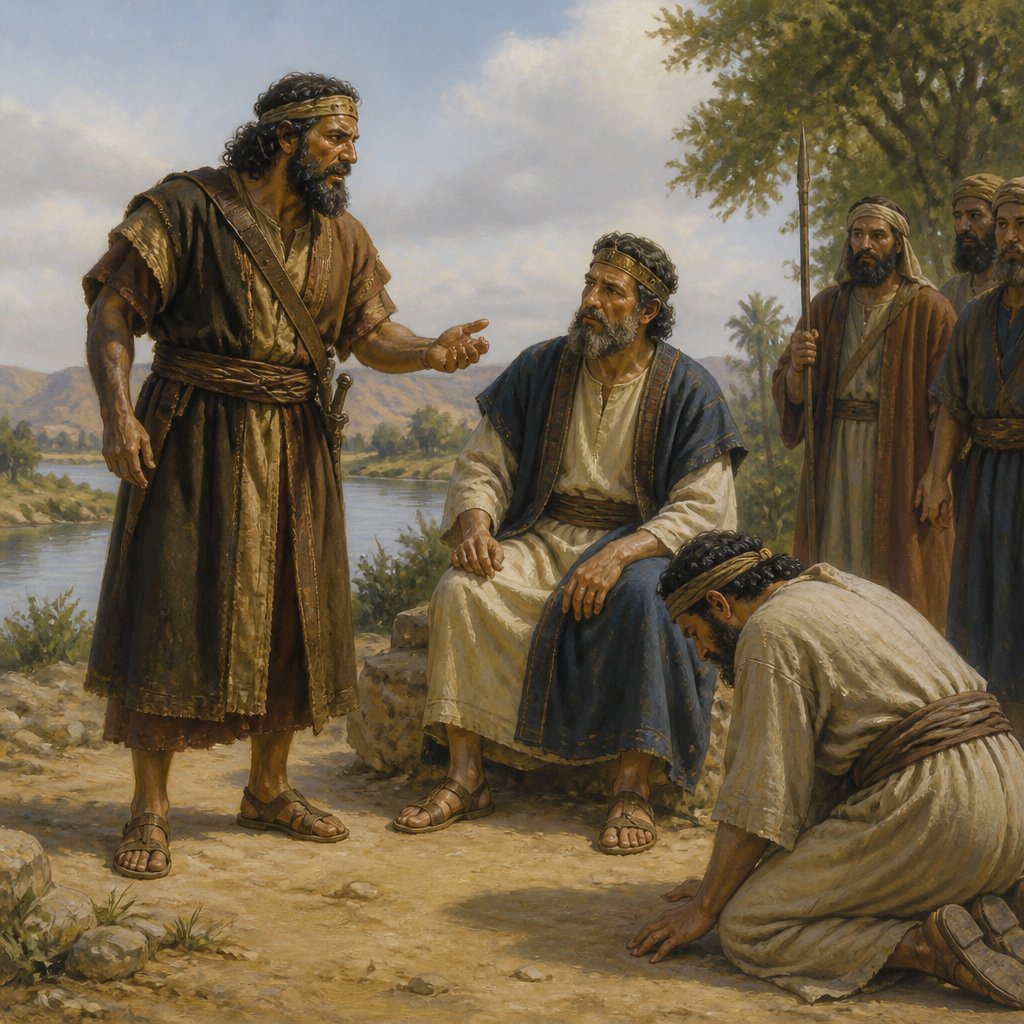
The Bible verse 2 Samuel 19:21 from the King James Version (KJV) reads: "But Abishai the son of Zeruiah answered and said, Shall not Shimei be put to death for this, because he cursed the Lord's anointed?"
This verse is part of the historical narrative of King David and his return to Jerusalem after his son Absalom rebelled against him and declared himself king. In this context, the verse comes from a moment of tension and conflict as King David is dealing with the aftermath of the rebellion and seeking to restore order and unity to his kingdom.
The verse opens with Abishai, the son of Zeruiah, speaking out against Shimei, who had cursed King David during the time of his exile. Abishai's question, "Shall not Shimei be put to death for this, because he cursed the Lord's anointed?" raises important themes of justice, mercy, and forgiveness.
One of the key themes in this verse is the tension between justice and mercy. Abishai advocates for justice in the form of putting Shimei to death for his cursing of the king, which was seen as a direct affront to God's chosen leader. This reflects the Old Testament principle of "an eye for an eye," which demanded strict retribution for wrongdoing. However, King David's response to this situation demonstrates the theme of mercy. Despite Shimei's actions, David chooses to extend mercy and forgiveness rather than seeking vengeance. This echoes the New Testament teaching of Jesus to "love your enemies, bless them that curse you, do good to them that hate you, and pray for them which despitefully use you, and persecute you" (Matthew 5:44).
The verse also brings to light the theme of the anointed one. In the Old Testament, the term "the Lord's anointed" referred to the king, who was chosen by God to lead and rule the people of Israel. This concept of the anointed one is deeply symbolic, representing the divine authority and calling placed on the king. Therefore, any act of defiance or disrespect towards the anointed one was viewed as an act against God himself. This theme points to the respect and reverence that was expected towards the leaders chosen by God, as well as the consequences of opposing divine authority.
Furthermore, the verse reflects the theme of power and authority. The question of whether Shimei should be put to death for his actions raises important questions about the nature of power, justice, and the proper use of authority. It also highlights the tensions that can arise when dealing with those who challenge or oppose authority. This theme invites readers to consider the responsibilities and ethical implications of exercising power and leadership, as well as the complexities of navigating justice and mercy in the face of opposition.
In addition to these themes, the verse also serves as a reminder of the complexities and challenges of leadership. King David's response to Abishai's question demonstrates the weight of leadership decisions and the necessity of wise and discerning judgment. It also speaks to the importance of seeking reconciliation and unity, even in the face of betrayal and opposition.
Symbolically, the verse can be seen as a foreshadowing of the coming of Jesus Christ as the ultimate anointed one. In the New Testament, Jesus faced similar opposition, betrayal, and cursing, yet he chose to extend mercy and forgiveness to his enemies. Through his life, death, and resurrection, Jesus demonstrated the perfect balance of justice and mercy, offering redemption and reconciliation to all who would believe in him.
In conclusion, 2 Samuel 19:21 presents a rich and complex exploration of themes such as justice, mercy, authority, and leadership, offering valuable insights into the moral and spiritual dimensions of human relationships and the divine calling to extend grace and forgiveness. Through the historical narrative of King David and his response to the challenges of leadership, the verse invites readers to reflect on the timeless principles of justice and mercy, and the profound significance of the anointed one.
Have questions about 2 Samuel 19:21?
Dive deeper into this scripture with Bible Chat — an AI-powered tool for exploring God's Word through conversation. Ask questions, get context, and grow in your understanding of the Bible.
Get Our Apps


2 Samuel 19:21 Artwork

2 Samuel 19:21 - "But Abishai the son of Zeruiah answered and said, Shall not Shimei be put to death for this, because he cursed the LORD'S anointed?"
"But Abishai the son of Zeruiah answered and said, Shall not Shimei be put to death for this, because he cursed the LORD'S anointed?" - 2 Samuel 19:21

2 Samuel 21:19 - "And there was again a battle in Gob with the Philistines, where Elhanan the son of Jaare-oregim, a Beth-lehemite, slew the brother of Goliath the Gittite, the staff of whose spear was like a weaver's beam."

2 Samuel 19:8

2 Samuel 19:8

2 Samuel 19:8

2 Samuel 19:8

2 Samuel 19:24

2 Samuel 21:21 - "And when he defied Israel, Jonathan the son of Shimea the brother of David slew him."

2 samuel 23:8-21

1 Samuel 19:21 - "And when it was told Saul, he sent other messengers, and they prophesied likewise. And Saul sent messengers again the third time, and they prophesied also."

2 Samuel 5:21 - "And there they left their images, and David and his men burned them."

2 Samuel 19:1 - "And it was told Joab, Behold, the king weepeth and mourneth for Absalom."

1 Samuel 2:21 - "And the LORD visited Hannah, so that she conceived, and bare three sons and two daughters. And the child Samuel grew before the LORD."

2 Samuel 22:19 - "They prevented me in the day of my calamity: but the LORD was my stay."

2 Samuel 21:11 - "And it was told David what Rizpah the daughter of Aiah, the concubine of Saul, had done."

2 Samuel 24:19 - "And David, according to the saying of Gad, went up as the LORD commanded."

2 Samuel 13:21 - "¶ But when king David heard of all these things, he was very wroth."

2 Samuel 2:19 - "And Asahel pursued after Abner; and in going he turned not to the right hand nor to the left from following Abner."

2 Samuel 1:19 - "The beauty of Israel is slain upon thy high places: how are the mighty fallen!"

2 Samuel 21:22 - "These four were born to the giant in Gath, and fell by the hand of David, and by the hand of his servants."

2 Samuel 19:2 - "And the victory that day was turned into mourning unto all the people: for the people heard say that day how the king was grieved for his son."

2 Samuel 19:23 - "Therefore the king said unto Shimei, Thou shalt not die. And the king sware unto him."

2 Samuel 11:19 - "And charged the messenger, saying, When thou hast made an end of telling the matters of the war unto the king,"

2 Samuel 23:19 - "Was he not most honourable of three? therefore he was their captain: howbeit he attained not unto the first three."

2 Samuel 17:19 - "And the woman took and spread a covering over the well's mouth, and spread ground corn thereon; and the thing was not known."

Revelation 19:19-21

Revelation 19:19-21

Revelation 19:19-21

2 Samuel 19:33 - "And the king said unto Barzillai, Come thou over with me, and I will feed thee with me in Jerusalem."