What does 2 Samuel 18:25 mean?
"And the watchman cried, and told the king. And the king said, If he be alone, there is tidings in his mouth. And he came apace, and drew near." - 2 Samuel 18:25
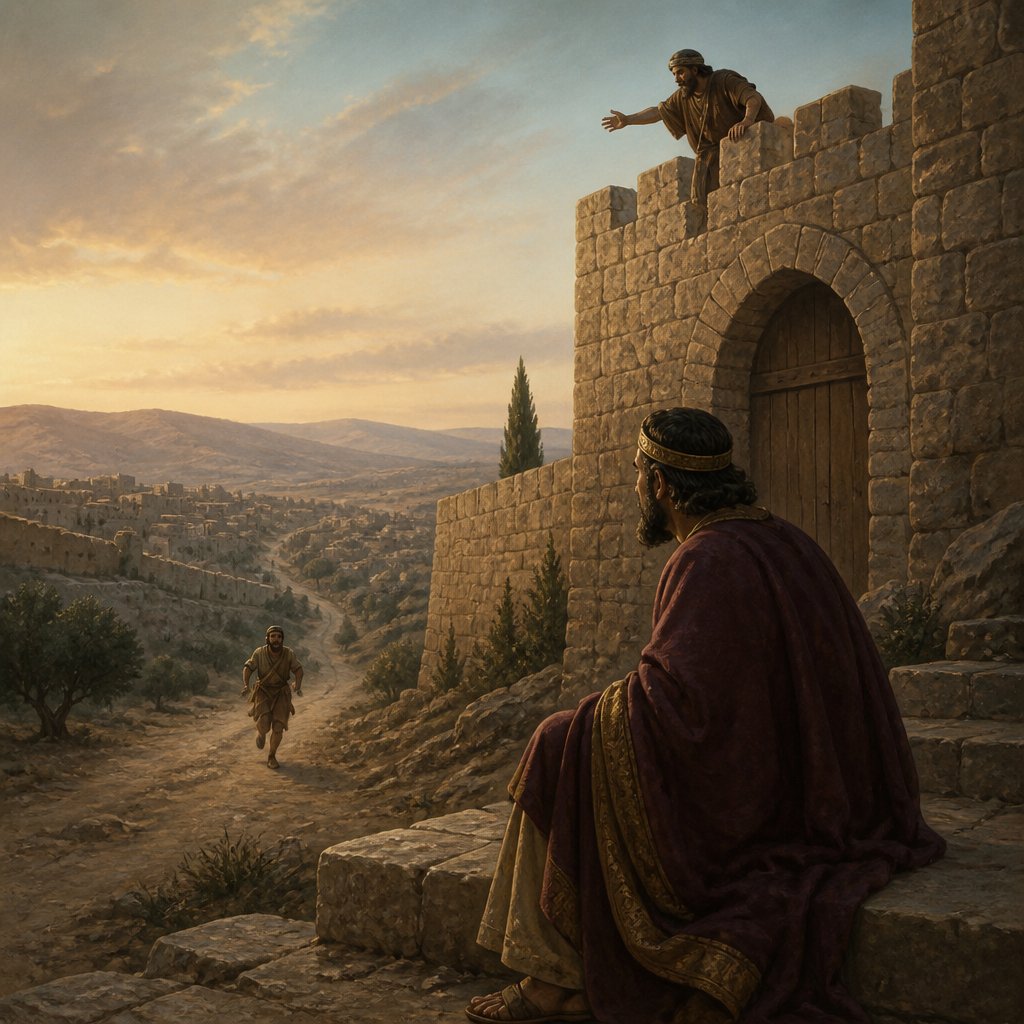
2 Samuel 18:25 (KJV) reads: "And the watchman cried, and told the king. And the king said, If he be alone, there is tidings in his mouth. And he came apace, and drew near."
This verse comes from the context of a battle between King David and his son Absalom. Absalom had rebelled against his father and had gained a significant following. The situation had escalated to a point where David had to lead his army to confront Absalom's forces in battle. The verse itself is part of the aftermath of the battle, as the watchman sees a lone figure approaching and informs the king of this.
One of the key themes that can be drawn from this verse is the theme of communication and the passing of information. In ancient times, before the advent of modern technology, communication was often a slow and difficult process. Messages had to be physically relayed from one person to another, and the messenger's ability to accurately convey the message was crucial. In this verse, the watchman plays the role of the messenger, and his cry to the king signifies the transmission of important information.
The verse also reveals the tense and uncertain atmosphere that surrounds the battle. The king's immediate assumption that the lone figure approaching must have tidings in his mouth reflects the heightened state of alertness and anticipation that comes with being in a war zone. The king's quick response and his urgency in drawing near to the lone figure further emphasize the high stakes and the sense of urgency that characterized the situation.
Furthermore, the verse can be seen as a symbol of the broader themes of loyalty and betrayal that are prevalent throughout the biblical narrative. The rebellion of Absalom against his father David is a prime example of betrayal, and the ensuing battle between them is a manifestation of the consequences of disloyalty. The figure mentioned in the verse could potentially be a messenger for either side, and the king's immediate reaction to his approach reflects the tension and uncertainty surrounding the loyalty of those involved in the conflict.
In a broader sense, this verse can also be interpreted as a reflection of the human condition and the universal experience of conflict and uncertainty. Throughout history, humanity has grappled with the impact of war and the consequences of betrayal and disloyalty. The urgency and anticipation conveyed in this verse are representative of the universal human experience of facing high-stakes situations and the need to quickly process and respond to incoming information.
In conclusion, 2 Samuel 18:25 is a verse that captures the atmosphere of tension, urgency, and uncertainty that surrounds a significant battle in the biblical narrative. Through its themes of communication, loyalty, and the human experience of conflict, the verse offers insights into the complexities of human relationships and the impact of warfare. It serves as a poignant reminder of the enduring relevance and timeless truths found within the biblical text.
Have questions about 2 Samuel 18:25?
Dive deeper into this scripture with Bible Chat — an AI-powered tool for exploring God's Word through conversation. Ask questions, get context, and grow in your understanding of the Bible.
Get Our Apps


2 Samuel 18:25 Artwork

2 Samuel 18:25 - "And the watchman cried, and told the king. And the king said, If he be alone, there is tidings in his mouth. And he came apace, and drew near."
"And the watchman cried, and told the king. And the king said, If he be alone, there is tidings in his mouth. And he came apace, and drew near." - 2 Samuel 18:25

2 Samuel 23:25 - "Shammah the Harodite, Elika the Harodite,"
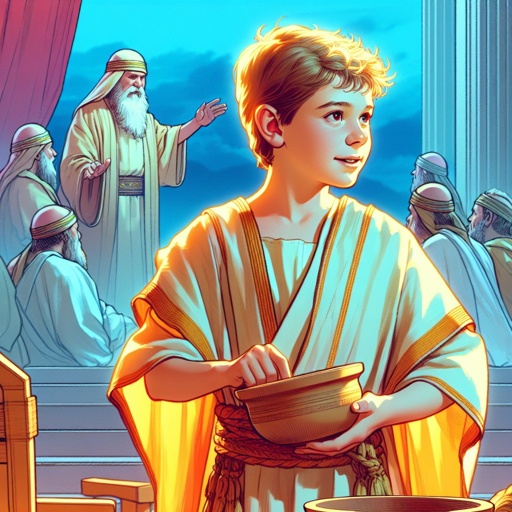
1 Samuel 2:18 - "¶ But Samuel ministered before the LORD, being a child, girded with a linen ephod."

2 Samuel 20:25 - "And Sheva was scribe: and Zadok and Abiathar were the priests:"

2 Samuel 2:25 - "¶ And the children of Benjamin gathered themselves together after Abner, and became one troop, and stood on the top of an hill."

2 Samuel 5:18 - "The Philistines also came and spread themselves in the valley of Rephaim."

"Shammah the Harodite, Elika the Harodite," - 2 Samuel 23:25

2 Samuel 2:18 - "¶ And there were three sons of Zeruiah there, Joab, and Abishai, and Asahel: and Asahel was as light of foot as a wild roe."

2 Samuel 11:18 - "¶ Then Joab sent and told David all the things concerning the war;"
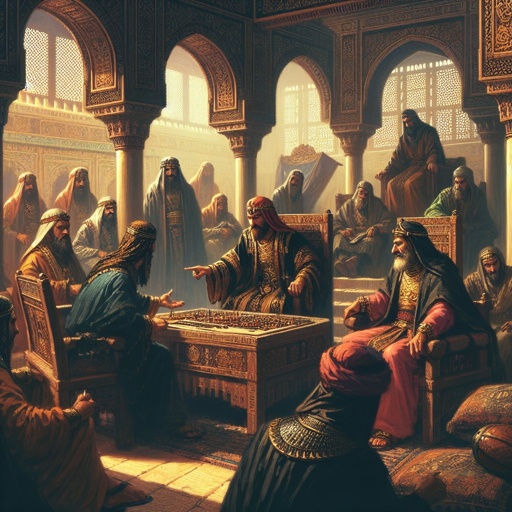
1 Samuel 18:25 - "And Saul said, Thus shall ye say to David, The king desireth not any dowry, but an hundred foreskins of the Philistines, to be avenged of the king's enemies. But Saul thought to make David fall by the hand of the Philistines."

2 Samuel 12:25 - "And he sent by the hand of Nathan the prophet; and he called his name Jedidiah, because of the LORD."

2 Samuel 1:25 - "How are the mighty fallen in the midst of the battle! O Jonathan, thou wast slain in thine high places."

2 Kings 25:18 - "¶ And the captain of the guard took Seraiah the chief priest, and Zephaniah the second priest, and the three keepers of the door:"

2 Samuel 18:6 - "¶ So the people went out into the field against Israel: and the battle was in the wood of Ephraim;"

2 Samuel 22:25 - "Therefore the LORD hath recompensed me according to my righteousness; according to my cleanness in his eye sight."

2 Samuel 5:25 - "And David did so, as the LORD had commanded him; and smote the Philistines from Geba until thou come to Gazer."

1 Samuel 18:2 - "And Saul took him that day, and would let him go no more home to his father's house."

"And Sheva was scribe: and Zadok and Abiathar were the priests:" - 2 Samuel 20:25

2 Samuel 18:10 - "And a certain man saw it, and told Joab, and said, Behold, I saw Absalom hanged in an oak."

2 Samuel 8:18 - "And Benaiah the son of Jehoiada was over both the Cherethites and the Pelethites; and David's sons were chief rulers."

2 Samuel 18:1 - "And David numbered the people that were with him, and set captains of thousands and captains of hundreds over them."

2 Samuel 18:15 - "And ten young men that bare Joab's armour compassed about and smote Absalom, and slew him."

"¶ But Samuel ministered before the LORD, being a child, girded with a linen ephod." - 1 Samuel 2:18

2 Chronicles 18:25 - "Then the king of Israel said, Take ye Micaiah, and carry him back to Amon the governor of the city, and to Joash the king's son;"

2 Samuel 19:25 - "And it came to pass, when he was come to Jerusalem to meet the king, that the king said unto him, Wherefore wentest not thou with me, Mephibosheth?"

1 Samuel 25:18 - "¶ Then Abigail made haste, and took two hundred loaves, and two bottles of wine, and five sheep ready dressed, and five measures of parched corn, and an hundred clusters of raisins, and two hundred cakes of figs, and laid them on asses."

2 Samuel 1:18 - "(Also he bade them teach the children of Judah the use of the bow: behold, it is written in the book of Jasher.)"

2 Samuel 18:30 - "And the king said unto him, Turn aside, and stand here. And he turned aside, and stood still."

2 Samuel 18:16 - "And Joab blew the trumpet, and the people returned from pursuing after Israel: for Joab held back the people."