What does 2 Samuel 14:5 mean?
"And the king said unto her, What aileth thee? And she answered, I am indeed a widow woman, and mine husband is dead." - 2 Samuel 14:5
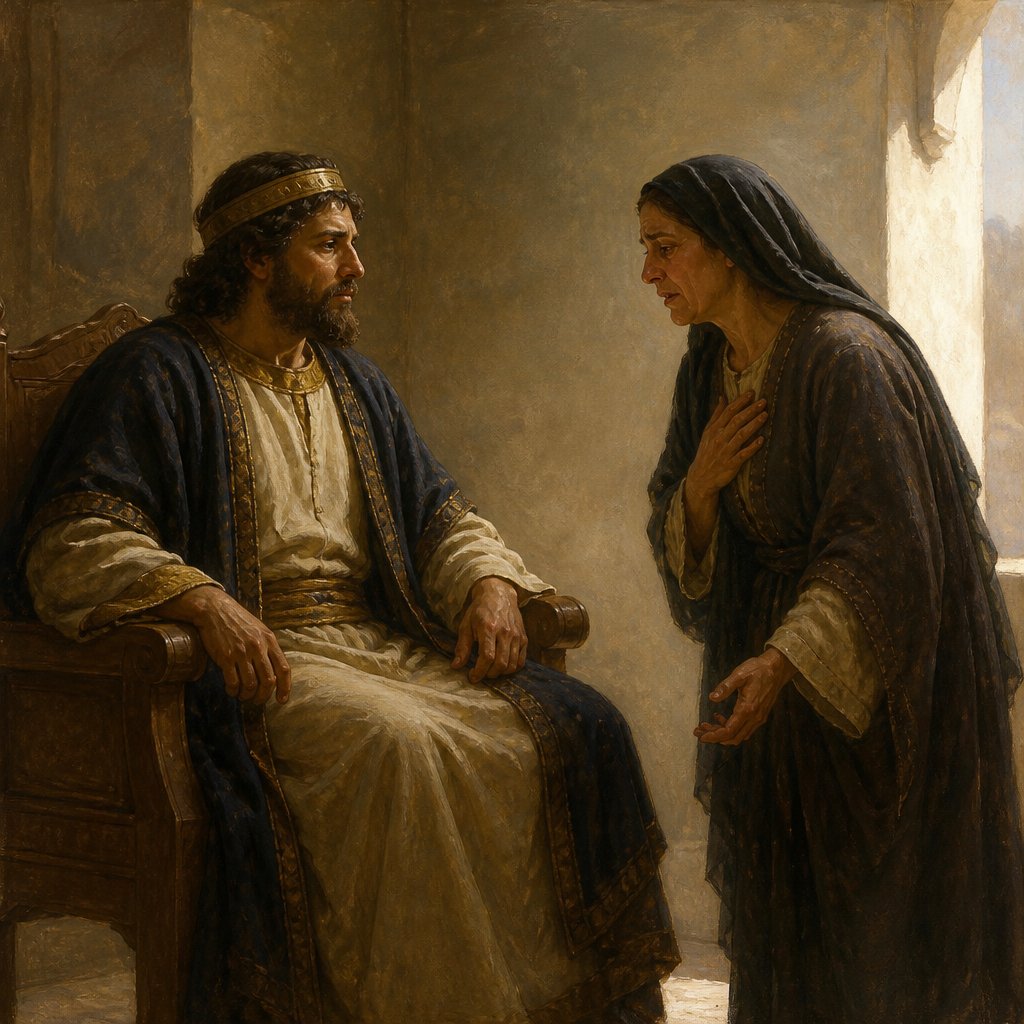
The Bible verse 2 Samuel 14:5 from the King James Version (KJV) reads: "And the king said unto her, What aileth thee? And she answered, I am indeed a widow woman, and mine husband is dead."
This verse is part of a larger narrative that tells the story of King David's interactions with a woman from Tekoa. To understand the full meaning and commentary of this verse, it is important to consider the broader context in which it is set.
King David had committed adultery with Bathsheba, the wife of Uriah the Hittite, and subsequently arranged for Uriah to be killed in battle. After these events, the prophet Nathan confronted David about his sin, and David repented. However, the consequences of his actions continued to impact his reign as king.
In 2 Samuel 14, we find that Absalom, David's son, has killed his brother Amnon in revenge for violating his sister Tamar. As a result, Absalom flees Jerusalem to escape his father's anger. Joab, David's commander, sees an opportunity to reconcile Absalom with David and uses a woman from Tekoa to deliver a parable to the king. The woman's portrayal of a widow who has lost both of her sons prompts David to pardon Absalom and allow him to return to Jerusalem.
The specific verse 2 Samuel 14:5 is a part of the woman's plea to King David. She approaches him with a problem and presents herself as a widow, seeking justice for her deceased husband. Her claim tugs at David's heartstrings and encourages him to listen to her story.
Looking at the deeper meaning of this verse, we see themes of grief, loss, and the plea for mercy and justice. The woman's claim of being a widow emphasizes the vulnerability of those who have lost their spouses and are left to fend for themselves. She is essentially asking for restoration and support in her time of need.
The verse also speaks to the theme of compassion and the importance of empathy in the face of suffering. King David's response to the woman's plight shows his capacity for empathy and his willingness to listen to those who are in need. This resonates with the broader message of compassion and mercy that is found throughout the Bible.
Furthermore, the symbolism in this verse is significant. The woman's portrayal of a widow serves as a metaphor for the marginalized and the downtrodden who seek justice and redemption. Her plea represents the cries of those who are in need of help and are looking for a way to find healing and restoration.
In the larger context of the biblical narrative, this verse also foreshadows David's eventual reconciliation with Absalom. Just as David shows compassion and mercy to the widow from Tekoa, he will eventually extend the same to his estranged son. This further underscores the overarching theme of forgiveness and redemption that is central to the Christian faith.
In conclusion, 2 Samuel 14:5 from the King James Version offers a profound commentary on the themes of grief, loss, compassion, and mercy. It highlights the importance of empathy and understanding in the face of suffering, as well as the need for reconciliation and restoration in broken relationships. The verse serves as a poignant reminder of the human need for love, justice, and grace, and ultimately points to the redemptive power of God's love in the midst of our brokenness.
Have questions about 2 Samuel 14:5?
Dive deeper into this scripture with Bible Chat — an AI-powered tool for exploring God's Word through conversation. Ask questions, get context, and grow in your understanding of the Bible.
Get Our Apps


2 Samuel 14:5 Artwork

2 Samuel 14:5 - "And the king said unto her, What aileth thee? And she answered, I am indeed a widow woman, and mine husband is dead."
"And the king said unto her, What aileth thee? And she answered, I am indeed a widow woman, and mine husband is dead." - 2 Samuel 14:5

2 Samuel 5:14 - "And these be the names of those that were born unto him in Jerusalem; Shammua, and Shobab, and Nathan, and Solomon,"

2 Samuel 6:14
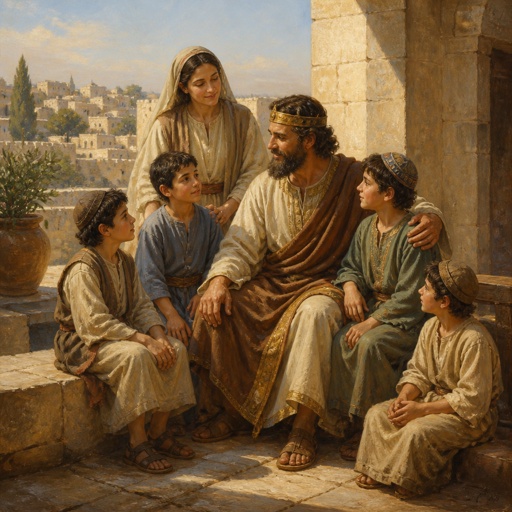
"And these be the names of those that were born unto him in Jerusalem; Shammua, and Shobab, and Nathan, and Solomon," - 2 Samuel 5:14

2 Samuel 5:12

2 Samuel 6:14–22

2 Samuel 5:16 - "And Elishama, and Eliada, and Eliphalet."

1 Samuel 14:5 - "The forefront of the one was situate northward over against Michmash, and the other southward over against Gibeah."

2 Samuel 23:14 - "And David was then in an hold, and the garrison of the Philistines was then in Beth-lehem."

2 Samuel 5:15 - "Ibhar also, and Elishua, and Nepheg, and Japhia,"

2 Samuel 14:23 - "So Joab arose and went to Geshur, and brought Absalom to Jerusalem."

2 Samuel 22:14 - "The LORD thundered from heaven, and the most High uttered his voice."

2 Samuel 16:14 - "And the king, and all the people that were with him, came weary, and refreshed themselves there."

2 Samuel 14:1 - "Now Joab the son of Zeruiah perceived that the king's heart was toward Absalom."

2 Samuel 5:18 - "The Philistines also came and spread themselves in the valley of Rephaim."

2 Samuel 5:21 - "And there they left their images, and David and his men burned them."

2 Samuel 5:7 - "Nevertheless David took the strong hold of Zion: the same is the city of David."

2 Samuel 14:28 - "¶ So Absalom dwelt two full years in Jerusalem, and saw not the king's face."

2 Samuel 11:14 - "¶ And it came to pass in the morning, that David wrote a letter to Joab, and sent it by the hand of Uriah."

2 Samuel 5:10 - "And David went on, and grew great, and the LORD God of hosts was with him."

2 Samuel 2:14 - "And Abner said to Joab, Let the young men now arise, and play before us. And Joab said, Let them arise."

2 Samuel 11:5 - "And the woman conceived, and sent and told David, and said, I am with child."

2 Samuel 5:22 - "¶ And the Philistines came up yet again, and spread themselves in the valley of Rephaim."

"And Elishama, and Eliada, and Eliphalet." - 2 Samuel 5:16

2 Samuel 6:14 - "And David danced before the LORD with all his might; and David was girded with a linen ephod."

2 Samuel 3:5 - "And the sixth, Ithream, by Eglah David's wife. These were born to David in Hebron."

1 Samuel 5:2 - "When the Philistines took the ark of God, they brought it into the house of Dagon, and set it by Dagon."

2 Samuel 14:3 - "And come to the king, and speak on this manner unto him. So Joab put the words in her mouth."

2 Samuel 14:8 - "And the king said unto the woman, Go to thine house, and I will give charge concerning thee."