What does 2 Samuel 11:1 mean?
"And it came to pass, after the year was expired, at the time when kings go forth to battle, that David sent Joab, and his servants with him, and all Israel; and they destroyed the children of Ammon, and besieged Rabbah. But David tarried still at Jerusalem." - 2 Samuel 11:1
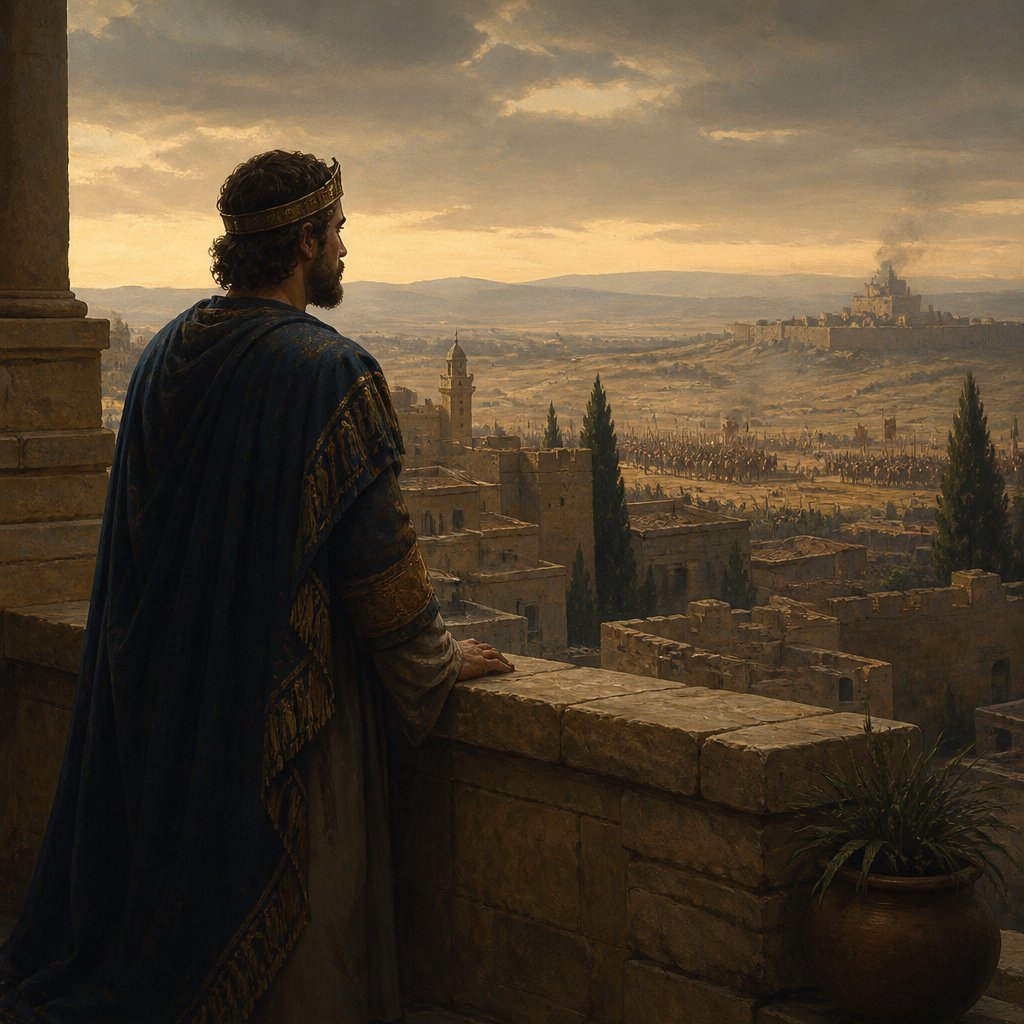
2 Samuel 11:1 (KJV) reads, "And it came to pass, after the year was expired, at the time when kings go forth to battle, that David sent Joab, and his servants with him, and all Israel; and they destroyed the children of Ammon, and besieged Rabbah. But David tarried still at Jerusalem."
This passage marks a turning point in the life of King David, a man revered in the Bible for his faith and leadership. The verse sets the stage for one of the most tragic and infamous episodes in the entire Old Testament: David's affair with Bathsheba and the subsequent murder of her husband, Uriah. The verse provides important context for understanding the events that follow, shedding light on the circumstances that led to David's moral failing.
The theme of complacency and lack of vigilance is central to the narrative. The verse starts with the phrase "after the year was expired," signifying a period of transition and change. It is at this precise moment that David, instead of leading his men into battle as was customary for kings, chooses to remain in Jerusalem. This decision to stay behind sets the stage for the pivotal events that follow.
The context of the verse is important for understanding the implications of David's actions. In ancient Israel, it was the duty of the king to lead his army into battle, as a demonstration of his commitment to his people and his reliance on God for victory. By choosing to stay in the comfort of his palace while his men were at war, David displays a level of detachment and negligence that is uncharacteristic of a king renowned for his bravery and military prowess.
Symbolism plays a significant role in this verse. The absence of David from the battlefield can be seen as a metaphor for his spiritual distance from God. Throughout his reign, David was known for his close relationship with the Lord, seeking His guidance and strength in times of trouble. However, his decision to remain in Jerusalem can be interpreted as a metaphorical separation from God, as he becomes more focused on his own desires and less concerned with following God's will.
Additionally, the verse symbolizes the beginning of David's moral decline. As the story progresses, we witness a man who was once known for his righteousness and devotion to God succumb to temptation and commit heinous acts. The passage serves as a warning against the dangers of complacency and moral apathy, illustrating how even the most devout individuals can be led astray when they become lax in their faith and moral convictions.
In conclusion, 2 Samuel 11:1 sets the stage for a tragic and cautionary tale of one of the Bible's most revered figures. The themes of complacency and moral decline, as well as the symbolism of spiritual detachment, are integral to understanding the significance of this verse in the larger narrative of King David's life. It serves as a sobering reminder of the consequences that can arise when one strays from the path of righteousness and neglects their spiritual responsibilities.
Have questions about 2 Samuel 11:1?
Dive deeper into this scripture with Bible Chat — an AI-powered tool for exploring God's Word through conversation. Ask questions, get context, and grow in your understanding of the Bible.
Get Our Apps


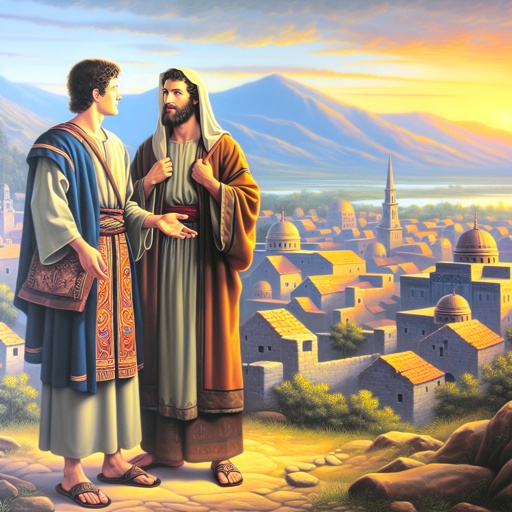
2 Samuel 11:1 Artwork

2 Samuel 11:1 - "And it came to pass, after the year was expired, at the time when kings go forth to battle, that David sent Joab, and his servants with him, and all Israel; and they destroyed the children of Ammon, and besieged Rabbah. But David tarried still at Jerusalem."
"And it came to pass, after the year was expired, at the time when kings go forth to battle, that David sent Joab, and his servants with him, and all Israel; and they destroyed the children of Ammon, and besieged Rabbah. But David tarried still at Jerusalem." - 2 Samuel 11:1

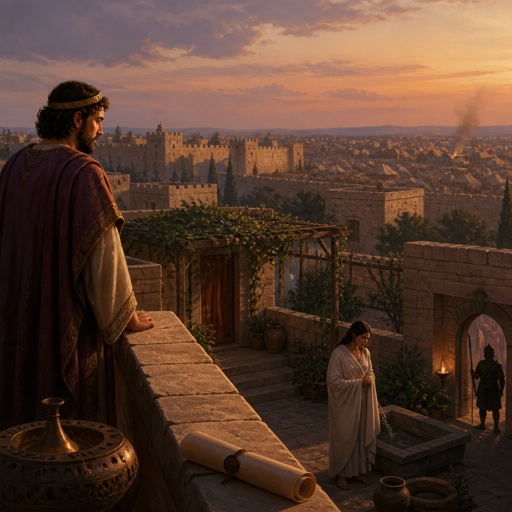
2 Samuel 11:1-15 - "In the spring, at the time when kings go off to war, David sent Joab out with the king’s men and the whole Israelite army. They destroyed the Ammonites and besieged Rabbah. But David remained in Jerusalem. One evening David got up from his bed and walked around on the roof of the palace. From the roof he saw a woman bathing. The woman was very beautiful, and David sent someone to find out about her. The man said, “She is Bathsheba, the daughter of Eliam and the wife of Uriah the Hittite.” Then David sent messengers to get her. She came to him, and he slept with her. (Now she was purifying herself from her monthly uncleanness.) Then she went back home. The woman conceived and sent word to David, saying, “I am pregnant.” So David sent this word to Joab: “Send me Uriah the Hittite.” And Joab sent him to David. When Uriah came to him, David asked him how Joab was, how the soldiers were and how the war was going. Then David said to Uriah, “Go down to your house and wash your feet.” So Uriah left the palace, and a gift from the king was sent after him. But Uriah slept at the entrance to the palace with all his master’s servants and did not go down to his house. David was told, “Uriah did not go home.” So he asked Uriah, “Haven’t you just come from a military campaign? Why didn’t you go home?” Uriah said to David, “The ark and Israel and Judah are staying in tents, and my commander Joab and my lord’s men are camped in the open country. How could I go to my house to eat and drink and make love to my wife? As surely as you live, I will not do such a thing!” Then David said to him, “Stay here one more day, and tomorrow I will send you back.” So Uriah remained in Jerusalem that day and the next. At David’s invitation, he ate and drank with him, and David made him drunk. But in the evening Uriah went out to sleep on his mat among his master’s servants; he did not go home. In the morning David wrote a letter to Joab and sent it with Uriah. In it he wrote, “Put Uriah out in front where the fighting is fiercest. Then withdraw from him so he will be struck down and die.”"
"In the spring, at the time when kings go off to war, David sent Joab out with the king’s men and the whole Israelite army. They destroyed the Ammonites and besieged Rabbah. But David remained in Jerusalem. One evening David got up from his bed and walked around on the roof of the palace. From the roof he saw a woman bathing. The woman was very beautiful, and David sent someone to find out about her. The man said, “She is Bathsheba, the daughter of Eliam and the wife of Uriah the Hittite.” Then David sent messengers to get her. She came to him, and he slept with her. (Now she was purifying herself from her monthly uncleanness.) Then she went back home. The woman conceived and sent word to David, saying, “I am pregnant.” So David sent this word to Joab: “Send me Uriah the Hittite.” And Joab sent him to David. When Uriah came to him, David asked him how Joab was, how the soldiers were and how the war was going. Then David said to Uriah, “Go down to your house and wash your feet.” So Uriah left the palace, and a gift from the king was sent after him. But Uriah slept at the entrance to the palace with all his master’s servants and did not go down to his house. David was told, “Uriah did not go home.” So he asked Uriah, “Haven’t you just come from a military campaign? Why didn’t you go home?” Uriah said to David, “The ark and Israel and Judah are staying in tents, and my commander Joab and my lord’s men are camped in the open country. How could I go to my house to eat and drink and make love to my wife? As surely as you live, I will not do such a thing!” Then David said to him, “Stay here one more day, and tomorrow I will send you back.” So Uriah remained in Jerusalem that day and the next. At David’s invitation, he ate and drank with him, and David made him drunk. But in the evening Uriah went out to sleep on his mat among his master’s servants; he did not go home. In the morning David wrote a letter to Joab and sent it with Uriah. In it he wrote, “Put Uriah out in front where the fighting is fiercest. Then withdraw from him so he will be struck down and die.”" - 2 Samuel 11:1-15

2 Samuel 11:9

2 Samuel 11

2 samuel 11

2 Samuel 1:11 - "Then David took hold on his clothes, and rent them; and likewise all the men that were with him:"

2 Samuel 11:11

1 Samuel 2:11 - "And Elkanah went to Ramah to his house. And the child did minister unto the LORD before Eli the priest."

1 Samuel 11:14 - "Then said Samuel to the people, Come, and let us go to Gilgal, and renew the kingdom there."

1 Samuel 11:2 - "And Nahash the Ammonite answered them, On this condition will I make a covenant with you, that I may thrust out all your right eyes, and lay it for a reproach upon all Israel."

2 Samuel 2:11 - "And the time that David was king in Hebron over the house of Judah was seven years and six months."

1 Samuel 22:11-13

2 Samuel 11:18 - "¶ Then Joab sent and told David all the things concerning the war;"

1 Samuel 28:11 - "Then said the woman, Whom shall I bring up unto thee? And he said, Bring me up Samuel."

2 Samuel 21:11 - "And it was told David what Rizpah the daughter of Aiah, the concubine of Saul, had done."

2 Samuel 11:5 - "And the woman conceived, and sent and told David, and said, I am with child."

1 Samuel 3:11 - "¶ And the LORD said to Samuel, Behold, I will do a thing in Israel, at which both the ears of every one that heareth it shall tingle."

2 Samuel 11:22 - "¶ So the messenger went, and came and shewed David all that Joab had sent him for."

1 Samuel 12:11 - "And the LORD sent Jerubbaal, and Bedan, and Jephthah, and Samuel, and delivered you out of the hand of your enemies on every side, and ye dwelled safe."

2 Samuel 3:11 - "And he could not answer Abner a word again, because he feared him."

1 Samuel 11:12 - "¶ And the people said unto Samuel, Who is he that said, Shall Saul reign over us? bring the men, that we may put them to death."

2 Samuel 11:14 - "¶ And it came to pass in the morning, that David wrote a letter to Joab, and sent it by the hand of Uriah."

1 Samuel 31:11 - "¶ And when the inhabitants of Jabesh-gilead heard of that which the Philistines had done to Saul;"

2 Samuel 22:11 - "And he rode upon a cherub, and did fly: and he was seen upon the wings of the wind."

1 Samuel 2:26 - "And the child Samuel grew on, and was in favour both with the LORD, and also with men."
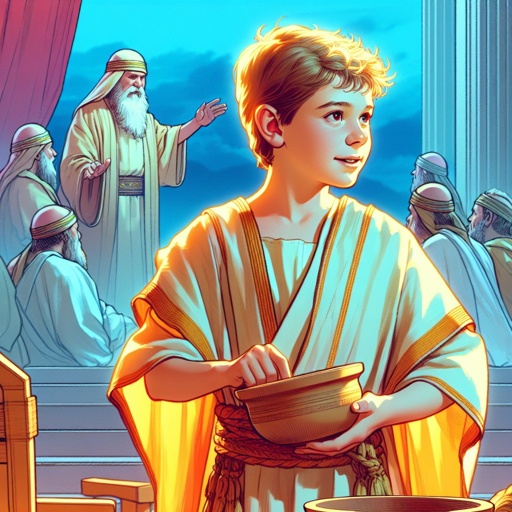
1 Samuel 2:18 - "¶ But Samuel ministered before the LORD, being a child, girded with a linen ephod."

"Then David took hold on his clothes, and rent them; and likewise all the men that were with him:" - 2 Samuel 1:11
1 Samuel 9:1-2