What does 2 Kings 7:14 mean?
"They took therefore two chariot horses; and the king sent after the host of the Syrians, saying, Go and see." - 2 Kings 7:14

2 Kings 7:14 (KJV) says, "They took two chariot horses; and the king sent after the host of the Syrians, saying, Go and see." This verse is found within the context of a story about the city of Samaria being surrounded by the Syrian army. The city was in a desperate situation, facing a severe famine due to the siege. In the preceding verses, we see that Elisha, the prophet, had prophesied that the Lord would provide deliverance for the people of Samaria by causing the Syrians to hear the sound of a great army, which would cause them to flee in fear, leaving behind their camp and supplies. In verse 14, we see the fulfillment of Elisha's prophecy as four lepers, who were at the gate of the city, discovered the abandoned camp and reported it to the king's household.
The verse holds several significant themes and lessons that can be drawn from it. Firstly, it speaks to the faithfulness and power of God to deliver His people in times of need. The people of Samaria were facing a seemingly insurmountable situation with the Syrian army laying siege to their city, and the resulting famine was causing great suffering. However, through the prophecy of Elisha and the unlikely discovery of the abandoned Syrian camp by the four lepers, God provided a miraculous deliverance for the people. This serves as a reminder that no situation is beyond God's ability to intervene and provide a way out for His people.
Another theme that can be drawn from this verse is the concept of divine reversal. The situation for the people of Samaria had become so dire that they were reduced to extreme measures just to survive. However, in a single moment, God turned the tables on their enemies, causing them to flee in fear and leaving behind an abundance of provisions. This serves as a powerful reminder that God has the ability to reverse the most hopeless of situations and bring about unexpected and miraculous deliverance.
Additionally, the verse also carries a theme of the unexpected sources of deliverance that God may choose to use. In this case, it was four lepers, who were often marginalized and overlooked in society due to their condition, that became the means through which the deliverance of the city of Samaria was made known. This serves as a reminder that God may choose to use unlikely and overlooked individuals or circumstances as His instruments of deliverance and blessing.
From a symbolic standpoint, the two chariot horses that the king sent after the host of the Syrians can be seen as a representation of the swift and decisive action taken to pursue after the fleeing enemy. The horses are often symbolic of strength, power, and speed, and in this context, they symbolize the pursuit and defeat of the enemy that had caused so much suffering for the people of Samaria. This can be seen as a symbol of the victory and triumph that God brings in the face of seemingly impossible odds.
In conclusion, 2 Kings 7:14 (KJV) holds rich themes of God's faithfulness, divine reversal, and the unexpected sources of deliverance. It serves as a powerful reminder of God's ability to intervene in the most desperate of situations and bring about miraculous deliverance for His people. It also serves as a lesson in being vigilant and prepared to take decisive action in response to the deliverance that God provides.
Have questions about 2 Kings 7:14?
Dive deeper into this scripture with Bible Chat — an AI-powered tool for exploring God's Word through conversation. Ask questions, get context, and grow in your understanding of the Bible.
Get Our Apps


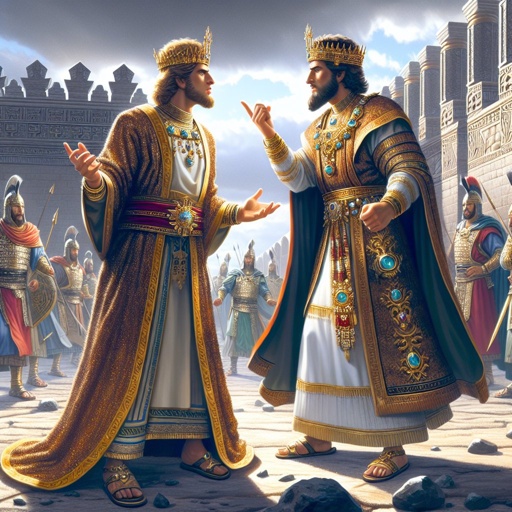
2 Kings 7:14 Artwork

2 Kings 7:14 - "They took therefore two chariot horses; and the king sent after the host of the Syrians, saying, Go and see."

"They took therefore two chariot horses; and the king sent after the host of the Syrians, saying, Go and see." - 2 Kings 7:14

2 Kings 14:7 - "He slew of Edom in the valley of salt ten thousand, and took Selah by war, and called the name of it Joktheel unto this day."

2 Kings 7:2

2 Kings 14:18 - "And the rest of the acts of Amaziah, are they not written in the book of the chronicles of the kings of Judah?"

2 Kings 14:29 - "And Jeroboam slept with his fathers, even with the kings of Israel; and Zachariah his son reigned in his stead."

2 chronicles 7:14

2 chronicles 7:14

2 Kings 12:14 - "But they gave that to the workmen, and repaired therewith the house of the LORD."

2 Kings 14:16 - "And Jehoash slept with his fathers, and was buried in Samaria with the kings of Israel; and Jeroboam his son reigned in his stead."

2 Kings 14:14 - "And he took all the gold and silver, and all the vessels that were found in the house of the LORD, and in the treasures of the king's house, and hostages, and returned to Samaria."

2 Kings 7:11 - "And he called the porters; and they told it to the king's house within."

2 Kings 7:7 - "Wherefore they arose and fled in the twilight, and left their tents, and their horses, and their asses, even the camp as it was, and fled for their life."

2 Kings 14:22 - "He built Elath, and restored it to Judah, after that the king slept with his fathers."

"He slew of Edom in the valley of salt ten thousand, and took Selah by war, and called the name of it Joktheel unto this day." - 2 Kings 14:7

2 Kings 14:12 - "And Judah was put to the worse before Israel; and they fled every man to their tents."
2 Kings 14:15 - "¶ Now the rest of the acts of Jehoash which he did, and his might, and how he fought with Amaziah king of Judah, are they not written in the book of the chronicles of the kings of Israel?"

2 Kings 2:7 - "And fifty men of the sons of the prophets went, and stood to view afar off: and they two stood by Jordan."

2 Kings 14:20 - "And they brought him on horses: and he was buried at Jerusalem with his fathers in the city of David."

"And the rest of the acts of Amaziah, are they not written in the book of the chronicles of the kings of Judah?" - 2 Kings 14:18

2 Kings 14:1 - "In the second year of Joash son of Jehoahaz king of Israel reigned Amaziah the son of Joash king of Judah."

2 Kings 25:14 - "And the pots, and the shovels, and the snuffers, and the spoons, and all the vessels of brass wherewith they ministered, took they away."

1 Kings 2:14 - "He said moreover, I have somewhat to say unto thee. And she said, Say on."

2 Kings 17:14 - "Notwithstanding they would not hear, but hardened their necks, like to the neck of their fathers, that did not believe in the LORD their God."

Humble ourselves and pray 2 Chronicles 7:14

2 Kings 22:7 - "Howbeit there was no reckoning made with them of the money that was delivered into their hand, because they dealt faithfully."

2 Kings 20:7 - "And Isaiah said, Take a lump of figs. And they took and laid it on the boil, and he recovered."

2 Kings 14:17 - "¶ And Amaziah the son of Joash king of Judah lived after the death of Jehoash son of Jehoahaz king of Israel fifteen years."

2 Kings 6:14 - "Therefore sent he thither horses, and chariots, and a great host: and they came by night, and compassed the city about."

2 Kings 14:2 - "He was twenty and five years old when he began to reign, and reigned twenty and nine years in Jerusalem. And his mother's name was Jehoaddan of Jerusalem."