What does 2 Kings 4:3 mean?
"Then he said, Go, borrow thee vessels abroad of all thy neighbours, even empty vessels; borrow not a few." - 2 Kings 4:3

In 2 Kings 4:3 in the King James Version of the Bible, the verse reads: "Then he said, Go, borrow thee vessels abroad of all thy neighbours, even empty vessels; borrow not a few." The context of this verse is the story of the widow of a prophet who is in debt and facing the possibility of her sons being sold into slavery to pay off the debt. She goes to Elisha, the prophet, for help, and he gives her instructions on how to solve her financial crisis.
This verse is part of a larger narrative in 2 Kings 4 that tells the story of Elisha's miracles. In this particular story, Elisha instructs the widow to gather as many empty vessels as she can from her neighbors and to not gather just a few. She is then instructed to take the vessels into her house and pour the small amount of oil she has left into the vessels. The oil miraculously multiplies and fills all of the vessels, allowing her to sell the oil and pay off her debt.
One of the themes present in this verse and the larger story is the theme of faith and trust in God. The widow is facing a desperate situation, but she chooses to trust in Elisha's instructions and follow them faithfully. She demonstrates her faith by obeying Elisha's unusual and seemingly illogical instructions to borrow empty vessels and pour her small supply of oil into them. Her faith is ultimately rewarded when the oil miraculously multiplies, providing for her immediate needs and securing her family's future.
Another theme present in this verse is the theme of abundance. The instruction to borrow not a few vessels suggests that there will be a great abundance of oil to fill them. This abundance is a reflection of God's provision and ability to meet our needs abundantly, even in the face of seemingly insurmountable challenges. It also serves as a reminder that God's resources are limitless and that He is able to provide abundantly beyond what we can imagine or hope for.
The symbolism in this verse is also significant. The vessels can be seen as representing the capacity to receive God's blessings. By borrowing as many vessels as possible, the widow displays a willingness to receive and make room for the abundance that God wants to provide. The vessels also symbolize the faith and trust that the widow demonstrates by obeying Elisha's instructions, as well as her willingness to act in obedience to God's will.
Overall, 2 Kings 4:3 is a verse that speaks to the themes of faith, trust, and abundance in God's provision. The story of the widow of a prophet serves as a powerful example of how God can work miraculously in our lives when we trust in Him and are obedient to His instructions. This verse reminds us that God is able to provide abundantly and meet our needs, even in the most desperate of situations, and it calls us to have faith and trust in His ability to provide for us.
Have questions about 2 Kings 4:3?
Dive deeper into this scripture with Bible Chat — an AI-powered tool for exploring God's Word through conversation. Ask questions, get context, and grow in your understanding of the Bible.
Get Our Apps


2 Kings 4:3 Artwork

2 Kings 4:3 - "Then he said, Go, borrow thee vessels abroad of all thy neighbours, even empty vessels; borrow not a few."

"Then he said, Go, borrow thee vessels abroad of all thy neighbours, even empty vessels; borrow not a few." - 2 Kings 4:3

2 Kings 3:4 - "¶ And Mesha king of Moab was a sheepmaster, and rendered unto the king of Israel an hundred thousand lambs, and an hundred thousand rams, with the wool."

1 Kings 4:3 - "Elihoreph and Ahiah, the sons of Shisha, scribes; Jehoshaphat the son of Ahilud, the recorder."

2 Kings 4:4-5

2 Kings 3:15

2 Kings 3:15

"Elihoreph and Ahiah, the sons of Shisha, scribes; Jehoshaphat the son of Ahilud, the recorder." - 1 Kings 4:3

2 Kings 3:15

2 Kings 3:16-19

2 Kings 3:10 - "And the king of Israel said, Alas! that the LORD hath called these three kings together, to deliver them into the hand of Moab!"

2 Kings 3:23 - "And they said, This is blood: the kings are surely slain, and they have smitten one another: now therefore, Moab, to the spoil."
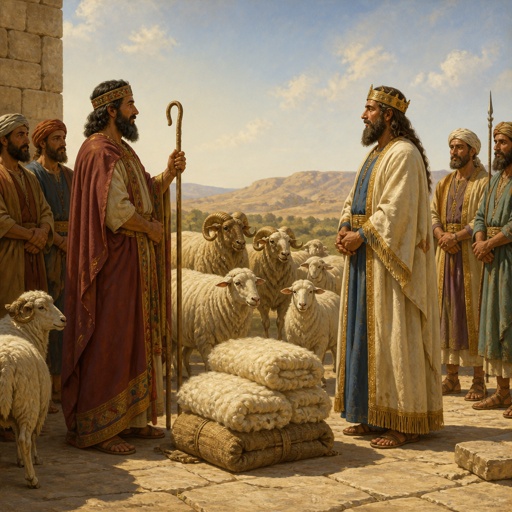
"¶ And Mesha king of Moab was a sheepmaster, and rendered unto the king of Israel an hundred thousand lambs, and an hundred thousand rams, with the wool." - 2 Kings 3:4

2 Kings 10:4 - "But they were exceedingly afraid, and said, Behold, two kings stood not before him: how then shall we stand?"

1 Kings 3:4 - "And the king went to Gibeon to sacrifice there; for that was the great high place: a thousand burnt offerings did Solomon offer upon that altar."

Matthew 2:3-4

Matthew 2:3-4

Matthew 2:3-4

Matthew 2:3-4

2 Kings 3:3 - "Nevertheless he cleaved unto the sins of Jeroboam the son of Nebat, which made Israel to sin; he departed not therefrom."

2 Kings 3:6 - "¶ And king Jehoram went out of Samaria the same time, and numbered all Israel."

2 Kings 3:5 - "But it came to pass, when Ahab was dead, that the king of Moab rebelled against the king of Israel."

2 Kings 4:11 - "And it fell on a day, that he came thither, and he turned into the chamber, and lay there."

2 Kings 3:16 - "And he said, Thus saith the LORD, Make this valley full of ditches."

1 Kings 4:2 - "And these were the princes which he had; Azariah the son of Zadok the priest,"

2 Corinthians 1:3-4

2 Kings 9:4 - "¶ So the young man, even the young man the prophet, went to Ramoth-gilead."

2 Kings 6:4 - "So he went with them. And when they came to Jordan, they cut down wood."

2 Kings 3:18 - "And this is but a light thing in the sight of the LORD: he will deliver the Moabites also into your hand."

2 Kings 25:3 - "And on the ninth day of the fourth month the famine prevailed in the city, and there was no bread for the people of the land."