What does 2 Kings 2:11 mean?
"And it came to pass, as they still went on, and talked, that, behold, there appeared a chariot of fire, and horses of fire, and parted them both asunder; and Elijah went up by a whirlwind into heaven." - 2 Kings 2:11

“**And it came to pass, as they still went on, and talked, that, behold, there appeared a chariot of fire, and horses of fire, and parted them both asunder; and Elijah went up by a whirlwind into heaven.**” (2 Kings 2:11, KJV)
This verse stands at the climax of a carefully prepared moment in Israel’s history, when the LORD brings to a close the public ministry of Elijah and confirms the continuation of that prophetic ministry in Elisha. The surrounding context matters. Elijah and Elisha have been traveling together from place to place, with repeated calls for Elisha to remain behind and repeated refusals, as though the narrative is testing and displaying the perseverance of the one who will inherit the work. Along the way, “the sons of the prophets” already know that the LORD will take Elijah away, but knowledge at a distance is not the same as faithful accompaniment. By the time 2 Kings 2:11 arrives, Elijah and Elisha have crossed Jordan, and the scene is set for an act of God that no human can produce or imitate. The taking of Elijah is not an ordinary deathbed ending; it is a divine removal that declares Elijah’s course finished by God’s own hand, and it introduces Elisha’s calling with extraordinary authority.
The verse’s first emphasis is on ordinary fellowship immediately before overwhelming revelation: “as they still went on, and talked.” Scripture often places the most astonishing interventions of God into the midst of very human moments to show that revelation is God’s initiative, not man’s achievement. Elijah is not performing a last wonder to crown himself; he is walking and speaking, and then God acts. The suddenness—“behold”—signals that what follows is entirely from above, breaking into the scene as a sign that the LORD governs the departure of His servant.
The appearance of “a chariot of fire, and horses of fire” draws deeply on biblical themes of divine presence, divine warfare, and divine holiness. Fire in the KJV repeatedly signifies the LORD’s manifested power: it is associated with purity, judgment, and the unapproachable glory of God. Elijah’s ministry itself has been marked by fire, most famously when the LORD answered by fire on Carmel, showing that “the LORD, he is the God.” The fiery chariot and horses are not mere spectacle; they are a visual declaration that Elijah’s mission and vindication belong to the LORD of hosts. The imagery suggests the heavenly host as God’s true army, implying that Israel’s real defense is not in earthly kings or armies but in the LORD’s presence. The chariot is a symbol of might and victory; the fire that enfolds it signifies that this might is holy and untouchable, the energy of God rather than the strength of man.
Yet the chariot and horses do something specific: they “parted them both asunder.” This is a sharp emotional and theological turn. Elisha has clung to Elijah, refusing separation, but God’s purpose includes a necessary dividing. The prophetic mantle cannot be inherited by mere attachment; the LORD Himself must separate the old from the new, the departing servant from the continuing one. This parting also echoes earlier divisions in Scripture where God makes a way or creates a boundary—most strikingly the parting of waters—but here the division is not of a river; it is of companionship. The moment teaches that spiritual succession is not ultimately controlled by human will, affection, or planning. Even the closest fellowship yields to God’s sovereign transition.
Then comes the heart of the verse: “and Elijah went up by a whirlwind into heaven.” The whirlwind is a frequent biblical sign of the LORD’s majesty and irresistible power. It suggests not chaos but command: God moves as He wills, and His servant is carried by a force no man can harness. Elijah does not ascend by human mechanism; he is taken. The language emphasizes divine action and divine honor. Elijah’s end is unique in Scripture’s narrative patterns, and the verse portrays it as a special act of God rather than the normal course of death, underscoring the extraordinary role Elijah played in confronting idolatry and calling Israel back to covenant faithfulness.
The “heaven” of the verse, as the KJV states it, directs attention to God’s realm and rule. The significance is not merely that Elijah departs upward, but that his departure is under God’s authority and into God’s keeping. In the flow of 2 Kings, this ascent also functions as a confirmation: Elijah’s ministry is not discredited or abandoned; it is sealed by a divine conclusion. The LORD who sent him now takes him, indicating that Elijah was indeed God’s prophet, not a self-appointed troublemaker.
Symbolically, the event sets the stage for Elisha. The fiery escort and the whirlwind are not only about Elijah’s honor; they are also about Elisha’s commissioning. The spectacle provides a public, God-given marker that a transition has occurred. Immediately around this verse, the narrative is concerned with whether Elisha will carry the same prophetic authority. The removal of Elijah by God’s own action prevents any suggestion that Elijah was simply lost, killed, or defeated; it forces Israel to reckon with a continuing prophetic word that originates with the LORD. Elijah’s going does not silence the LORD; it makes room for the next phase of His work.
Themes of holiness and separation run through the verse. Fire signifies the holiness of God that cannot be domesticated. The chariot and horses signify that God’s power is not dependent on Israel’s institutions. The parting “asunder” shows that God’s calling can require painful detachment, even from the best and dearest relationships, to fulfill His purposes. The whirlwind speaks of divine sovereignty, the LORD who removes and raises up according to His will. And the ascent “into heaven” highlights that the prophet’s life and end are held within God’s rule, not man’s.
In the wider theological horizon of the KJV, Elijah’s translation becomes a signpost within Scripture’s expectation that God is able to act beyond ordinary patterns, and it leaves a lasting imprint on Israel’s prophetic imagination. Elijah’s departure is not presented as escape from responsibility but as the LORD’s concluding act after a life of costly obedience. It underscores that the prophet belongs to God from beginning to end, and that when God’s servant is taken, God’s word does not fail; it continues, sometimes in a new vessel, but with the same divine authority.
Have questions about 2 Kings 2:11?
Dive deeper into this scripture with Bible Chat — an AI-powered tool for exploring God's Word through conversation. Ask questions, get context, and grow in your understanding of the Bible.
Get Our Apps


2 Kings 2:11 Artwork
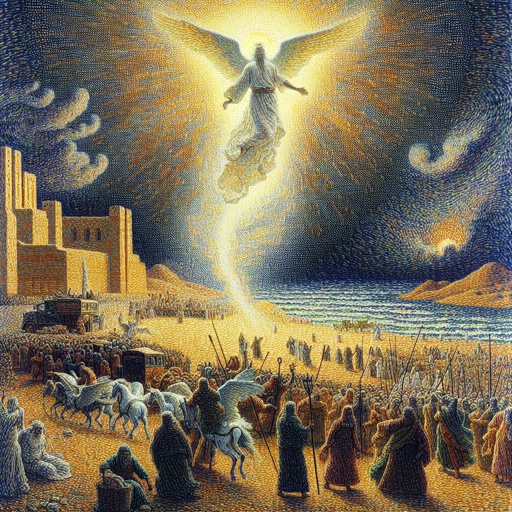
2 Kings 2:11
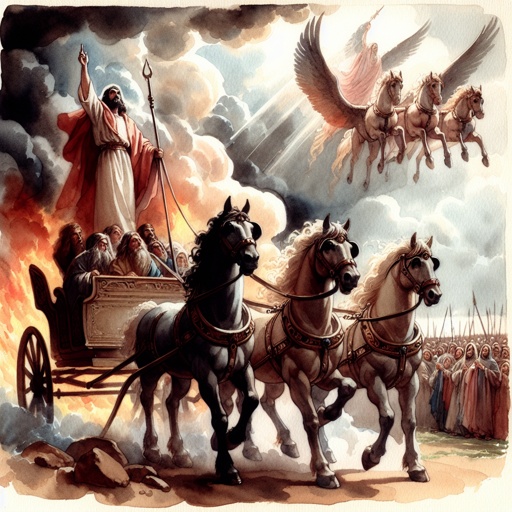
2 Kings 2:11
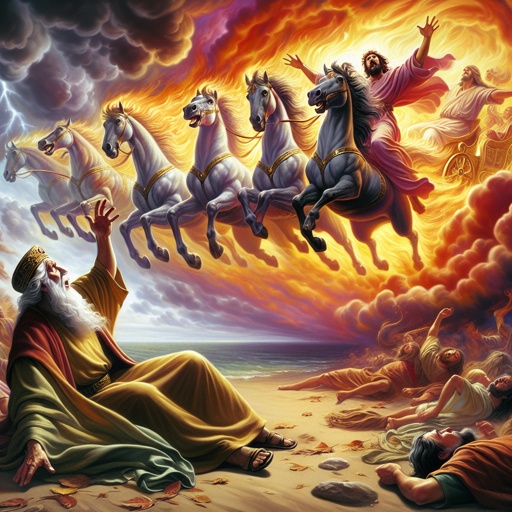
2 Kings 2:11

2 Kings 2:11 – "As they were walking along and talking together, suddenly a chariot of fire and horses of fire appeared."
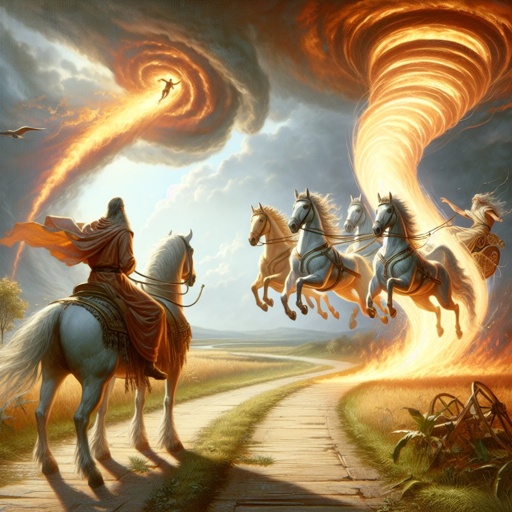
2 Kings 2:11 - "And it came to pass, as they still went on, and talked, that, behold, there appeared a chariot of fire, and horses of fire, and parted them both asunder; and Elijah went up by a whirlwind into heaven."

2 Kings 2:11-12 (11) ... behold, there appeared a chariot of fire, and horses of fire, and parted them both asunder; and Elijah went up by a whirlwind into heaven.

2 Kings 2:11-12 (11) And it came to pass, as they still went on, and talked, that, behold, there appeared a chariot of fire, and horses of fire, and parted them both asunder; and Elijah went up by a whirlwind into heaven. (12) And Elisha saw it, and he cried, My father, my father, the chariot of Israel, and the horsemen thereof. And he saw him no more: and he took hold of his own clothes, and rent them in two pieces.
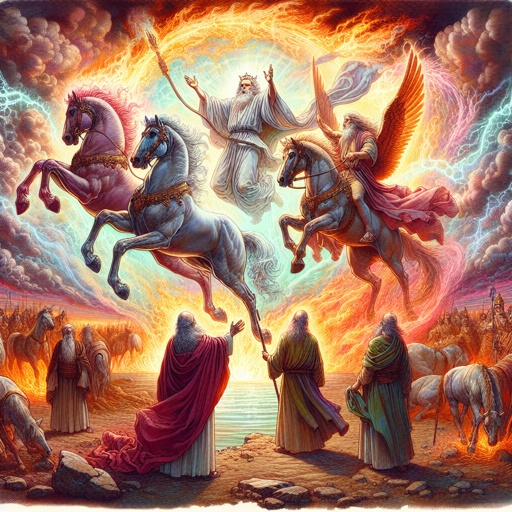
2 Kings 2:11-12 KJVA (11) And it came to pass, as they still went on, and talked, that, behold, there appeared a chariot of fire, and horses of fire, and parted them both asunder; and Elijah went up by a whirlwind into heaven. (12) And Elisha saw it, and he cried, My father, my father, the chariot of Israel, and the horsemen thereof. And he saw him no more: and he took hold of his own clothes, and rent them in two pieces.

2 Kings 2:11-12 (11) And it came to pass, as they still went on, and talked, that, behold, there appeared a chariot of fire, and horses of fire, and parted them both asunder; and Elijah went up by a whirlwind into heaven. (12) And Elisha saw it, and he cried, My father, my father, the chariot of Israel, and the horsemen thereof. And he saw him no more: and he took hold of his own clothes, and rent them in two pieces.

2 Kings 2:11-13 KJVA (11) And it came to pass, as they still went on, and talked, that, behold, there appeared a chariot of fire, and horses of fire, and parted them both asunder; and Elijah went up by a whirlwind into heaven. (12) And Elisha saw it, and he cried, My father, my father, the chariot of Israel, and the horsemen thereof. And he saw him no more: and he took hold of his own clothes, and rent them in two pieces. (13) He took up also the mantle of Elijah that fell from him, and went back, and stood by the bank of Jordan;

2 Kings 2:11-13 KJVA (11) And it came to pass, as they still went on, and talked, that, behold, there appeared a chariot of fire, and horses of fire, and parted them both asunder; and Elijah went up by a whirlwind into heaven. (12) And Elisha saw it, and he cried, My father, my father, the chariot of Israel, and the horsemen thereof. And he saw him no more: and he took hold of his own clothes, and rent them in two pieces. (13) He took up also the mantle of Elijah that fell from him, and went back, and stood by the bank of Jordan;

2 Kings 2:11-12 KJVA (11) And it came to pass, as they still went on, and talked, that, behold, there appeared a chariot of fire, and horses of fire, and parted them both asunder; and Elijah went up by a whirlwind into heaven. (12) And Elisha saw it, and he cried, My father, my father, the chariot of Israel, and the horsemen thereof. And he saw him no more: and he took hold of his own clothes, and rent them in two pieces.

2 Kings 2:11-12 (11) And it came to pass, as they still went on, and talked, that, behold, there appeared a chariot of fire, and horses of fire, and parted them both asunder; and Elijah went up by a whirlwind into heaven. (12) And Elisha saw it, and he cried, My father, my father, the chariot of Israel, and the horsemen thereof. And he saw him no more: and he took hold of his own clothes, and rent them in two pieces.
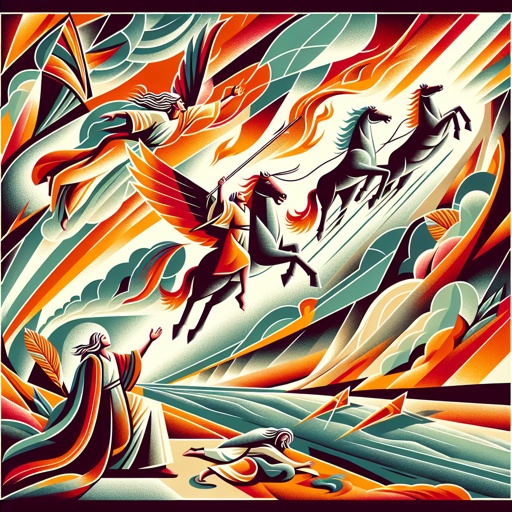
2 Kings 2:11-13 KJVA (11) And it came to pass, as they still went on, and talked, that, behold, there appeared a chariot of fire, and horses of fire, and parted them both asunder; and Elijah went up by a whirlwind into heaven. (12) And Elisha saw it, and he cried, My father, my father, the chariot of Israel, and the horsemen thereof. And he saw him no more: and he took hold of his own clothes, and rent them in two pieces. (13) He took up also the mantle of Elijah that fell from him, and went back, and stood by the bank of Jordan;
!["And it came to pass, as they still went on, and talked, that, behold, [there appeared] a chariot of fire, and horses of fire, and parted them both asunder; and Elijah went up by a whirlwind into heaven." - 2 Kings 2:11](https://media.bible.art/e30b7e0a-adfa-4283-958a-c71332b36c51-thumbnail.jpg)
"And it came to pass, as they still went on, and talked, that, behold, [there appeared] a chariot of fire, and horses of fire, and parted them both asunder; and Elijah went up by a whirlwind into heaven." - 2 Kings 2:11

2 Kings 2:11-12 (11) And it came to pass, as they still went on, and talked, that, behold, there appeared a chariot of fire, and horses of fire, and parted them both asunder; and Elijah went up by a whirlwind into heaven. (12) And Elisha saw it, and he cried, My father, my father, the chariot of Israel, and the horsemen thereof. And he saw him no more: and he took hold of his own clothes, and rent them in two pieces.
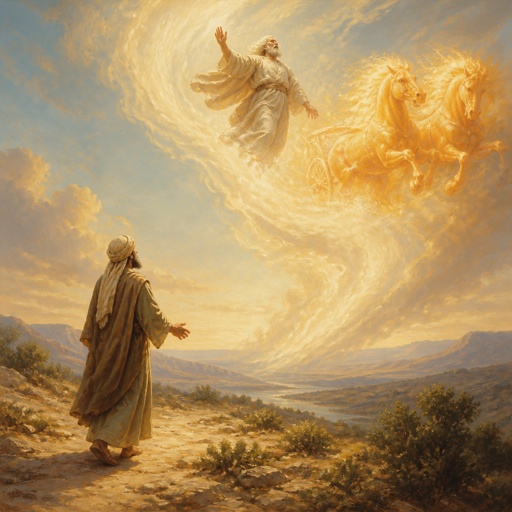
"And it came to pass, as they still went on, and talked, that, behold, there appeared a chariot of fire, and horses of fire, and parted them both asunder; and Elijah went up by a whirlwind into heaven." - 2 Kings 2:11

2 Kings 2:11-13 KJVA (11) And it came to pass, as they still went on, and talked, that, behold, there appeared a chariot of fire, and horses of fire, and parted them both asunder; and Elijah went up by a whirlwind into heaven. (12) And Elisha saw it, and he cried, My father, my father, the chariot of Israel, and the horsemen thereof. And he saw him no more: and he took hold of his own clothes, and rent them in two pieces. (13) He took up also the mantle of Elijah that fell from him, and went back, and stood by the bank of Jordan; show only Elijah and Elisha and the chariot of fire, no other people

2 Kings 15:11 - "And the rest of the acts of Zachariah, behold, they are written in the book of the chronicles of the kings of Israel."

2 Kings 7:11 - "And he called the porters; and they told it to the king's house within."

2 Kings 11:21 - "Seven years old was Jehoash when he began to reign."

2 Kings 24:11 - "And Nebuchadnezzar king of Babylon came against the city, and his servants did besiege it."

2 Kings 4:11 - "And it fell on a day, that he came thither, and he turned into the chamber, and lay there."

Joshua 11:2 - "And to the kings that were on the north of the mountains, and of the plains south of Chinneroth, and in the valley, and in the borders of Dor on the west,"

2 Kings 19:11 - "Behold, thou hast heard what the kings of Assyria have done to all lands, by destroying them utterly: and shalt thou be delivered?"

2 Kings 11:20 - "And all the people of the land rejoiced, and the city was in quiet: and they slew Athaliah with the sword beside the king's house."

2 Chronicles 16:11 - "¶ And, behold, the acts of Asa, first and last, lo, they are written in the book of the kings of Judah and Israel."

2 Kings 11:13 - "¶ And when Athaliah heard the noise of the guard and of the people, she came to the people into the temple of the LORD."

2 Kings 8:11 - "And he settled his countenance stedfastly, until he was ashamed: and the man of God wept."

2 Kings 11:16 - "And they laid hands on her; and she went by the way by the which the horses came into the king's house: and there was she slain."