What does 2 Kings 25:27 mean?
"¶ And it came to pass in the seven and thirtieth year of the captivity of Jehoiachin king of Judah, in the twelfth month, on the seven and twentieth day of the month, that Evil-merodach king of Babylon in the year that he began to reign did lift up the head of Jehoiachin king of Judah out of prison;" - 2 Kings 25:27

2 Kings 25:27 (KJV) states, "And it came to pass in the seven and thirtieth year of the captivity of Jehoiachin king of Judah, in the twelfth month, on the seven and twentieth day of the month, that Evilmerodach king of Babylon in the year that he began to reign did lift up the head of Jehoiachin king of Judah out of prison."
This verse is found in the final chapter of 2 Kings, which describes the fall of Jerusalem and the subsequent exile of the Jews to Babylon. The verse specifically mentions the release of Jehoiachin, the king of Judah, from prison by Evilmerodach, the new king of Babylon. To understand the full meaning and significance of this verse, it is important to consider its historical, thematic, and symbolic context.
Historically, this verse marks the end of a dark period in the history of Judah and the exile of its people to Babylon. Jehoiachin, also known as Jeconiah, was the son of King Jehoiakim and the grandson of King Josiah. He became king of Judah at a young age and reigned for only three months before he was captured by King Nebuchadnezzar of Babylon in 597 BC. Following his capture, Jehoiachin, along with thousands of other Jews, was taken into exile in Babylon. This event is significant in biblical history because it marked the beginning of the Babylonian captivity, a period of great suffering and hardship for the people of Judah.
In the context of the larger biblical narrative, the release of Jehoiachin from prison by Evilmerodach can be seen as a glimmer of hope amidst the darkness of exile. The mention of the "seven and thirtieth year of the captivity" emphasizes the long duration of the exile, which had lasted for several decades. The fact that Jehoiachin is released from prison after such a long time symbolizes a new beginning and a restoration of hope for the people of Judah. It signals a shift in the political landscape of Babylon and raises the possibility of a return to the Promised Land for the exiled Jews.
Thematically, this verse speaks to the themes of captivity, restoration, and divine intervention. Throughout the biblical narrative, the concept of captivity is often intertwined with the idea of spiritual and physical bondage. The release of Jehoiachin from prison symbolizes the potential for freedom and liberation from captivity, both on a literal and metaphorical level. It also underscores the notion of divine intervention, as it is through the actions of Evilmerodach, who is described as the "king of Babylon," that Jehoiachin is released. This can be interpreted as a sign of God's providence and his ability to work through earthly rulers to accomplish his purposes.
Symbolically, the release of Jehoiachin can be viewed as a foreshadowing of the ultimate restoration and redemption of God's people. The release of Jehoiachin from prison mirrors the future release of the Jewish exiles from Babylon and their return to their homeland, as prophesied by the prophet Jeremiah. It anticipates the fulfillment of God's promise to restore the fortunes of his people and bring them back to the land of Israel. Furthermore, the release of Jehoiachin can also be seen as a prefiguration of the coming of the Messiah, who would bring about the ultimate freedom and deliverance of God's people from the bondage of sin and death.
In conclusion, 2 Kings 25:27 is a verse that holds deep historical, thematic, and symbolic significance within the biblical narrative. It marks the end of a period of captivity and foretells the possibility of restoration and deliverance for the people of Judah. It serves as a reminder of God's faithfulness in the midst of suffering and his ability to bring about redemption and renewal. It also points forward to the ultimate fulfillment of God's promises through the coming of Jesus Christ. This verse serves as a testament to the enduring hope and restoration that is found in God's plan for his people.
Have questions about 2 Kings 25:27?
Dive deeper into this scripture with Bible Chat — an AI-powered tool for exploring God's Word through conversation. Ask questions, get context, and grow in your understanding of the Bible.
Get Our Apps


2 Kings 25:27 Artwork

Jehoiachin is released from Babylonian jail 2 kings 25: 27

2 Kings 25:27 - "¶ And it came to pass in the seven and thirtieth year of the captivity of Jehoiachin king of Judah, in the twelfth month, on the seven and twentieth day of the month, that Evil-merodach king of Babylon in the year that he began to reign did lift up the head of Jehoiachin king of Judah out of prison;"

"¶ And it came to pass in the seven and thirtieth year of the captivity of Jehoiachin king of Judah, in the twelfth month, on the seven and twentieth day of the month, that Evil-merodach king of Babylon in the year that he began to reign did lift up the head of Jehoiachin king of Judah out of prison;" - 2 Kings 25:27

2 Kings 25:2 - "And the city was besieged unto the eleventh year of king Zedekiah."

2 Kings 25:1 show King Nebuchadnezzar in war zone

2 Kings 21:25 - "Now the rest of the acts of Amon which he did, are they not written in the book of the chronicles of the kings of Judah?"

2 Kings 25:28 - "And he spake kindly to him, and set his throne above the throne of the kings that were with him in Babylon;"

2 Kings 2:25 - "And he went from thence to mount Carmel, and from thence he returned to Samaria."

2 Kings 25:1 show King Nebuchadnezzar and the army and the Temple

2 Kings 25:12 - "But the captain of the guard left of the poor of the land to be vinedressers and husbandmen."

Proverbs 25:2 - "It is the glory of God to conceal a thing: but the honour of kings is to search out a matter."

2 Kings 25:20 - "And Nebuzar-adan captain of the guard took these, and brought them to the king of Babylon to Riblah:"

2 Chronicles 35:27 - "And his deeds, first and last, behold, they are written in the book of the kings of Israel and Judah."
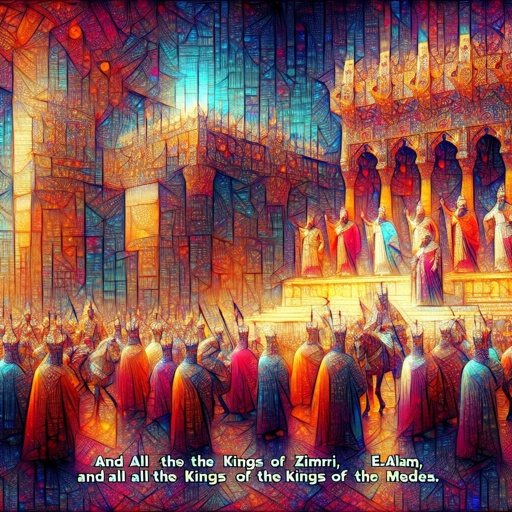
Jeremiah 25:25 - "And all the kings of Zimri, and all the kings of Elam, and all the kings of the Medes,"

"And the city was besieged unto the eleventh year of king Zedekiah." - 2 Kings 25:2

2 Kings 25:3 - "And on the ninth day of the fourth month the famine prevailed in the city, and there was no bread for the people of the land."

2 Kings 25:6 - "So they took the king, and brought him up to the king of Babylon to Riblah; and they gave judgment upon him."

2 Kings 25:14 - "And the pots, and the shovels, and the snuffers, and the spoons, and all the vessels of brass wherewith they ministered, took they away."

1 Kings 2:25 - "And king Solomon sent by the hand of Benaiah the son of Jehoiada; and he fell upon him that he died."

2 Kings 19:27 - "But I know thy abode, and thy going out, and thy coming in, and thy rage against me."

2 Kings 25:10 - "And all the army of the Chaldees, that were with the captain of the guard, brake down the walls of Jerusalem round about."

2 Kings 25:18 - "¶ And the captain of the guard took Seraiah the chief priest, and Zephaniah the second priest, and the three keepers of the door:"

2 Chronicles 25:26 - "Now the rest of the acts of Amaziah, first and last, behold, are they not written in the book of the kings of Judah and Israel?"

2 Kings 25:15 - "And the firepans, and the bowls, and such things as were of gold, in gold, and of silver, in silver, the captain of the guard took away."

2 Kings 10:27 - "And they brake down the image of Baal, and brake down the house of Baal, and made it a draught house unto this day."

2 Kings 8:25 - "¶ In the twelfth year of Joram the son of Ahab king of Israel did Ahaziah the son of Jehoram king of Judah begin to reign."

2 Kings 25:26 - "And all the people, both small and great, and the captains of the armies, arose, and came to Egypt: for they were afraid of the Chaldees."

2 Kings 25:30 - "And his allowance was a continual allowance given him of the king, a daily rate for every day, all the days of his life."

1 Corinthians 9:25-27

1 Corinthians 9:25-27