What does 2 Kings 18:17 mean?
"¶ And the king of Assyria sent Tartan and Rabsaris and Rabshakeh from Lachish to king Hezekiah with a great host against Jerusalem. And they went up and came to Jerusalem. And when they were come up, they came and stood by the conduit of the upper pool, which is in the highway of the fuller's field." - 2 Kings 18:17
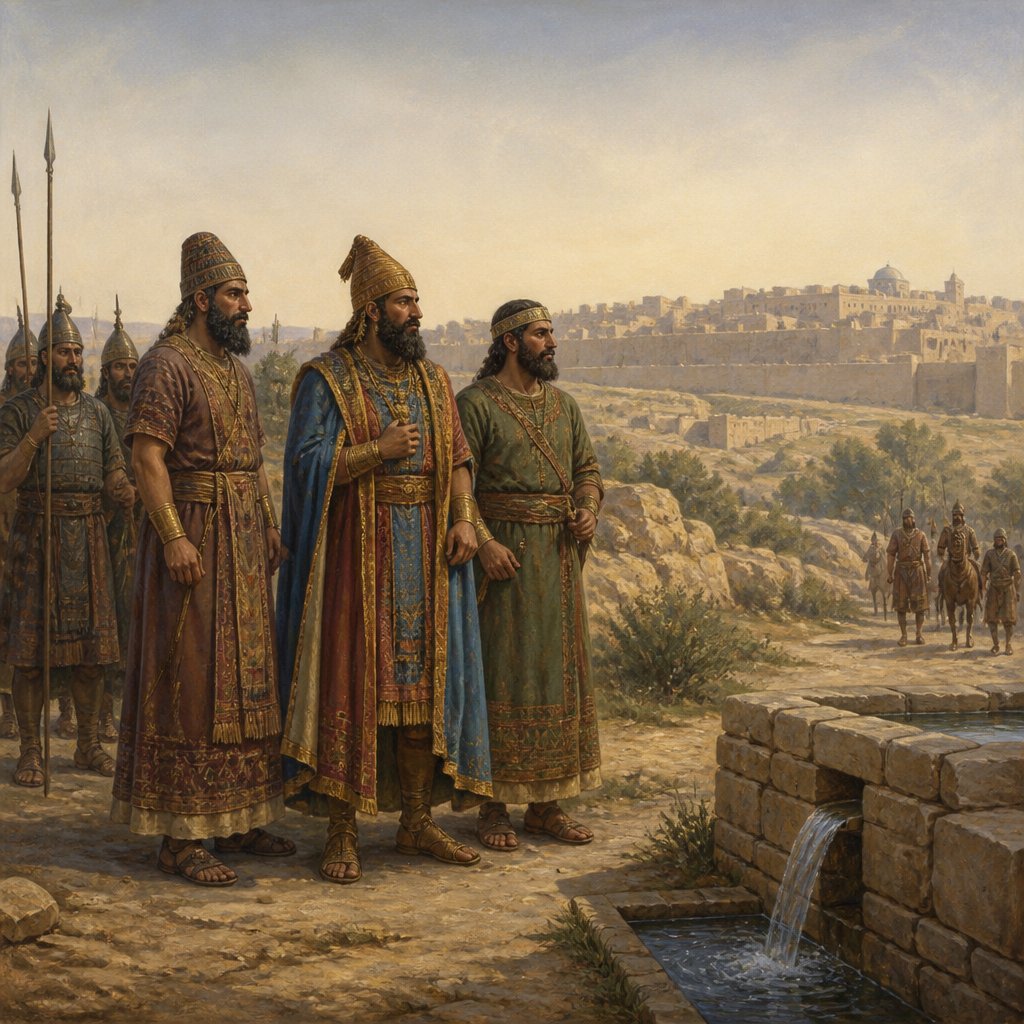
Sure! Here is a detailed and in-depth meaning and commentary on 2 Kings 18:17 from the King James Version of the Bible:
"And the king of Assyria sent Tartan and Rabsaris and Rabshakeh from Lachish to king Hezekiah with a great host against Jerusalem. And they went up and came to Jerusalem. And when they were come up, they came and stood by the conduit of the upper pool, which is in the highway of the fuller's field."
This verse is part of the historical narrative found in the books of Kings and Chronicles, which documents the reign of Hezekiah, the king of Judah. Hezekiah was a righteous and faithful king who sought to lead his people back to the worship of the true God and away from the idolatry that had plagued the nation in previous years. However, he faced many challenges, including the invasion of Judah by the Assyrian Empire, which was known for its cruelty and military might.
In this particular verse, we see the king of Assyria sending his top officials – Tartan, Rabsaris, and Rabshakeh – along with a large army, to confront Hezekiah in Jerusalem. The fact that the Assyrians sent such high-ranking officials indicates the seriousness of their intent to conquer Judah and subdue its king. The location of their arrival at the conduit of the upper pool, which was in the highway of the fuller's field, is significant because it was a strategic point of entry into the city of Jerusalem, where they could make their intentions known to Hezekiah and his people.
The context of this verse is one of impending danger and threat to the people of Judah. The Assyrian army was a formidable force, and their presence at the gates of Jerusalem was a cause for great concern. Hezekiah was faced with the daunting task of protecting his kingdom and his people from the invading enemy. The Assyrians were not only a military threat, but they also represented a spiritual and moral challenge to the people of Judah, as their pagan beliefs and practices stood in stark contrast to the worship of the one true God.
Symbolism is also present in this verse. The arrival of the Assyrian officials and army at the conduit of the upper pool can be seen as a symbolic representation of the forces of evil and opposition that often confront God's people. The "upper pool" may symbolize a place of spiritual refreshment and sustenance, while the "highway of the fuller's field" may represent the paths of righteousness and godliness. The Assyrian threat then becomes a symbol of the challenges and obstacles that believers face in their walk with God, and the need for vigilance and faithfulness in the face of such opposition.
The themes present in this verse include the sovereignty of God, the faithfulness of His people, and the ongoing struggle between good and evil. Despite the overwhelming odds, Hezekiah's response to the Assyrian threat is one of faith and trust in the Lord. His actions in the face of this crisis provide a powerful example of how believers should respond when confronted with adversity and opposition. Hezekiah sought the counsel of the prophet Isaiah and he prayed earnestly to God for deliverance and victory. This serves as a reminder that our ultimate hope and security lie in God's power and providence, rather than in our own strength or resources.
In conclusion, 2 Kings 18:17 from the King James Version of the Bible offers a profound and stirring account of the historical events surrounding the invasion of Judah by the Assyrians. It serves as a poignant reminder of the challenges and dangers that believers often face in their walk with God, as well as the need for unwavering faith and reliance on the Lord in the midst of such trials. The verse also contains rich symbolism and themes that resonate with the spiritual journey of believers throughout the ages, making it a timeless and enduring source of inspiration and encouragement.
Have questions about 2 Kings 18:17?
Dive deeper into this scripture with Bible Chat — an AI-powered tool for exploring God's Word through conversation. Ask questions, get context, and grow in your understanding of the Bible.
Get Our Apps


2 Kings 18:17 Artwork

2 Kings 18:17 - "¶ And the king of Assyria sent Tartan and Rabsaris and Rabshakeh from Lachish to king Hezekiah with a great host against Jerusalem. And they went up and came to Jerusalem. And when they were come up, they came and stood by the conduit of the upper pool, which is in the highway of the fuller's field."
"¶ And the king of Assyria sent Tartan and Rabsaris and Rabshakeh from Lachish to king Hezekiah with a great host against Jerusalem. And they went up and came to Jerusalem. And when they were come up, they came and stood by the conduit of the upper pool, which is in the highway of the fuller's field." - 2 Kings 18:17

2 Kings 17:18 - "Therefore the LORD was very angry with Israel, and removed them out of his sight: there was none left but the tribe of Judah only."

2 Kings 17:2 - "And he did that which was evil in the sight of the LORD, but not as the kings of Israel that were before him."

Revelation 17:18 - "And the woman which thou sawest is that great city, which reigneth over the kings of the earth."

2 Kings 14:18 - "And the rest of the acts of Amaziah, are they not written in the book of the chronicles of the kings of Judah?"

2 Kings 19:17 - "Of a truth, LORD, the kings of Assyria have destroyed the nations and their lands,"

1 Kings 18:17 - "¶ And it came to pass, when Ahab saw Elijah, that Ahab said unto him, Art thou he that troubleth Israel?"

2 Kings 1:18 - "Now the rest of the acts of Ahaziah which he did, are they not written in the book of the chronicles of the kings of Israel?"

1 Kings 17:2 - "And the word of the LORD came unto him, saying,"

"Therefore the LORD was very angry with Israel, and removed them out of his sight: there was none left but the tribe of Judah only." - 2 Kings 17:18

2 Kings 17:40 - "Howbeit they did not hearken, but they did after their former manner."

1 Kings 2:18 - "And Bath-sheba said, Well; I will speak for thee unto the king."

2 Kings 17:8 - "And walked in the statutes of the heathen, whom the LORD cast out from before the children of Israel, and of the kings of Israel, which they had made."

2 Kings 21:17 - "¶ Now the rest of the acts of Manasseh, and all that he did, and his sin that he sinned, are they not written in the book of the chronicles of the kings of Judah?"

2 Kings 8:18 - "And he walked in the way of the kings of Israel, as did the house of Ahab: for the daughter of Ahab was his wife: and he did evil in the sight of the LORD."

2 Kings 18:18 - "And when they had called to the king, there came out to them Eliakim the son of Hilkiah, which was over the household, and Shebna the scribe, and Joah the son of Asaph the recorder."

1 Kings 18:2 - "And Elijah went to shew himself unto Ahab. And there was a sore famine in Samaria."

2 Kings 18:15 - "And Hezekiah gave him all the silver that was found in the house of the LORD, and in the treasures of the king's house."

2 Kings 18:36 - "But the people held their peace, and answered him not a word: for the king's commandment was, saying, Answer him not."

2 Kings 17:17 - "And they caused their sons and their daughters to pass through the fire, and used divination and enchantments, and sold themselves to do evil in the sight of the LORD, to provoke him to anger."

2 Chronicles 17:18 - "And next him was Jehozabad, and with him an hundred and fourscore thousand ready prepared for the war."

"And he did that which was evil in the sight of the LORD, but not as the kings of Israel that were before him." - 2 Kings 17:2

"Of a truth, LORD, the kings of Assyria have destroyed the nations and their lands," - 2 Kings 19:17

"And the rest of the acts of Amaziah, are they not written in the book of the chronicles of the kings of Judah?" - 2 Kings 14:18

2 Kings 3:18 - "And this is but a light thing in the sight of the LORD: he will deliver the Moabites also into your hand."

2 Kings 18:33 - "Hath any of the gods of the nations delivered at all his land out of the hand of the king of Assyria?"

2 Kings 17:19 - "Also Judah kept not the commandments of the LORD their God, but walked in the statutes of Israel which they made."

2 Kings 18:5 - "He trusted in the LORD God of Israel; so that after him was none like him among all the kings of Judah, nor any that were before him."

2 Kings 16:18 - "And the covert for the sabbath that they had built in the house, and the king's entry without, turned he from the house of the LORD for the king of Assyria."