What does 2 Corinthians 5:1 mean?
"For we know that if our earthly house of this tabernacle were dissolved, we have a building of God, an house not made with hands, eternal in the heavens." - 2 Corinthians 5:1
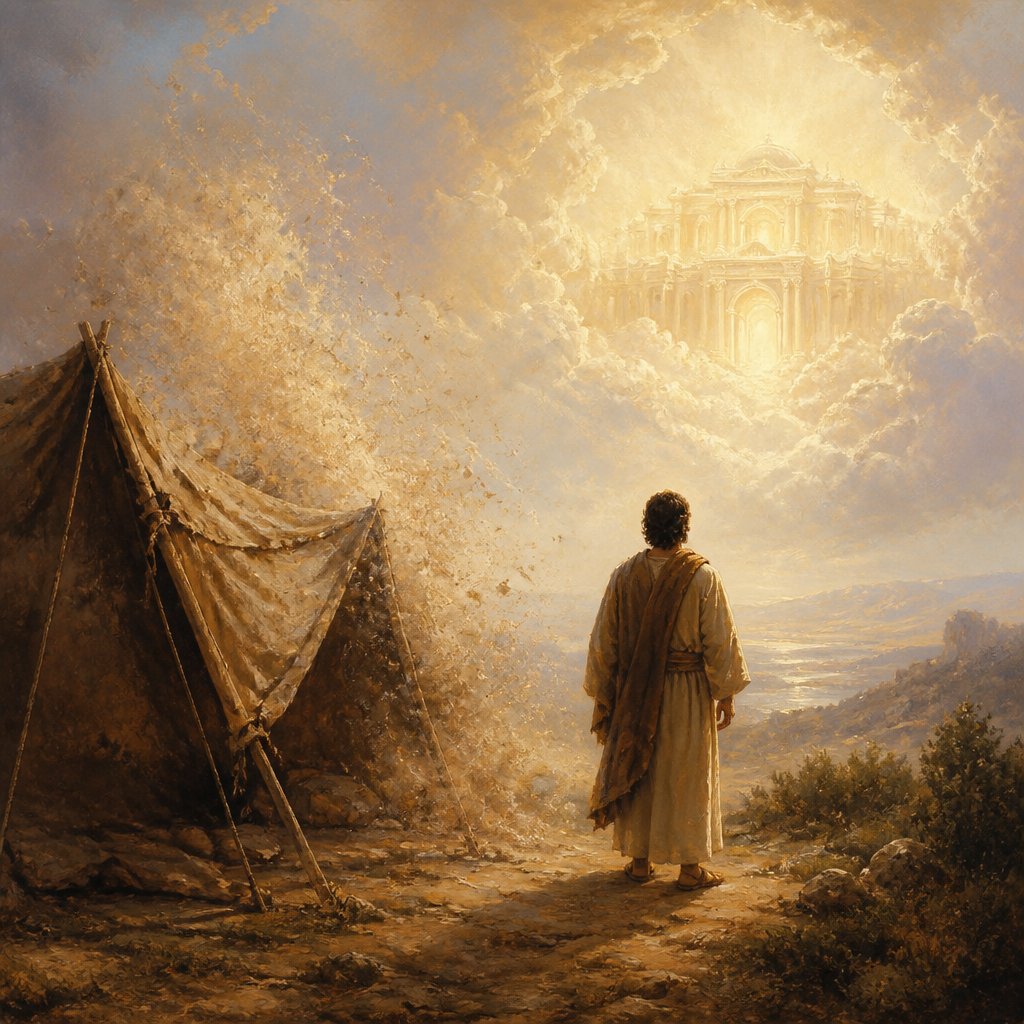
“For we know that if our earthly house of this tabernacle were dissolved, we have a building of God, an house not made with hands, eternal in the heavens.” (2 Corinthians 5:1, KJV)
In this sentence Paul gathers up the pressure, suffering, and frailty that have run through the surrounding chapters and answers them with a calm certainty: “For we know.” He is not guessing at comfort; he is confessing a settled conviction shaped by the gospel. Just before this, he has spoken of outward decay and inward renewal, of “light affliction” that “worketh for us a far more exceeding and eternal weight of glory,” and of fixing the gaze not on “things which are seen,” but on “things which are not seen.” From that perspective, 2 Corinthians 5:1 functions as an explanation of how a Christian can endure affliction without despair. The reason is not that pain is unreal, but that it is temporary, and it is held within a larger certainty about what God has prepared beyond death.
The “earthly house of this tabernacle” is Paul’s reverent way of describing the present human body as it exists in this world. By calling it a “house,” he acknowledges that the body is a real dwelling, a true place of life and activity, not a meaningless shell. Yet by adding “of this tabernacle,” he stresses its temporary character. A tabernacle, in biblical thought, is a tent-like dwelling, something suited for pilgrimage, travel, and transience. It is not the permanent structure one builds for settled life. The word “earthly” further anchors the point: this bodily life belongs to the present order, tied to dust, weakness, aging, and mortality. Paul’s language does not despise the body; it recognizes that, as presently constituted, it is fragile and passing.
“If … were dissolved” is a gentle but realistic description of death. The image suggests the taking down of a tent when a journey ends. It conveys that death dismantles the present mode of bodily existence; the cords are loosened, the stakes removed, the structure collapses. Paul does not pretend that this is pleasant, but he refuses to treat it as ultimate defeat. The dissolving is not the last word over the believer, because it is immediately answered by “we have,” not “we might have.” The verb is present and confident. Even if death comes, something already stands secured for the Christian by God’s promise and power.
That “something” is “a building of God, an house not made with hands, eternal in the heavens.” Here the symbolism shifts from tent to building. The contrast is deliberate. A building suggests permanence, stability, and completion. The first dwelling is called “our earthly house,” but the second is “a building of God.” The emphasis lands on divine origin and divine craftsmanship. What replaces the dissolved tent is not the product of human effort, ingenuity, or merit. It is not assembled by human hands, and therefore it does not share the weakness of human constructions. “Not made with hands” points to what is not merely earthly or man-produced; it signals something that belongs to God’s own order, given rather than achieved.
Paul also calls it “eternal in the heavens.” “Eternal” answers the fragility of the tabernacle; what God provides is not subject to decay. “In the heavens” describes its location and character. It is safe with God, above the reach of corruption, secured in the realm where God’s power and promise are unthreatened. This does not mean the Christian’s hope is vague or disembodied. Rather, it means the believer’s future is anchored with God, and is therefore certain. The Christian’s destiny is not merely to escape trouble, but to be brought into a lasting, God-given mode of life.
In its themes, the verse is about assurance in the face of mortality, the contrast between temporary suffering and permanent glory, and the Christian’s hope of a God-provided dwelling beyond death. It also touches the theme of pilgrimage: believers live now as travelers, living in a tent, looking toward what is permanent. It speaks to courage: the body may fail, life may be “dissolved,” but the believer is not left homeless. The verse also quietly reinforces that salvation is God’s work. The permanent “house” is “of God,” “not made with hands,” and “eternal,” all of which direct the reader away from self-reliance and toward trust in God’s promise.
The significance of 2 Corinthians 5:1, then, is not only that it comforts the grieving or steadies the fearful, but that it reorients the meaning of the present life. If the body is a tabernacle, then life now is real and purposeful, yet not final. If the future is a building of God, then the believer’s endurance in hardship is not denial but hope, rooted in a sure possession promised by God. Paul’s point is that Christian courage is rational within the gospel: the worst that can happen to the “earthly house” is not the end, because God has prepared an eternal dwelling that cannot be dissolved.
Have questions about 2 Corinthians 5:1?
Dive deeper into this scripture with Bible Chat — an AI-powered tool for exploring God's Word through conversation. Ask questions, get context, and grow in your understanding of the Bible.
Get Our Apps


2 Corinthians 5:1 Artwork
2 Corinthians 5:1 - "For we know that if our earthly house of this tabernacle were dissolved, we have a building of God, an house not made with hands, eternal in the heavens."
!["For we know that if our earthly house of [this] tabernacle were dissolved, we have a building of God, an house not made with hands, eternal in the heavens." - 2 Corinthians 5:1](https://media.bible.art/f452bb93-936b-4365-8cfe-74ac8fdc4ea5-thumbnail.jpg)
"For we know that if our earthly house of [this] tabernacle were dissolved, we have a building of God, an house not made with hands, eternal in the heavens." - 2 Corinthians 5:1
"For we know that if our earthly house of this tabernacle were dissolved, we have a building of God, an house not made with hands, eternal in the heavens." - 2 Corinthians 5:1

1 Corinthians 2:5 - "That your faith should not stand in the wisdom of men, but in the power of God."

2 Corinthians 5:17

2 Corinthians 5:17

2 Corinthians 5:17

2 Corinthians 5:17

2 Corinthians 5:17

The old has gone, the new is here. — 2 Corinthians 5:17

2 Corinthians 5:17

2 Corinthians 5:17

2 Corinthians 5:17

2 Corinthians 5:17

2 Corinthians 5:17

2 Corinthians 5:17

2 corinthians 10:3-5

2 corinthians 10:3-5

2 corinthians 10:3-5

2 corinthians 10:3-5

2 corinthians 10:3-5

2 corinthians 10:3-5

2 corinthians 10:3-5

2 corinthians 10:3-5

2 corinthians 10:3-5

2 corinthians 10:3-5

2 corinthians 10:3-5

2 corinthians 10:3-5

1 Corinthians 5:2 - "And ye are puffed up, and have not rather mourned, that he that hath done this deed might be taken away from among you."

2 Corinthians 5:7 - "(For we walk by faith, not by sight:)"