What does 2 Chronicles 33:22 mean?
"But he did that which was evil in the sight of the LORD, as did Manasseh his father: for Amon sacrificed unto all the carved images which Manasseh his father had made, and served them;" - 2 Chronicles 33:22
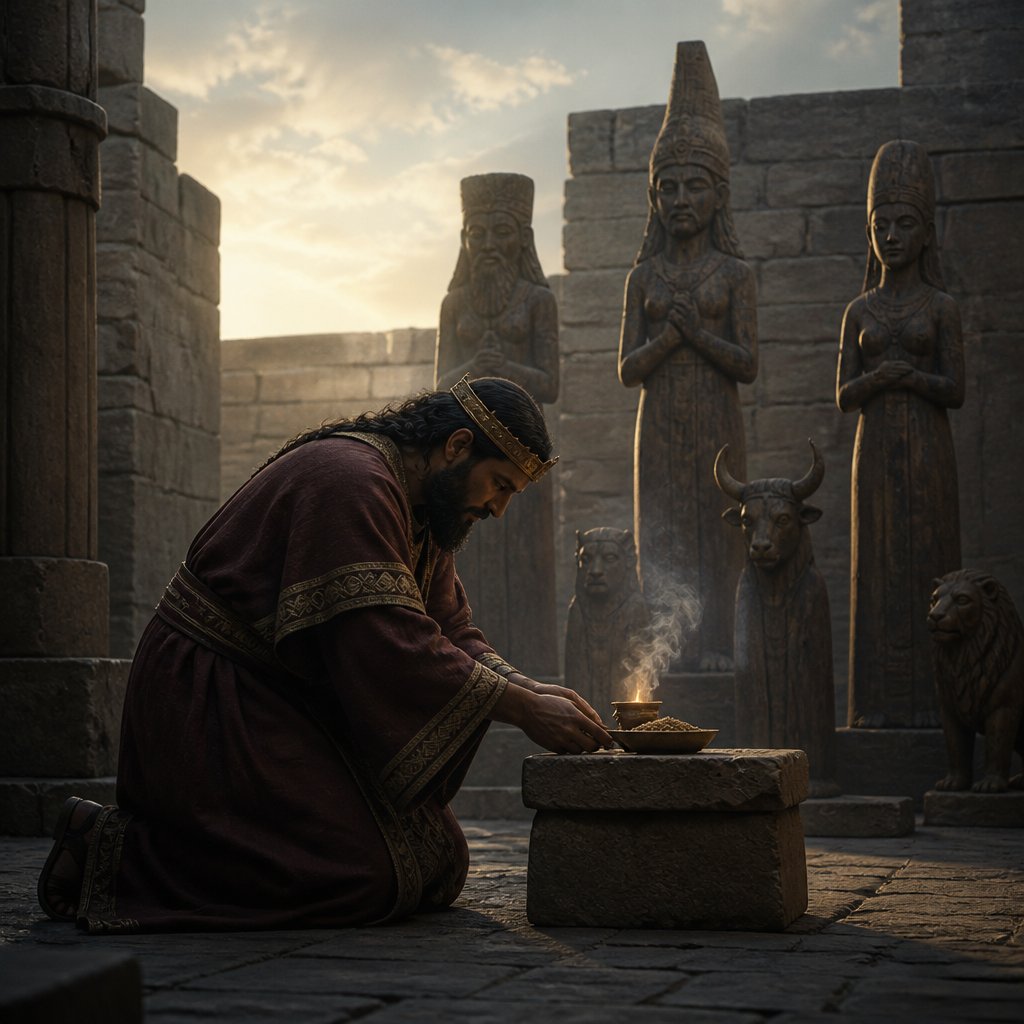
The Bible verse 2 Chronicles 33:22 in the King James Version (KJV) states, "But he did that which was evil in the sight of the LORD, as did Manasseh his father: for Amon sacrificed unto all the carved images which Manasseh his father had made, and served them." This verse is part of the historical account of the reign of King Amon, who was the son of King Manasseh, in the Old Testament. To fully understand the meaning and significance of this verse, we must examine its context within the larger narrative of these two kings' reigns, as well as the themes, symbolism, and theological implications it holds.
King Manasseh is portrayed as one of the most wicked and idolatrous kings in the history of Judah. He led the nation into idolatry, witchcraft, and the shedding of innocent blood, causing the people to commit "more evil than the nations whom the Lord destroyed before the children of Israel" (2 Chronicles 33:9). However, in a dramatic turn of events, God allowed Manasseh to be captured and taken into captivity by the Assyrian army. It was during this time of affliction that Manasseh humbled himself, prayed to the Lord, and experienced personal repentance. As a result, God heard his prayer, restored him to the throne in Jerusalem, and Manasseh began to reverse the evil policies of his earlier rule by seeking to lead the people back to the worship of the true God.
However, the impact of Manasseh's earlier idolatry and wickedness was not easily undone, as seen in the life of his son King Amon. Despite the example of his father's repentance, Amon chose to follow in the footsteps of Manasseh's earlier idolatry, causing him to do "evil in the sight of the Lord" (2 Chronicles 33:22). The verse specifically mentions that Amon "sacrificed unto all the carved images which Manasseh his father had made, and served them." This indicates that Amon not only continued in the idolatrous practices initiated by his father, but he also actively promoted and participated in their worship, despite the knowledge of God's judgment on his father's actions.
The theological implication of this verse lies in the idea that each person is responsible for their own choices and actions, regardless of their family background or upbringing. Amon had the example of his father's repentance and the opportunity to turn away from idolatry, yet he deliberately chose to continue in sin. This serves as a sobering reminder that our personal relationship with God and our obedience to His commands cannot be inherited or assumed based on our family lineage or cultural upbringing. Each individual must make a conscious decision to follow God and live according to His will.
In addition to the moral and theological implications, this verse also carries significant symbolism in the larger biblical narrative. The carved images and idolatrous practices mentioned in this verse represent the spiritual unfaithfulness and rebellion of the people of Judah towards God. Throughout the Old Testament, the Lord consistently condemned the worship of false gods and the making of carved images, emphasizing that He alone is the true and living God. The choice of Amon to sacrifice to these carved images symbolizes the deeper issue of the human heart's tendency to seek after false gods and earthly pleasures, rather than fully committing to the worship and obedience of the one true God.
Ultimately, 2 Chronicles 33:22 serves as a cautionary tale about the danger of continuing in disobedience and the consequences of choosing to worship false gods. It highlights the need for personal repentance, sincere obedience, and the acknowledgment of God's sovereignty over our lives. This verse reminds us that our choices have real consequences and that true faithfulness to God requires a heart that turns away from sin and turns towards Him in humble obedience.
Have questions about 2 Chronicles 33:22?
Dive deeper into this scripture with Bible Chat — an AI-powered tool for exploring God's Word through conversation. Ask questions, get context, and grow in your understanding of the Bible.
Get Our Apps


2 Chronicles 33:22 Artwork

2 Chronicles 33:22 - "But he did that which was evil in the sight of the LORD, as did Manasseh his father: for Amon sacrificed unto all the carved images which Manasseh his father had made, and served them;"
"But he did that which was evil in the sight of the LORD, as did Manasseh his father: for Amon sacrificed unto all the carved images which Manasseh his father had made, and served them;" - 2 Chronicles 33:22

2 Chronicles 33:21 - "¶ Amon was two and twenty years old when he began to reign, and reigned two years in Jerusalem."

1 Chronicles 2:33 - "And the sons of Jonathan; Peleth, and Zaza. These were the sons of Jerahmeel."

2 Chronicles 33:10 - "And the LORD spake to Manasseh, and to his people: but they would not hearken."

2 Samuel 22:33 - "God is my strength and power: and he maketh my way perfect."

2 Chronicles 29:33 - "And the consecrated things were six hundred oxen and three thousand sheep."

2 Chronicles 33:5 - "And he built altars for all the host of heaven in the two courts of the house of the LORD."

2 Chronicles 33:24 - "And his servants conspired against him, and slew him in his own house."

2 Chronicles 36:22

2 Chronicles 4:22

2 Chronicles 33:2 - "But did that which was evil in the sight of the LORD, like unto the abominations of the heathen, whom the LORD had cast out before the children of Israel."

2 Chronicles 33:17 - "Nevertheless the people did sacrifice still in the high places, yet unto the LORD their God only."

2 Chronicles 20:33 - "Howbeit the high places were not taken away: for as yet the people had not prepared their hearts unto the God of their fathers."

2 Chronicles 33:23 - "And humbled not himself before the LORD, as Manasseh his father had humbled himself; but Amon trespassed more and more."

2 Chronicles 33:1 - "Manasseh was twelve years old when he began to reign, and he reigned fifty and five years in Jerusalem:"

2 Chronicles 33:12 - "And when he was in affliction, he besought the LORD his God, and humbled himself greatly before the God of his fathers,"

2 Chronicles 33:4 - "Also he built altars in the house of the LORD, whereof the LORD had said, In Jerusalem shall my name be for ever."

2 Chronicles 33:20 - "¶ So Manasseh slept with his fathers, and they buried him in his own house: and Amon his son reigned in his stead."

2 Chronicles 33:16 - "And he repaired the altar of the LORD, and sacrificed thereon peace offerings and thank offerings, and commanded Judah to serve the LORD God of Israel."

2 Chronicles 9:22 - "And king Solomon passed all the kings of the earth in riches and wisdom."

"And the LORD spake to Manasseh, and to his people: but they would not hearken." - 2 Chronicles 33:10

"And the sons of Jonathan; Peleth, and Zaza. These were the sons of Jerahmeel." - 1 Chronicles 2:33

2 Chronicles 33:9 - "So Manasseh made Judah and the inhabitants of Jerusalem to err, and to do worse than the heathen, whom the LORD had destroyed before the children of Israel."

2 Chronicles 33:25 - "¶ But the people of the land slew all them that had conspired against king Amon; and the people of the land made Josiah his son king in his stead."

2 Chronicles 25:22 - "And Judah was put to the worse before Israel, and they fled every man to his tent."

1 Chronicles 2:22 - "And Segub begat Jair, who had three and twenty cities in the land of Gilead."

2 Chronicles 33:13 - "And prayed unto him: and he was intreated of him, and heard his supplication, and brought him again to Jerusalem into his kingdom. Then Manasseh knew that the LORD he was God."

2 Chronicles 22:12 - "And he was with them hid in the house of God six years: and Athaliah reigned over the land."

2 Chronicles 13:22 - "And the rest of the acts of Abijah, and his ways, and his sayings, are written in the story of the prophet Iddo."