What does 2 Chronicles 12:3 mean?
"With twelve hundred chariots, and threescore thousand horsemen: and the people were without number that came with him out of Egypt; the Lubims, the Sukkiims, and the Ethiopians." - 2 Chronicles 12:3
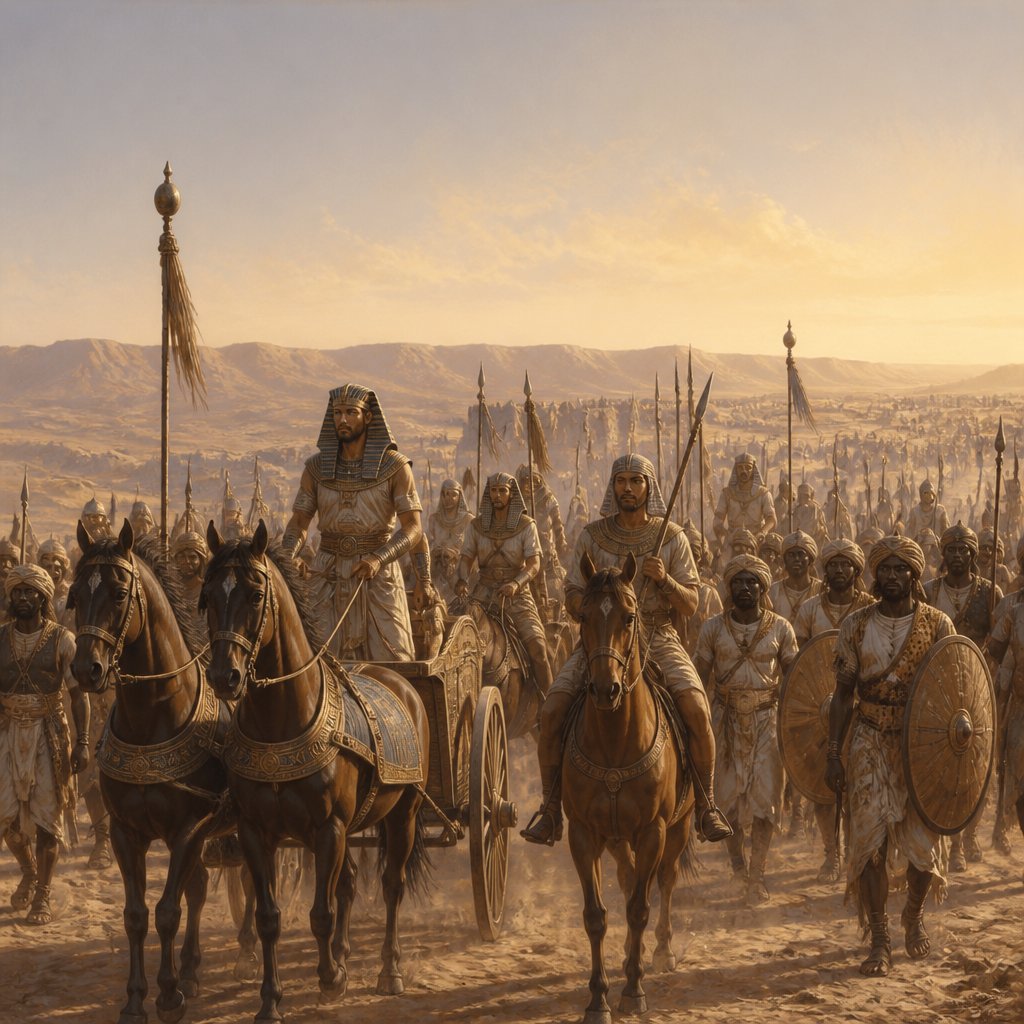
The verse 2 Chronicles 12:3 in the King James Version (KJV) of the Bible reads, "With twelve hundred chariots, and threescore thousand horsemen: and the people were without number that came with him out of Egypt; the Lubims, the Sukkiims, and the Ethiopians."
This verse is part of the larger context of the reign of King Rehoboam, the son of Solomon, who became the ruler of the Kingdom of Judah. In this chapter, we see the description of King Rehoboam's reign and his downfall. The verse in question describes the invasion of Judah by the Egyptian king Shishak. Shishak is mentioned in this verse as leading a massive army, consisting of 1,200 chariots, 60,000 horsemen, and a countless number of soldiers from different nations, including the Lubims, the Sukkiims, and the Ethiopians.
The context of this verse provides an important historical insight into the political and military challenges faced by the Kingdom of Judah during King Rehoboam's reign. It also serves as a reminder of the consequences of straying from the ways of the Lord, as it was the result of King Rehoboam and the people of Judah turning away from God that led to the invasion by the Egyptian forces.
One of the key themes of this verse is the consequence of disobedience and unfaithfulness. Throughout the Bible, there are numerous examples of nations and individuals facing the consequences of their actions when they turn away from God. In this case, the invasion by the Egyptian forces can be seen as a direct result of King Rehoboam and the people of Judah forsaking the worship of the Lord and turning to idolatry and other sinful practices. This theme serves as a powerful reminder of the importance of remaining faithful to God and following His commandments.
The verse also symbolizes the power and might of earthly kingdoms and the consequences of reliance on human strength rather than God's protection. The sheer size and strength of the Egyptian army, with its chariots and horsemen, may have seemed overwhelming to the people of Judah. However, the verse serves as a symbol of the futility of relying on human strength and military power in the face of divine retribution. It reminds believers of the importance of trusting in the Lord's protection and seeking His guidance in all circumstances.
Furthermore, the mention of the Lubims, Sukkiims, and Ethiopians in this verse highlights the diversity of the Egyptian army. These nations were likely allies or mercenaries in Shishak's army, emphasizing the widespread opposition faced by Judah. This serves as a reminder of the global nature of spiritual warfare and the need for believers to be vigilant and steadfast in their faith, regardless of the challenges they may face from different quarters.
In conclusion, 2 Chronicles 12:3 in the King James Version of the Bible provides a powerful historical account of the consequences of unfaithfulness and disobedience, as well as a symbol of the futility of relying on human strength and power. It serves as a sobering reminder of the importance of remaining faithful to God and seeking His protection and guidance in all circumstances.
Have questions about 2 Chronicles 12:3?
Dive deeper into this scripture with Bible Chat — an AI-powered tool for exploring God's Word through conversation. Ask questions, get context, and grow in your understanding of the Bible.
Get Our Apps


2 Chronicles 12:3 Artwork

2 Chronicles 12:3 - "With twelve hundred chariots, and threescore thousand horsemen: and the people were without number that came with him out of Egypt; the Lubims, the Sukkiims, and the Ethiopians."
"With twelve hundred chariots, and threescore thousand horsemen: and the people were without number that came with him out of Egypt; the Lubims, the Sukkiims, and the Ethiopians." - 2 Chronicles 12:3

2 Chronicles 3:12 - "And one wing of the other cherub was five cubits, reaching to the wall of the house: and the other wing was five cubits also, joining to the wing of the other cherub."

2 chronicles 13:12

1 Chronicles 3:12 - "Amaziah his son, Azariah his son, Jotham his son,"

2 Chronicles 28:3

1 Chronicles 2:12 - "And Boaz begat Obed, and Obed begat Jesse,"

1 Chronicles 12:3 - "The chief was Ahiezer, then Joash, the sons of Shemaah the Gibeathite; and Jeziel, and Pelet, the sons of Azmaveth; and Berachah, and Jehu the Antothite,"

2 Chronicles 8:3 - "And Solomon went to Hamath-zobah, and prevailed against it."

2 Chronicles 12:6 - "Whereupon the princes of Israel and the king humbled themselves; and they said, The LORD is righteous."

2 Chronicles 3:2 - "And he began to build in the second day of the second month, in the fourth year of his reign."

2 Chronicles 12:4 - "And he took the fenced cities which pertained to Judah, and came to Jerusalem."

2 Chronicles 17:12 - "¶ And Jehoshaphat waxed great exceedingly; and he built in Judah castles, and cities of store."

2 Chronicles 14:12 - "So the LORD smote the Ethiopians before Asa, and before Judah; and the Ethiopians fled."

2 Chronicles 15:12 - "And they entered into a covenant to seek the LORD God of their fathers with all their heart and with all their soul;"

2 Chronicles 12:14 - "And he did evil, because he prepared not his heart to seek the LORD."

2 Chronicles 12:12 - "And when he humbled himself, the wrath of the LORD turned from him, that he would not destroy him altogether: and also in Judah things went well."

2 Chronicles 12:8 - "Nevertheless they shall be his servants; that they may know my service, and the service of the kingdoms of the countries."

2 Chronicles 22:12 - "And he was with them hid in the house of God six years: and Athaliah reigned over the land."

2 Kings 12:19 - "¶ And the rest of the acts of Joash, and all that he did, are they not written in the book of the chronicles of the kings of Judah?"

2 Chronicles 3:6 - "And he garnished the house with precious stones for beauty: and the gold was gold of Parvaim."

2 Chronicles 26:12 - "The whole number of the chief of the fathers of the mighty men of valour were two thousand and six hundred."

2 Chronicles 24:3 - "And Jehoiada took for him two wives; and he begat sons and daughters."

2 Chronicles 12:2 - "And it came to pass, that in the fifth year of king Rehoboam Shishak king of Egypt came up against Jerusalem, because they had transgressed against the LORD,"

2 Chronicles 3:9 - "And the weight of the nails was fifty shekels of gold. And he overlaid the upper chambers with gold."

2 Chronicles 12:16 - "And Rehoboam slept with his fathers, and was buried in the city of David: and Abijah his son reigned in his stead."

2 Chronicles 6:12 - "¶ And he stood before the altar of the LORD in the presence of all the congregation of Israel, and spread forth his hands:"

2 Chronicles 3:3 - "¶ Now these are the things wherein Solomon was instructed for the building of the house of God. The length by cubits after the first measure was threescore cubits, and the breadth twenty cubits."

2 Chronicles 27:3 - "He built the high gate of the house of the LORD, and on the wall of Ophel he built much."

2 Chronicles 10:3 - "And they sent and called him. So Jeroboam and all Israel came and spake to Rehoboam, saying,"