What does 1 Timothy 6:15-16 mean?
"1 Timothy 6:15-16: 15 Which in his times he shall shew, who is the blessed and only Potentate, the King of kings, and Lord of lords; 16 Who only hath immortality, dwelling in the light which no man can approach unto; whom no man hath seen, nor can see: to whom be honour and power everlasting. Amen." - 1 Timothy 6:15-16

In 1 Timothy 6, Paul is drawing his letter to a climax by pressing Timothy to live and minister with a holy seriousness in the sight of God. The chapter has already warned against corrupt teaching, urged contentment over covetousness, exposed the spiritual danger of loving money, and called Timothy to “fight the good fight of faith” and to “lay hold on eternal life.” Into that setting Paul places a solemn charge: Timothy is to keep the commandment “without spot, unrebukeable, until the appearing of our Lord Jesus Christ.” Immediately after naming that “appearing,” Paul’s words rise into worship, and 1 Timothy 6:15–16 reads like a doxology that grounds Timothy’s obedience not in Timothy’s strength but in God’s incomparable majesty.
The “appearing” of Jesus is not presented as something managed by men, predicted by calculations, or produced by human power. It is something God will unveil at the time God has appointed. That is the force of the phrase, “Which in his times he shall shew.” The KJV wording stresses divine sovereignty over history: the Lord Jesus Christ will be displayed openly, but the timing belongs to God. The verse is therefore both a comfort and a restraint. It comforts Timothy because the cause he serves will be vindicated by God himself. It restrains him from impatience, speculation, or compromise, because faithfulness is required until God’s appointed time.
When Paul calls God “the blessed and only Potentate,” he is identifying the One who holds ultimate authority. “Blessed” here is not merely that God gives blessing, but that God is himself the perfectly happy, self-sufficient, untroubled One, the fountain of all life and goodness. “Only Potentate” means the only absolute Sovereign. Earthly rulers possess real but limited authority; God possesses authority that is underived and unmatched. In a letter addressed to a minister laboring amid false teachers and social pressures, this title places every rival claim in its proper place. No faction in the church, no cultural power, no persecution, no wealth, no human influence can compete with the rule of the One Paul is describing.
Paul then intensifies the point: God is “the King of kings, and Lord of lords.” This is royal language meant to swallow up all other royalty. Whatever kings exist, he is their King; whatever lords exist, he is their Lord. It is both political and spiritual in its implication, because it says that every created hierarchy is subordinate to God’s throne. The phrase also functions as a direct answer to the idolatries and emperor-worship of the first-century world, as well as to the quieter idolatries of the heart. If God is King of kings, then no earthly allegiance can demand what belongs to him, and no earthly threat can finally overturn what he wills.
Verse 16 continues by moving from God’s rule to God’s very being. “Who only hath immortality” speaks of God as possessing life in an absolute way. Creatures may be immortal only by gift and sustaining power; God is immortal by nature. This makes him the one fixed point in a world of decay. In the immediate context, where Paul has reminded Timothy of “eternal life” and warned about the fleeting nature of riches, “only hath immortality” underlines that true permanence belongs to God, and that any hope of immortality for man is dependent upon him. It rebukes human pride, because no man has life in himself; it steadies faith, because the God who commands is not subject to death.
Paul adds vivid symbolism: God “dwelling in the light which no man can approach unto.” Light in Scripture often signifies holiness, truth, purity, and revelation; yet here the light is not merely enlightening, it is unapproachable. The image conveys transcendence. God is not one object among other objects in the universe, available to be inspected or mastered. He is so holy, so pure, so infinite in glory, that fallen man cannot close the distance. The “light” also suggests that God is the source of all true knowledge, yet beyond the reach of human control. Timothy is to minister in truth, but he is to do so with reverent humility, remembering that God is not reduced to human categories.
The statement “whom no man hath seen, nor can see” further emphasizes God’s invisibility and incomprehensibility. It does not mean that God has never made himself known, since Scripture also teaches that God reveals himself and that the Son makes him known, but it does mean that God in his essence is beyond the capacity of human sight and human grasp. The KJV’s “nor can see” underscores inability, not merely lack of opportunity. This protects the faith from superstition and presumption. It reminds Timothy that the minister does not traffic in private visions as proof of authority, but serves the God who is known truly by his word and works, yet never domesticated by human experience.
Paul ends with an ascription: “to whom be honour and power everlasting. Amen.” This is not a new thought tacked on; it is the proper conclusion of everything that has been said. If God is the blessed and only Potentate, then honour belongs to him. If God is King of kings, then power belongs to him. If God alone has immortality, then his power is “everlasting,” not temporary or dependent. And the “Amen” is Timothy’s and the church’s assent: it is the seal of worship placed upon doctrine. The verse therefore does more than describe God; it reorders Timothy’s inner life. It calls him to obey not because the times are easy, not because men applaud, not because gain is promised, but because the God who will “shew” Christ’s appearing is the only Sovereign, the only One with immortality, the One whose holiness is unapproachable, and the One to whom all honour and power rightly belong.
In the flow of 1 Timothy 6, this doxology functions like a mountain peak after strenuous counsel. Paul has addressed practical matters, moral dangers, and ministerial responsibilities; then he lifts Timothy’s eyes to God’s supremacy and mystery. The significance of 1 Timothy 6:15–16 is that it anchors Christian endurance and purity in the character of God himself. Timothy’s charge to keep the commandment “until the appearing” is sustained by the certainty that God rules the times, that God outranks every authority, that God is life itself, and that God’s glory is both radiant and untouchable. The passage therefore teaches reverence, steadies faith under pressure, exposes the smallness of worldly power, and turns doctrine into worship, so that duty is carried out in the presence of the King of kings and Lord of lords.
Have questions about 1 Timothy 6:15-16?
Dive deeper into this scripture with Bible Chat — an AI-powered tool for exploring God's Word through conversation. Ask questions, get context, and grow in your understanding of the Bible.
Get Our Apps


1 Timothy 6:15-16 Artwork

1 Timothy 6:15-16 – "God, the blessed and only Ruler, the King of kings and Lord of lords."

1 Timothy 6:15-16 – "God, the blessed and only Ruler, the King of kings and Lord of lords."

1 Timothy 6:15-16 – "God, the blessed and only Ruler, the King of kings and Lord of lords."
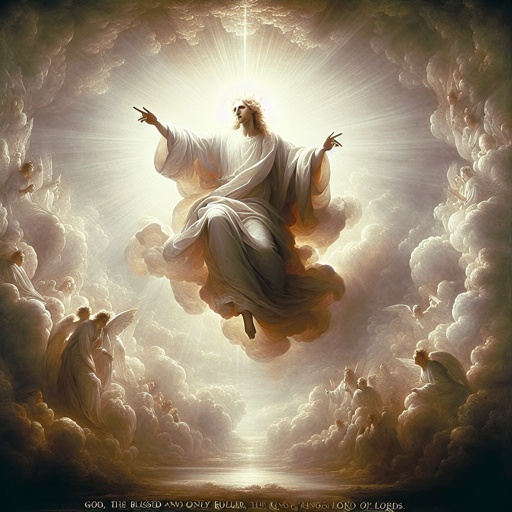
1 Timothy 6:15-16 – "God, the blessed and only Ruler, the King of kings and Lord of lords."

1 Timothy 6:15-16 – "God, the blessed and only Ruler, the King of kings and Lord of lords."

1 Timothy 6:15-16 - "which God will bring about in his own time—God, the blessed and only Ruler, the King of kings and Lord of lords, who alone is immortal and who lives in unapproachable light, whom no one has seen or can see. To him be honor and might forever. Amen."

"which God will bring about in his own time—God, the blessed and only Ruler, the King of kings and Lord of lords, who alone is immortal and who lives in unapproachable light, whom no one has seen or can see. To him be honor and might forever. Amen." - 1 Timothy 6:15-16

1 Timothy 6:15 - "Which in his times he shall shew, who is the blessed and only Potentate, the King of kings, and Lord of lords;"

inapproachable light 1 Timothy 6:16

"Which in his times he shall shew, who is the blessed and only Potentate, the King of kings, and Lord of lords;" - 1 Timothy 6:15

Ezra 6:15-16

Ezra 6:15-16

"Who only hath immortality, dwelling in the light which no man can approach unto; whom no man hath seen, nor can see: to whom be honour and power everlasting. Amen." - 1 Timothy 6:16

"Who only hath immortality, dwelling in the light which no man can approach unto; whom no man hath seen, nor can see: to whom be honour and power everlasting. Amen." - 1 Timothy 6:16

1 Timothy 4:15

1 Timothy 6:6 - "But godliness with contentment is great gain."

1 Timothy 3:15

1 Timothy 3:16

2 Timothy 2:15

1 Timothy 6:16 - "Who only hath immortality, dwelling in the light which no man can approach unto; whom no man hath seen, nor can see: to whom be honour and power everlasting. Amen."

1 Timothy 5:15 - "For some are already turned aside after Satan."

1 Timothy 6:8 - "And having food and raiment let us be therewith content."

1 Timothy 6:20 - "O Timothy, keep that which is committed to thy trust, avoiding profane and vain babblings, and oppositions of science falsely so called:"

"But godliness with contentment is great gain." - 1 Timothy 6:6

1 Timothy 1:5

1 Timothy 6:21 - "Which some professing have erred concerning the faith. Grace be with thee. Amen."

1 Timothy 5:6 - "But she that liveth in pleasure is dead while she liveth."
1 Timothy 1:6 - "From which some having swerved have turned aside unto vain jangling;"

1 Timothy 2:6 - "Who gave himself a ransom for all, to be testified in due time."

1 Timothy 2:15 - "Notwithstanding she shall be saved in childbearing, if they continue in faith and charity and holiness with sobriety."