What does 1 Samuel 31:12 mean?
"All the valiant men arose, and went all night, and took the body of Saul and the bodies of his sons from the wall of Beth-shan, and came to Jabesh, and burnt them there." - 1 Samuel 31:12
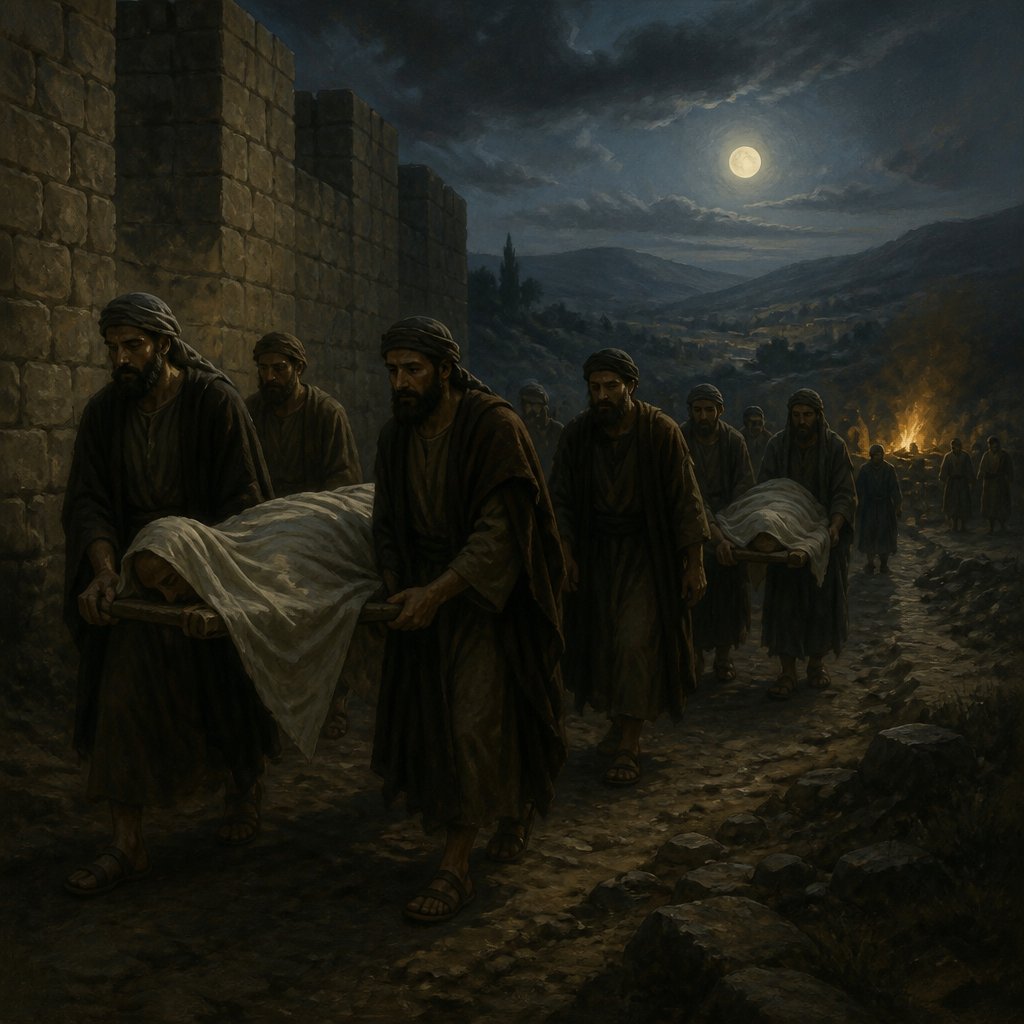
The Bible verse 1 Samuel 31:12 in the King James Version reads:
"All the valiant men arose, and went all night, and took the body of Saul and the bodies of his sons from the wall of Bethshan, and came to Jabesh, and burnt them there."
This verse comes at the end of the book of 1 Samuel, which details the rise and fall of the Israelite monarchy. In this chapter, we see the tragic end of King Saul, the first king of Israel. The preceding verses describe the battle between the Israelites and the Philistines, in which the Israelites are defeated and King Saul and his sons are killed.
In verse 12, we see the aftermath of this defeat as the valiant men of Israel come to retrieve the bodies of King Saul and his sons from the wall of Bethshan, where the Philistines had hung them after their deaths, and gave them a proper burial. This act of bravery and honor, despite the grim circumstances, highlights the loyalty and respect the people had for their fallen king and his family.
At its core, this verse speaks to the themes of loyalty, honor, and respect, even in the face of defeat and death. Despite the tragic outcome of the battle, the valiant men of Israel showed unwavering loyalty and respect to their fallen king and his family by retrieving their bodies and giving them a proper burial. This act serves as a testament to the values and virtues upheld by the Israelites, even in the midst of despair and sorrow.
The historical and cultural context of this verse is also significant. King Saul was the first king of Israel, chosen and anointed by the prophet Samuel. His reign was marked by both triumphs and failures, and his downfall ultimately paved the way for the rise of King David. The retrieval and burial of Saul and his sons held deep symbolic meaning for the Israelites, as it represented the end of an era and the beginning of a new chapter in their nation's history.
Symbolically, the act of retrieving and burying the bodies of Saul and his sons can be seen as a demonstration of honor and closure. By giving them a proper burial, the valiant men of Israel honored the memory of their fallen king and paid their respects to his family. This act also provided a sense of closure for the nation, allowing them to grieve and process the loss of their leader and come to terms with the transition of power that was to come.
Overall, 1 Samuel 31:12 serves as a poignant reminder of the values of loyalty, honor, and respect, even in the face of tragedy and defeat. It also highlights the cultural and historical significance of King Saul's reign and the transition of power to King David. This verse is a testament to the enduring legacy of the Israelites and the timeless virtues that they upheld in the face of adversity.
Have questions about 1 Samuel 31:12?
Dive deeper into this scripture with Bible Chat — an AI-powered tool for exploring God's Word through conversation. Ask questions, get context, and grow in your understanding of the Bible.
Get Our Apps


1 Samuel 31:12 Artwork

1 Samuel 31:12 - "All the valiant men arose, and went all night, and took the body of Saul and the bodies of his sons from the wall of Beth-shan, and came to Jabesh, and burnt them there."

1 Sam 31: 12-13
"All the valiant men arose, and went all night, and took the body of Saul and the bodies of his sons from the wall of Beth-shan, and came to Jabesh, and burnt them there." - 1 Samuel 31:12
1 Samuel 15:31 - "So Samuel turned again after Saul; and Saul worshipped the LORD."

Titus 3:1-2

Titus 3:1-2

1 Samuel 31:11 - "¶ And when the inhabitants of Jabesh-gilead heard of that which the Philistines had done to Saul;"

1 Samuel 12

1 Samuel 31:6 - "So Saul died, and his three sons, and his armourbearer, and all his men, that same day together."

1 Samuel 4:12

1 Samuel 14:31 - "And they smote the Philistines that day from Michmash to Aijalon: and the people were very faint."

1 Samuel 31:13 - "And they took their bones, and buried them under a tree at Jabesh, and fasted seven days."

1 Samuel 31:3 - "And the battle went sore against Saul, and the archers hit him; and he was sore wounded of the archers."

1 Samuel 31:10 - "And they put his armour in the house of Ashtaroth: and they fastened his body to the wall of Beth-shan."

"So Samuel turned again after Saul; and Saul worshipped the LORD." - 1 Samuel 15:31

1 Samuel 31:1 - "Now the Philistines fought against Israel: and the men of Israel fled from before the Philistines, and fell down slain in mount Gilboa."

1 Samuel 2:12

1 Samuel 12:13

1 Samuel 12:13

1 Samuel 31:5 - "And when his armourbearer saw that Saul was dead, he fell likewise upon his sword, and died with him."

1 Samuel 17:31 - "And when the words were heard which David spake, they rehearsed them before Saul: and he sent for him."

1 Samuel 12:18 - "So Samuel called unto the LORD; and the LORD sent thunder and rain that day: and all the people greatly feared the LORD and Samuel."

1 Samuel 30:31 - "And to them which were in Hebron, and to all the places where David himself and his men were wont to haunt."

1 Samuel 31:8 - "And it came to pass on the morrow, when the Philistines came to strip the slain, that they found Saul and his three sons fallen in mount Gilboa."

1 Samuel 31:2 - "And the Philistines followed hard upon Saul and upon his sons; and the Philistines slew Jonathan, and Abinadab, and Malchi-shua, Saul's sons."

1 Samuel 3:1-10

1 Corinthians 12:31 - "But covet earnestly the best gifts: and yet shew I unto you a more excellent way."

1 Samuel 31:4 Saul took his own sword and fell on it. create the image in color

1 Samuel 12:6 - "¶ And Samuel said unto the people, It is the LORD that advanced Moses and Aaron, and that brought your fathers up out of the land of Egypt."

1 Samuel 13:12 Saul's disobedience