What does 1 Samuel 1:8 mean?
"Then said Elkanah her husband to her, Hannah, why weepest thou? and why eatest thou not? and why is thy heart grieved? am not I better to thee than ten sons?" - 1 Samuel 1:8
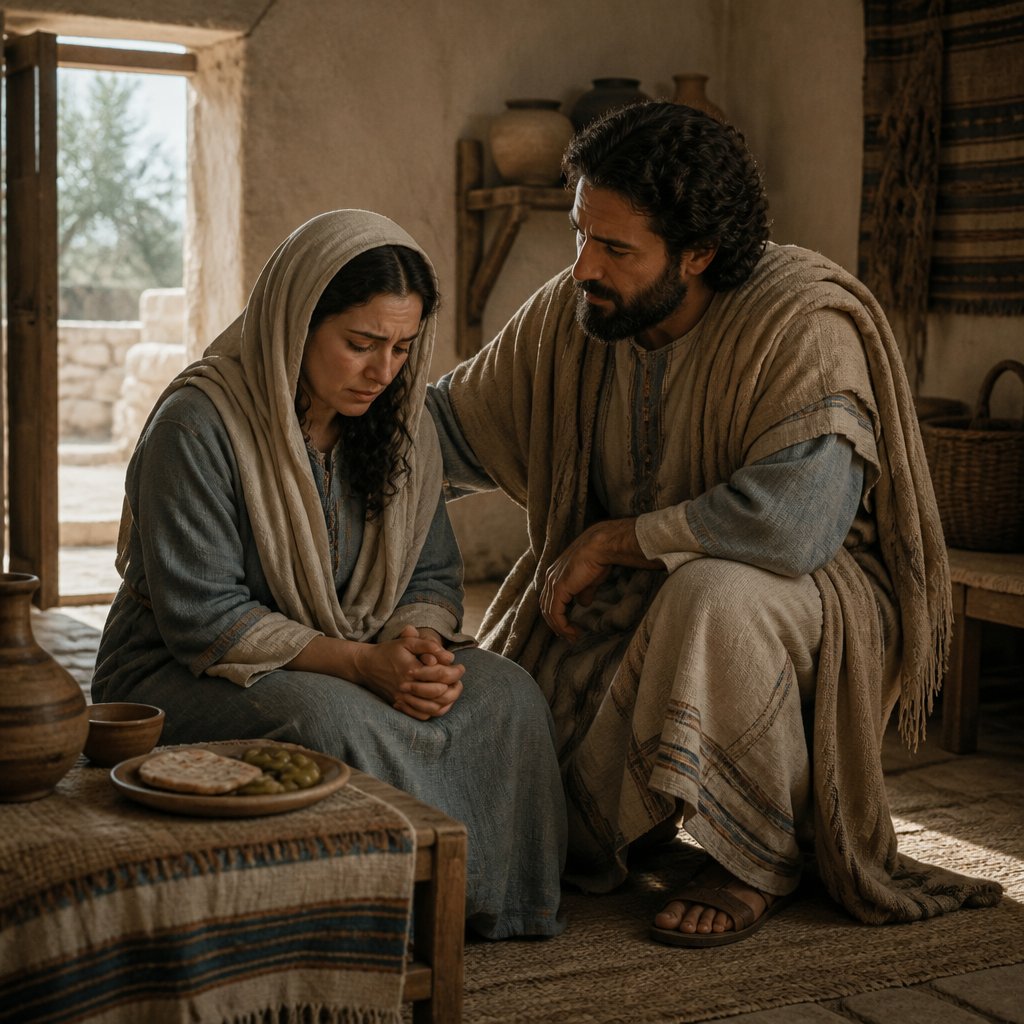
The Bible verse 1 Samuel 1:8 from the King James Version (KJV) states: "Then said Elkanah her husband to her, Hannah, why weepest thou? and why eatest thou not? and why is thy heart grieved? am not I better to thee than ten sons?"
This verse is part of the narrative of Hannah, a woman who is deeply distressed because she is unable to conceive a child. The passage takes place during a yearly visit to the house of the Lord, when Elkanah, Hannah's husband, is concerned about her distress. This verse is a part of a larger story that offers valuable insights into themes such as maternal longing, the power of prayer, and the faithfulness of God.
One of the prominent themes in this verse is the sorrow of infertility and the longing for a child. During the time in which this verse is set, the ability to conceive and bear children was highly valued in society. It brought fulfillment to a woman, secured her position within the family, and was seen as a blessing from God. However, Hannah is unable to bear a child, and her emotional anguish is evident through her weeping and loss of appetite. This verse portrays the deep emotional pain that Hannah experiences as she faces the stigma and disappointment of being unable to conceive. Her inability to have a child brings great distress, and Elkanah, her husband, notices her grief and is concerned for her well-being.
The verse also delves into the complexities of relationships and the ways in which individuals attempt to console one another in times of hardship. Elkanah's response to Hannah's distress demonstrates his care and concern for her well-being. He questions her sorrow, asking why she is weeping and not eating, and why her heart is grieved. Additionally, his statement, "am not I better to thee than ten sons?" reveals his desire to comfort her and remind her of the love and support he offers. This reveals the interpersonal dynamics of their relationship and Elkanah's attempt to bring solace to his wife in her time of distress.
Moreover, this verse also underscores the pain and frustration experienced by those who grapple with unmet desires and unanswered prayers. Hannah's longing for a child and her emotional turmoil is a universal experience that resonates with many individuals who have experienced unfulfilled desires and unmet expectations. It speaks to the deep-seated desire for something that is ultimately beyond one’s control, and the anguish that accompanies this longing.
Additionally, this verse can be seen as a prelude to Hannah's act of prayer and her encounter with Eli, the priest. The subsequent verses in 1 Samuel reveal Hannah's fervent prayer for a child and her commitment to God. Her heartfelt petition is heard and answered by God, demonstrating the power of prayer and the faithfulness of God in response to genuine supplication.
In terms of symbolism, the number "ten" in the phrase "am not I better to thee than ten sons?" holds significance as a symbol of completion and abundance in the Bible. It represents fullness and completeness, suggesting that Elkanah sees himself as more than sufficient to fulfill Hannah's needs and desires. His desire to comfort and console Hannah embodies the love and support that can be found in human relationships, as well as the futility of comparing oneself to others or comparing one's worth to that of another.
In conclusion, 1 Samuel 1:8 provides a poignant portrayal of the grief and longing experienced by Hannah, as well as the compassionate response of Elkanah. This verse addresses universal themes of longing, sorrow, and the complexities of human relationships. It sets the stage for Hannah's prayer and her eventual blessing of conceiving a child, highlighting the power of prayer and the faithfulness of God. Overall, this verse is a testament to the depth of human emotion and the enduring faith in the divine.
Have questions about 1 Samuel 1:8?
Dive deeper into this scripture with Bible Chat — an AI-powered tool for exploring God's Word through conversation. Ask questions, get context, and grow in your understanding of the Bible.
Get Our Apps


1 Samuel 1:8 Artwork

1 Samuel 1:8 - "Then said Elkanah her husband to her, Hannah, why weepest thou? and why eatest thou not? and why is thy heart grieved? am not I better to thee than ten sons?"
"Then said Elkanah her husband to her, Hannah, why weepest thou? and why eatest thou not? and why is thy heart grieved? am not I better to thee than ten sons?" - 1 Samuel 1:8

1 Samuel 8:1 - "And it came to pass, when Samuel was old, that he made his sons judges over Israel."

1 Samuel 8:7

1 Samuel 8:21 - "And Samuel heard all the words of the people, and he rehearsed them in the ears of the LORD."

1 Samuel 8:10 - "¶ And Samuel told all the words of the LORD unto the people that asked of him a king."

1 Samuel 8:4 - "Then all the elders of Israel gathered themselves together, and came to Samuel unto Ramah,"

1 Samuel 8:6 - "¶ But the thing displeased Samuel, when they said, Give us a king to judge us. And Samuel prayed unto the LORD."

1 Samuel 8:19 - "¶ Nevertheless the people refused to obey the voice of Samuel; and they said, Nay; but we will have a king over us;"

1 Samuel 13:8 - "¶ And he tarried seven days, according to the set time that Samuel had appointed: but Samuel came not to Gilgal; and the people were scattered from him."

1 Samuel 16:8 - "Then Jesse called Abinadab, and made him pass before Samuel. And he said, Neither hath the LORD chosen this."

1 Samuel 8:13 - "And he will take your daughters to be confectionaries, and to be cooks, and to be bakers."

1 Samuel 8:22 - "And the LORD said to Samuel, Hearken unto their voice, and make them a king. And Samuel said unto the men of Israel, Go ye every man unto his city."

1 Samuel 8:17 - "He will take the tenth of your sheep: and ye shall be his servants."

1 Samuel 7:8 - "And the children of Israel said to Samuel, Cease not to cry unto the LORD our God for us, that he will save us out of the hand of the Philistines."

"And it came to pass, when Samuel was old, that he made his sons judges over Israel." - 1 Samuel 8:1

1 Samuel 23:8 - "And Saul called all the people together to war, to go down to Keilah, to besiege David and his men."

1 Samuel 15:8 - "And he took Agag the king of the Amalekites alive, and utterly destroyed all the people with the edge of the sword."

Soothing the Soul: The Gospel of Gentle Care 1 Kings 19:3-8; 1 Samuel 16:14-23

1 Samuel 8:15 - "And he will take the tenth of your seed, and of your vineyards, and give to his officers, and to his servants."

Soothing the Soul: The Gospel of Gentle Care 1 Kings 19:3-8; 1 Samuel 16:14-23

1 Samuel 8:2 - "Now the name of his firstborn was Joel; and the name of his second, Abiah: they were judges in Beer-sheba."

1 Samuel 14:8 - "Then said Jonathan, Behold, we will pass over unto these men, and we will discover ourselves unto them."

2 Samuel 1:8 - "And he said unto me, Who art thou? And I answered him, I am an Amalekite."

1 Samuel 8:3 - "And his sons walked not in his ways, but turned aside after lucre, and took bribes, and perverted judgment."

1 Samuel 19:8 - "¶ And there was war again: and David went out, and fought with the Philistines, and slew them with a great slaughter; and they fled from him."

1 Samuel 8:7 - "And the LORD said unto Samuel, Hearken unto the voice of the people in all that they say unto thee: for they have not rejected thee, but they have rejected me, that I should not reign over them."

1 Samuel 31:8 - "And it came to pass on the morrow, when the Philistines came to strip the slain, that they found Saul and his three sons fallen in mount Gilboa."

1 Samuel 3:8 - "And the LORD called Samuel again the third time. And he arose and went to Eli, and said, Here am I; for thou didst call me. And Eli perceived that the LORD had called the child."

1 Samuel 8:14 - "And he will take your fields, and your vineyards, and your oliveyards, even the best of them, and give them to his servants."