What does 1 Samuel 17:56 mean?
"And the king said, Enquire thou whose son the stripling is." - 1 Samuel 17:56
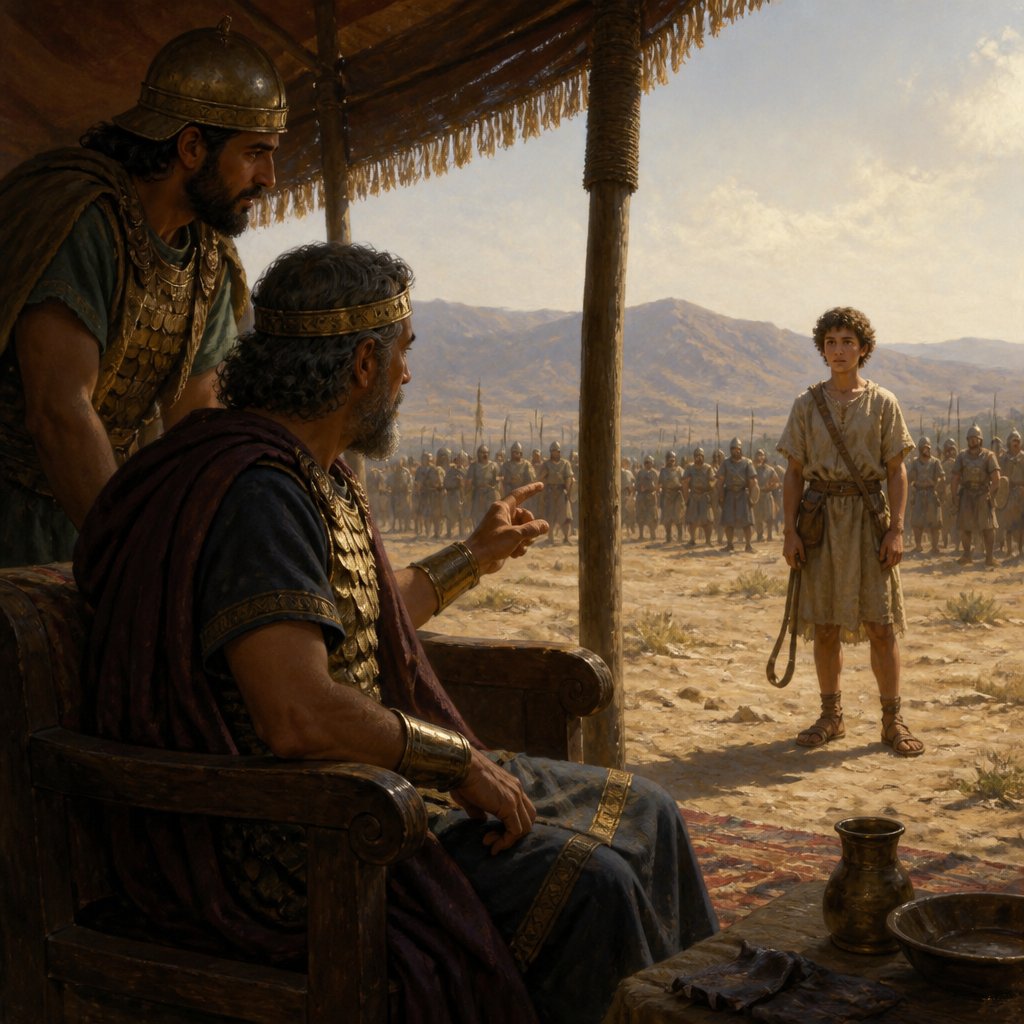
1 Samuel 17:56 (KJV) says, "And the king said, Inquire thou whose son the stripling is." This verse comes at the end of the famous story of David and Goliath, one of the most well-known and beloved stories in the Bible. The context of this verse is crucial to understanding its deeper meaning and significance.
In 1 Samuel 17, the Philistine army is gathered for battle against the Israelites. The champion of the Philistines, a giant named Goliath, challenges the Israelites to send out a man to fight him in single combat. Despite their fear, no one in the Israelite army is willing to face Goliath. However, David, a young shepherd boy who had been anointed by the prophet Samuel, steps forward to take on the giant.
David refuses to wear the armor and weapons of King Saul, opting instead for his shepherd's staff, a sling, and five smooth stones. Goliath mocks David, but David remains steadfast and confident in the Lord. He slings a stone at Goliath, striking him in the forehead and killing him. This victory shatters the morale of the Philistine army, and the Israelites are victorious in battle.
The verse 1 Samuel 17:56 occurs after David has defeated Goliath. The king, Saul, now inquires about David's identity, asking whose son he is. This question comes at a significant moment in the narrative. It reflects the king's curiosity about the unknown young man who has just accomplished a great feat. The inquiry also signifies David's newfound prominence and sets the stage for his rise to power.
Symbolically, David's defeat of Goliath represents the triumph of faith and courage over seemingly insurmountable odds. David's reliance on God and his willingness to step out in faith demonstrate the theme of divine deliverance. This story serves as a powerful reminder that God's strength is made perfect in our weakness, and that it is not by our might or power, but by the Spirit of God, that we overcome obstacles.
The inquiry about David's lineage is also significant. In the ancient world, a person's lineage and family background were of great importance. Saul's question underscores the idea that David's identity and background are now of interest and importance to the king and the larger community. It foreshadows David's future as a central figure in Israel's history and the royal line.
Furthermore, this verse highlights the theme of divine favor and calling. David's anointing by Samuel was a divine commissioning, and his victory over Goliath is evidence of God's hand upon him. The inquiry about David's sonship signifies the beginning of his journey from shepherd boy to national hero and, eventually, to the throne of Israel.
The story of David and Goliath has been a source of encouragement and inspiration for countless people throughout history. It serves as a reminder that God can use the least likely individuals to accomplish great things. David's faith, courage, and obedience to God's calling serve as an example for believers to trust in the Lord and to be bold in the face of adversity.
In conclusion, 1 Samuel 17:56 from the King James Version of the Bible captures a significant moment in the story of David and Goliath. It conveys themes of divine deliverance, the triumph of faith and courage, divine favor and calling, and the transformative power of God in the lives of His chosen individuals. This verse serves as a reminder that with God, all things are possible, and that He can use ordinary people to accomplish extraordinary feats for His glory.
Have questions about 1 Samuel 17:56?
Dive deeper into this scripture with Bible Chat — an AI-powered tool for exploring God's Word through conversation. Ask questions, get context, and grow in your understanding of the Bible.
Get Our Apps


1 Samuel 17:56 Artwork

1 Samuel 17:56 - "And the king said, Enquire thou whose son the stripling is."
"And the king said, Enquire thou whose son the stripling is." - 1 Samuel 17:56

1 Samuel 10:17 - "¶ And Samuel called the people together unto the LORD to Mizpeh;"

1 Samuel 17:33

Isaiah 56:3-5

1 Samuel 1:15-17

1 Samuel 17:34-35

1 Samuel 17:49

1 Samuel 17:45

1 Samuel 17:49

1 Samuel 17:45

1 samuel 17:3

1 Samuel 17:49

1 Samuel 17:45
1 Samuel 17:49

2 Samuel 1. 17-27

1 Samuel 17:38-40

1 Samuel 17:14 - "And David was the youngest: and the three eldest followed Saul."

1 Samuel 17:45-49

1 Samuel 9:17 - "And when Samuel saw Saul, the LORD said unto him, Behold the man whom I spake to thee of! this same shall reign over my people."

2 Samuel 1:17 - "¶ And David lamented with this lamentation over Saul and over Jonathan his son:"

1 Chronicles 6:56 - "But the fields of the city, and the villages thereof, they gave to Caleb the son of Jephunneh."

1 Samuel 17:19 - "Now Saul, and they, and all the men of Israel, were in the valley of Elah, fighting with the Philistines."

1 Samuel 17:29 - "And David said, What have I now done? Is there not a cause?"

1 Corinthians 15:56 - "The sting of death is sin; and the strength of sin is the law."

"¶ And Samuel called the people together unto the LORD to Mizpeh;" - 1 Samuel 10:17

1 Samuel 17:21 - "For Israel and the Philistines had put the battle in array, army against army."

1 Samuel 17:53 - "And the children of Israel returned from chasing after the Philistines, and they spoiled their tents."

1 Samuel 8:17 - "He will take the tenth of your sheep: and ye shall be his servants."

1 Samuel 17:15 - "But David went and returned from Saul to feed his father's sheep at Beth-lehem."