What does 1 Samuel 17:38 mean?
"¶ And Saul armed David with his armour, and he put an helmet of brass upon his head; also he armed him with a coat of mail." - 1 Samuel 17:38
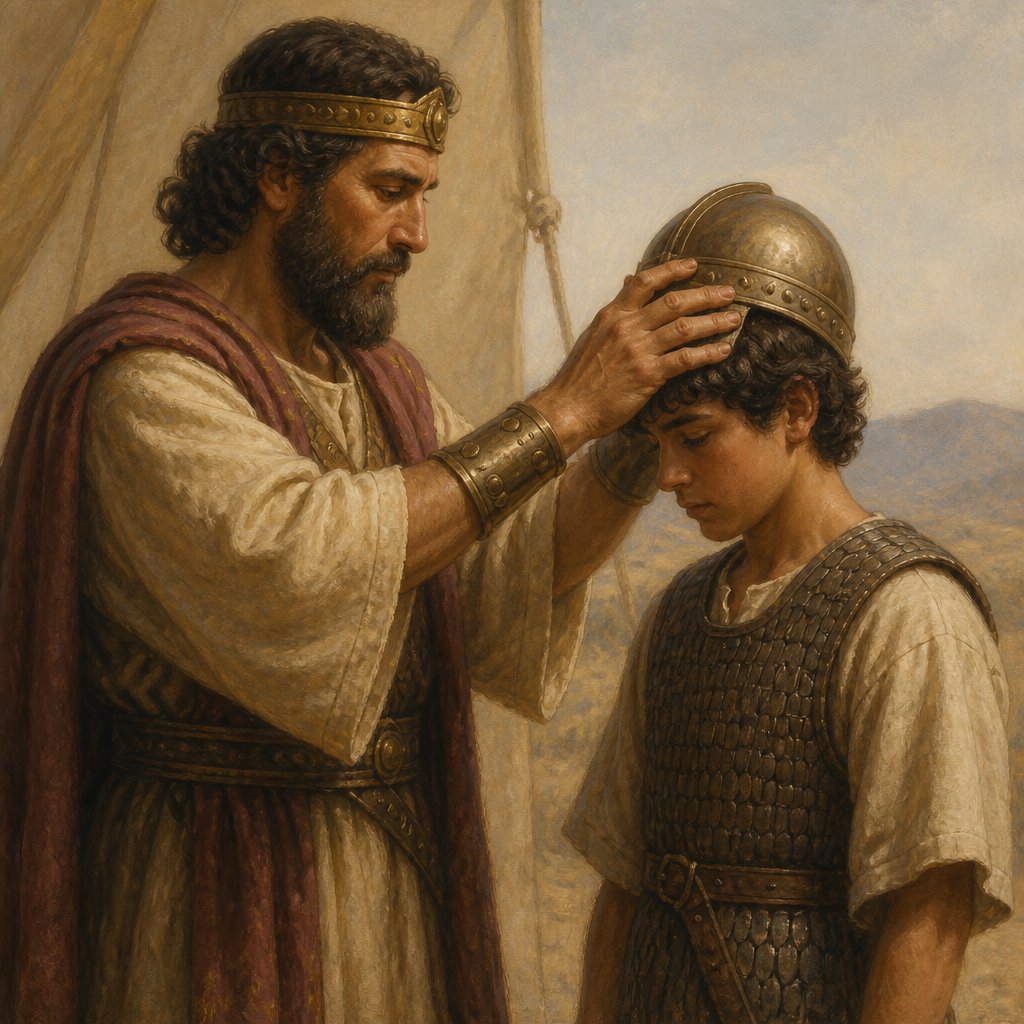
1 Samuel 17:38 (KJV) - "And Saul armed David with his armor, and he put an helmet of brass upon his head; also he armed him with a coat of mail."
This particular verse is found in the Old Testament of the Bible and is part of the account of the famous battle between David and Goliath. This passage is significant because it illustrates the contrast between worldly power and divine strength and reveals the importance of staying true to one's own identity and unique gifts.
The context of this verse is crucial to understanding its deeper meaning. The Philistines and the Israelites were at war, and the Philistine champion, Goliath, was challenging the Israelites to send out their own champion to decide the outcome of the battle in single combat. King Saul and his army were terrified of Goliath, as he was a formidable and intimidating opponent. However, a young shepherd boy named David, who was visiting the camp to bring provisions to his brothers, stepped forward to face Goliath.
In the preceding verses, David confidently expresses his trust in God's deliverance and his belief that God will grant him victory over the giant. In response, Saul offers David his personal armor and weaponry to prepare him for battle against Goliath. This act can be seen as a well-intentioned gesture of support from Saul, who was attempting to equip David with the best resources available. However, it also reveals Saul's limited understanding of the true source of strength and victory.
Saul's armor is symbolic of human strength and worldly power. It represents the traditional methods of warfare and the reliance on physical prowess and military might. However, David, being a humble shepherd, was not accustomed to wearing such heavy, cumbersome armor. Instead of relying on the equipment provided by Saul, David chooses to go into battle with what he knows best - a sling and five smooth stones.
This contrast between Saul's armor and David's sling is significant. It highlights the theme of divine deliverance and victory through unexpected means. David's decision to reject Saul's armor is a symbolic rejection of worldly power and a reliance on his own abilities and trust in God. It is a statement that victory does not come from human strength or conventional methods, but from faith and obedience to God's will.
The symbolism in this verse is powerful and multifaceted. The helmet of brass and the coat of mail represent the conventional methods of protection and warfare, while the sling and stones represent unconventional and unexpected means of victory. The use of a sling, a simple and humble weapon, illustrates that God can use the weak and the unlikely to achieve great things. It also emphasizes the importance of remaining true to one's own identity and not succumbing to the pressure to conform to worldly standards.
Furthermore, this passage serves as a reminder that true strength and victory come from trusting in God and relying on His power. It challenges us to reevaluate our reliance on worldly strength and to remember that God can work through the most unlikely and unexpected means to achieve His purposes.
In conclusion, 1 Samuel 17:38 is a powerful and thought-provoking passage that addresses important themes of faith, identity, and reliance on God's strength. It challenges us to reconsider our understanding of power and victory and reminds us of the significance of staying true to our unique gifts and trusting in God's sovereignty. It is a timeless message that continues to resonate with readers today.
Have questions about 1 Samuel 17:38?
Dive deeper into this scripture with Bible Chat — an AI-powered tool for exploring God's Word through conversation. Ask questions, get context, and grow in your understanding of the Bible.
Get Our Apps


1 Samuel 17:38 Artwork

1 Samuel 17:38-40

1 Samuel 17:38 - "¶ And Saul armed David with his armour, and he put an helmet of brass upon his head; also he armed him with a coat of mail."
"¶ And Saul armed David with his armour, and he put an helmet of brass upon his head; also he armed him with a coat of mail." - 1 Samuel 17:38

1 Samuel 25:38 - "And it came to pass about ten days after, that the LORD smote Nabal, that he died."

1 Samuel 10:17 - "¶ And Samuel called the people together unto the LORD to Mizpeh;"

1 Samuel 17:33

1 Samuel 1:15-17

1 Samuel 17:34-35

1 Samuel 17:49

1 Samuel 17:45

1 Samuel 17:49

1 Samuel 17:45

1 samuel 17:3

1 Samuel 17:49

1 Samuel 17:45
1 Samuel 17:49

1 Samuel 14:38 - "And Saul said, Draw ye near hither, all the chief of the people: and know and see wherein this sin hath been this day."

1 Samuel 20:38 - "And Jonathan cried after the lad, Make speed, haste, stay not. And Jonathan's lad gathered up the arrows, and came to his master."

Isaiah 38:17

2 Samuel 1. 17-27

1 Samuel 17:14 - "And David was the youngest: and the three eldest followed Saul."

1 Samuel 17:45-49

1 Samuel 17:56 - "And the king said, Enquire thou whose son the stripling is."

2 Samuel 23:38 - "Ira an Ithrite, Gareb an Ithrite,"

1 Samuel 9:17 - "And when Samuel saw Saul, the LORD said unto him, Behold the man whom I spake to thee of! this same shall reign over my people."

2 Samuel 1:17 - "¶ And David lamented with this lamentation over Saul and over Jonathan his son:"

1 Samuel 17:19 - "Now Saul, and they, and all the men of Israel, were in the valley of Elah, fighting with the Philistines."

1 Samuel 17:29 - "And David said, What have I now done? Is there not a cause?"

"¶ And Samuel called the people together unto the LORD to Mizpeh;" - 1 Samuel 10:17

1 Samuel 17:21 - "For Israel and the Philistines had put the battle in array, army against army."